
Bubba Watson stood among the trees at Augusta National during the second playoff hole of the 2012 Masters, with pine straw beneath his feet and no view of the green. On CBS, Nick Faldo doubted Watson could get the ball close, but Watson was already thinking through his next move. He grabbed his gap wedge, hooked the ball about 40 yards through a gap in the trees, and watched it stop just 10 feet from the hole. When Louis Oosthuizen missed his par putt, Watson claimed his first green jacket with a shot that curved the entire way.
Watch What’s Trending Now!
That shot says a lot about how Watson looks at the game. At the International Series Morocco, he put it simply for Golf Monthly: “The hardest shot in golf is straight.” And to back it up, he pointed right at the top guys. “Scottie Scheffler — look how he’s moving the ball. Look at Rory. They shape it.”
Amateur golfers have long pursued the straight shot, and practice sessions only end once a straight ball flight is achieved. When that doesn’t happen, a 10-handicap golfer loses strokes to course design. Despite advancements in equipment and instruction, the average handicap for men in recreational golf has remained between 14.0 and 17.0 for the past 50 years.
Every shot you hit is going to curve a little, whether you like it or not. The real trick is deciding if that curve is on purpose or just a surprise. If you play for a fade, you pretty much know where your miss is going. But if you aim straight and end up with a fade, now you’ve got two problems: your ball started in the wrong spot and curved when you didn’t want it to.
Watson put this plainly:
“If you’re hitting a cut then that’s the direction it’s going. You can predict it.” Predictability is more important than perfection.

Imago
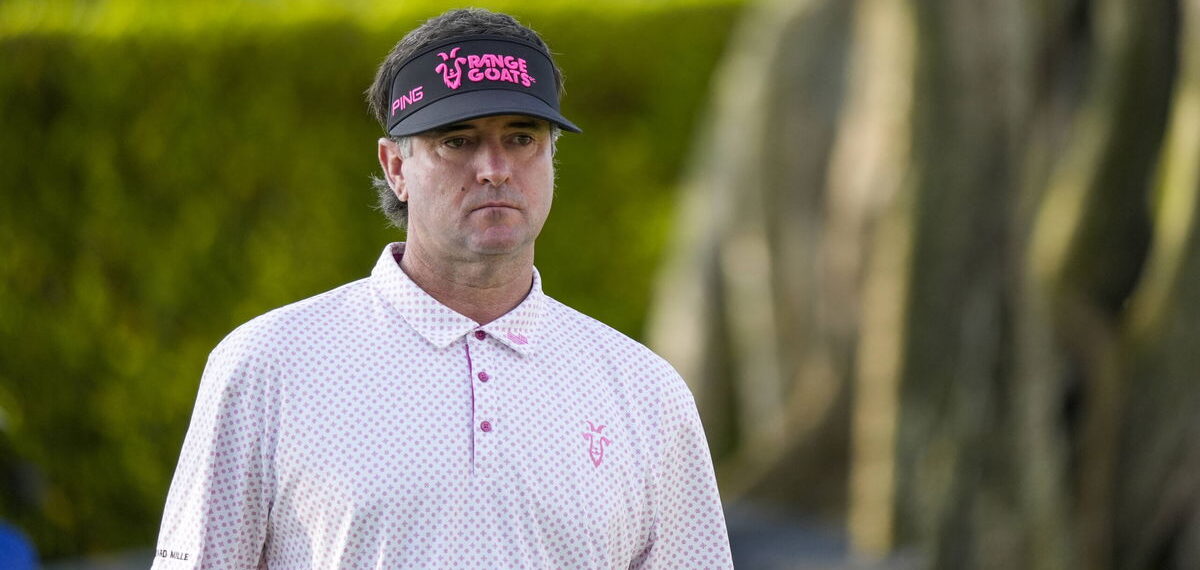
Golf: LIV Golf Miami – First Round Apr 4, 2025 Miami, Florida, USA Bubba Watson watches his shot from the third tee during the first round of the LIV Golf Miami golf tournament at Trump National Doral. Miami Trump National Doral Florida USA, EDITORIAL USE ONLY PUBLICATIONxINxGERxSUIxAUTxONLY Copyright: xSamxNavarrox 20250404_SN__na2_0012
Dustin Johnson has said the difference between tour pros and amateurs isn’t hitting good shots—it’s managing bad ones. This is the principle behind building a reliable fade, as explained in this guide.
Scheffler is the best example of this approach today. His standard shot is a fade, and he uses it at every tournament. When a hole at Augusta, like the 10th or 13th, calls for a draw, he makes a clear adjustment. He changes his swing path and face angle to get the shot shape he needs. He does not just aim straight and hope for the best. Watson has used the same logic for years. His equipment is chosen to help him shape the ball off the tee, as shown in his 2025 equipment breakdown. This is not by chance but a clear philosophy put into practice.
When Watson was asked to name a player who truly hits it straight, he answered immediately: Lee Westwood.
“He barely moves it and it just rifles out there. I think he might be the greatest we’ve seen at hitting a ball straight.”
Watson was clear when asked who hits it straight: Lee Westwood. According to Watson, Westwood barely moves the ball and sends it straight every time. In a field of top players, Westwood stands out. He is the exception, not the standard. Most golfers who try to follow that model end up pursuing a style that does not suit them.
Bubba Watson’s lesson: Golf courses aren’t built for straight lines
Golf course architects have known this for over a century. Doglegs, tree-lined corridors, and angled greens are not design flourishes. They are assumptions about how the ball moves. Watson at Valderrama during LIV Golf Andalucía carried a 2-iron specifically because the course demanded low, shaped flights through trees. He finished in the top 10. The course did not punish his curves; it rewarded them. Watson’s philosophy aligns with course design.
The 18th at Riviera and the 16th at Pebble Beach are both designed to reward a fade off the tee. On dogleg holes, trouble is always waiting on the inside curve. Rough, trees, water, or bunkers are placed there to punish the golfer who aims straight and gets an unplanned curve. Augusta National uses trees and slope to defend its doglegs. This exposes accidental ball flight much more than deliberate shot shape. The course on which Watson won twice is not built for straight lines, either.
Most recreational golfers read a tree blocking the direct line and see trouble. Watson reads it and sees an angle. That gap is not an obstacle. It is a target. The difference is not in ability. It is the question being asked. Watson asks where the ball needs to curve. The average golfer asks how to avoid curving it at all. One of those questions has an answer.