
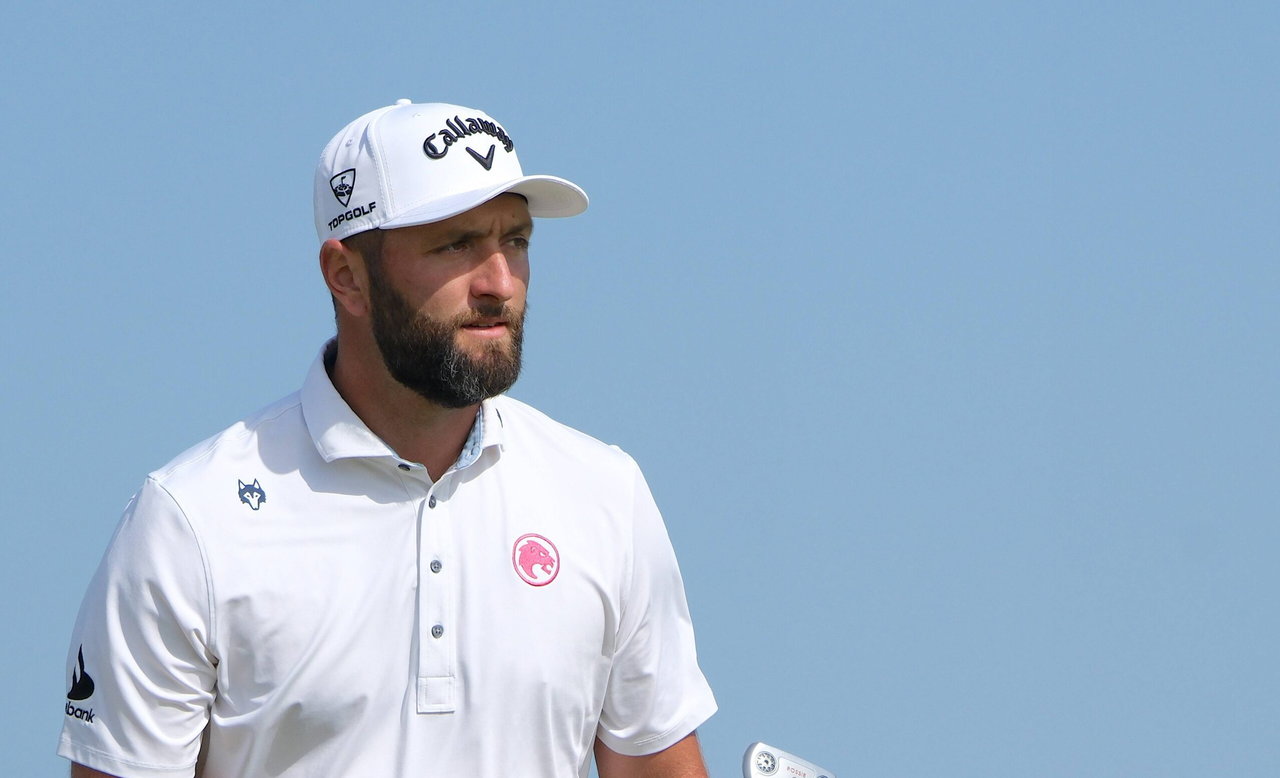
Golf has been fighting slow play for over a century. It’s only gotten worse. According to Alexander H. Revell, the author of Pro and Con of Golf, excessive practice swings, hesitation, and overthinking each shot are the reasons behind a slower pace. While many players, like veteran Colin Montgomerie, have voiced their complaints about five-hour long rounds at events, Jon Rahm believes there’s a simple solution to this problem. Golf.com posted a video of him talking about it ahead of LIV Golf United Kingdom.
Watch What’s Trending Now!
“Now that you bring up pace of play, I can give you an idea. If you get a warning for code of conduct on Thursday, that warning stays for the whole week, and it doesn’t reset. You can be slow on Thursday. Your group gets warned. You have time to catch up. Then you get put on the clock. And then once you’re on the clock, you get one more warning before you get penalized. So you get three possible bad times amongst many others. And then when you tee off on Friday, you start from zero again. That doesn’t seem very fair to me, right?
“So how come one, which is a pressing issue in the game that can cause slow play and affect other people, you get so many breaks and is completely looked over. And then in the code of conduct, you don’t know where the line is. You have no definition of what you can or cannot do, even though we all understand where the limit may be. And that warning stays with you for the whole week. I know there are different things in what they’re doing, but there should be either one of them made a lot stricter or the other a lot looser. Whatever you choose, but it would be nice to see them on the same line. Don’t care. I think make pace of play stricter.”
Rahm’s comments on the unfairness of the two rules stem from his recent experience. He received a code of conduct warning at The Open Championship. In his second round, he threw his club after a poor tee shot on the par-3 15th. While he aimed to hit the green, the ball veered left and landed on the fairway instead. Although fans called for a two-stroke penalty, as Joaquin Niemann got at the U.S. Open, the Spaniard received only a warning.
The primary issue here is field size. The U.S. Open and The Open both have very large fields, which is true. Both these events feature a field size of 156 golfers. Comparing this to the Masters, Jon Rahm said that the slow pace is less of an issue because their field is smaller.
However, it’s an issue at Augusta National, too. An example from this year is that fans were fuming at Justin Rose for slow play. While he didn’t receive an official warning for it, the incident shows that the slow pace of play has become an increasingly serious issue on the PGA Tour.
Everyone has a different view of the issue. Bryson DeChambeau, for instance, suggested that a simple individual-timing system would work best. Officials should time every shot and apply penalties to individual golfers instead of entire groups. Tyrrell Hatton said that he does not have a solution for it. However, he did acknowledge that major-championship conditions make rounds longer. Similarly, Cameron Smith has accepted slow play as part of major golf’s reality.
While the views and solutions differ, everyone knows that the slow pace of play is a significant issue. Regardless of whether the governing bodies accept Jon Rahm’s solution or not, the problem certainly needs a solution, and quickly.