
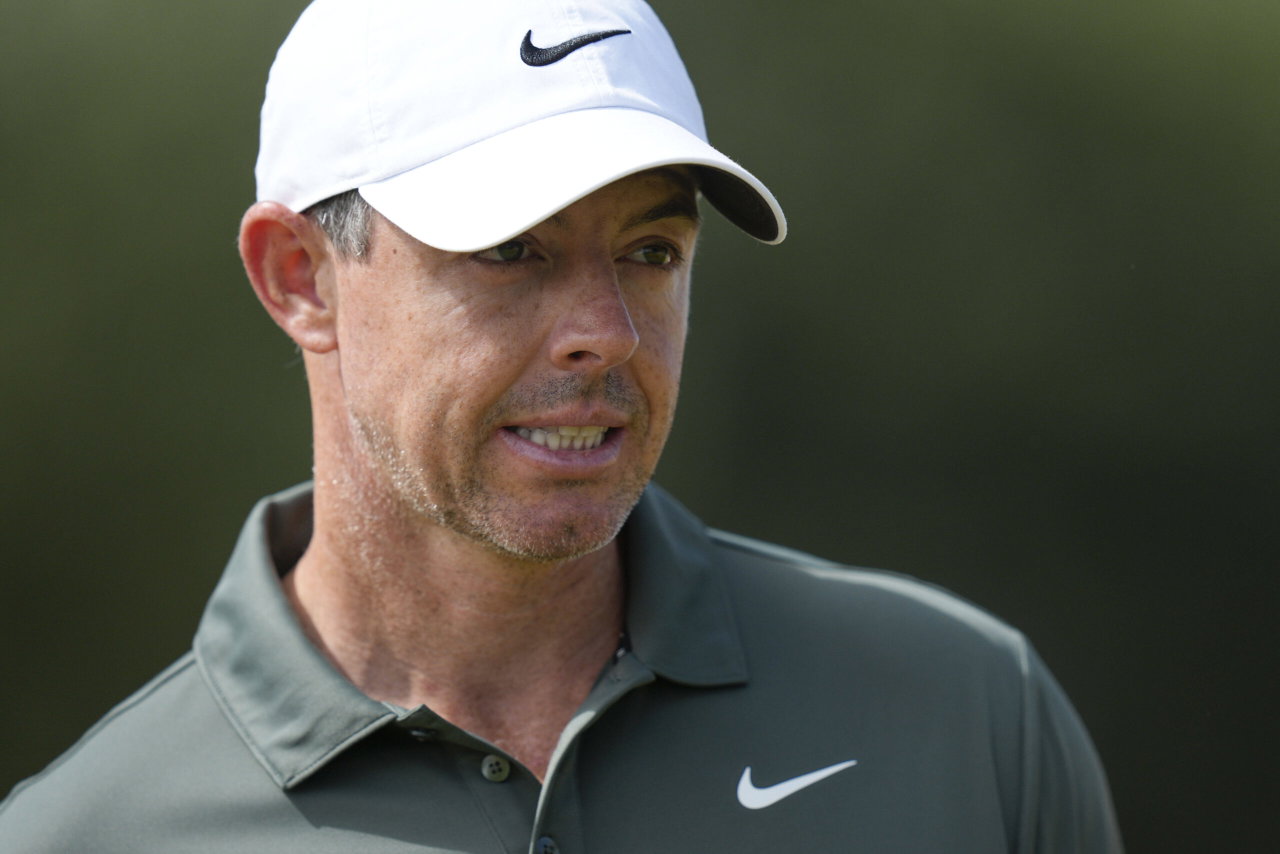
Rory McIlroy unleashed a monster drive during the final round of the 2023 Scottish Open, sending the ball an astonishing 427 yards down the fairway on the par-4 seventh hole. The mammoth effort marked the longest drive of his career at the time. But it also highlighted a growing concern in golf: modern equipment and athlete conditioning are making several historic courses less challenging.
Watch What’s Trending Now!
In response, the USGA and R&A introduced the golf ball rollback, altering testing standards to limit how far golf balls can travel. Initially, it was scheduled for 2028 before being pushed to January 2030. However, players like Adam Scott and Patrick Reed favour reducing driver and fairway wood head sizes instead. McIlroy, meanwhile, has no preference, as long as stricter equipment regulations are introduced.
“I’m in favour of doing anything and everything to sort of curb where we are at,” McIlroy said on Tuesday ahead of the DP World Tour Championship, before reminding officials, “Ball, club, I think the equipment at the top level needs to be regulated better than where it is right now. Just overall, skill, there’s a disproportionate — I guess distance is a big issue in the game at the top level because it may negate other skills that were more prevalent in golf 20 or 30 years ago.”
Earlier this year, Golf Monthly compared statistics from 1996, 2006, 2016, and 2026 to see how dramatically driving distances on the PGA Tour have increased over the last 30 years. What they found was astonishing! In 1996, John Daly led the distance rankings with a 288-yard average, while the Tour average was approximately 255 yards. By 2006, Bubba Watson was averaging 319 yards, and the Tour average had caught up with Daly’s figure from a decade earlier.
In 2016, the Tour average reached 292 yards, with Rory McIlroy leading the rankings at 317 yards. By the 2026 season, the average had climbed to 303 yards, with Aldrich Potgieter topping the list at 328 yards. The growing emphasis on distance hasn’t gone unnoticed by the World No. 2, who acknowledged that he is among the sport’s longest hitters. He also admitted that a golf ball rollback could potentially disadvantage his own game.
“I’m sort of the poster child for this, right,” McIlroy added. “I drove it on a couple of greens last week. You could argue that rolling it back for me is not advantageous, but the longest guys are still going to be the longest guys. And I think if we can just get a little bit more skill and shot-making back into the game, I think that would be better for everyone.
“I think it would separate the best players from each other, and I think it would make the game more entertaining to watch.”
As McIlroy pointed out, without intervention, the elite professional game risks becoming overly one-dimensional, where raw distance off the tee overrides traditional strategy, creativity, and iron-play variety. Not to mention, maintaining ever-longer courses drives up land use, water consumption, and the resources needed for maintenance.
Once implemented, golf ball rollback is expected to reduce driving distance by 10 to 15 yards for elite pros and 5 yards or less for recreational golfers. While McIlroy is ready to accept the disadvantage in his own game, World No. 1 Scottie Scheffler has issued a warning to the PGA Tour.
Scottie Scheffler said golf ball rollback won’t address the main issue
Scheffler has warned the PGA Tour that the golf ball rollback may not address the underlying issue of distance becoming increasingly important in the professional game. While the world No. 1 agrees with some of the principles behind the proposed change, he believes golf course design is a much bigger factor in rewarding power over strategy.
Speaking to the media in June, Scheffler pointed out that the rollback could have an uneven impact on players.
“When you look at the golf ball rollback, when you start moving it back only eight yards, not only does it disproportionately affect certain players, where you have some guys who it won’t affect at all, and some guys where it will affect 15 to 20 yards, I think creates some issues within our game when you start changing the rules,” he said.
The 30-year-old also argued that golf courses are increasingly designed in ways that reward players who hit the ball longer. Using Colonial and Harbour Town as examples, he explained that shorter courses can still provide challenging tests without relying on distance.
“When the corridors are big, and greens are big, and there’s not many trees in your way, guys are going to learn how to hit the ball far,” Scheffler added.
He believes the PGA Tour should look more closely at course setups and design rather than relying solely on equipment changes to tackle the distance problem. That said, though, only time will tell how golf ball rollback affects the players and the sport.