
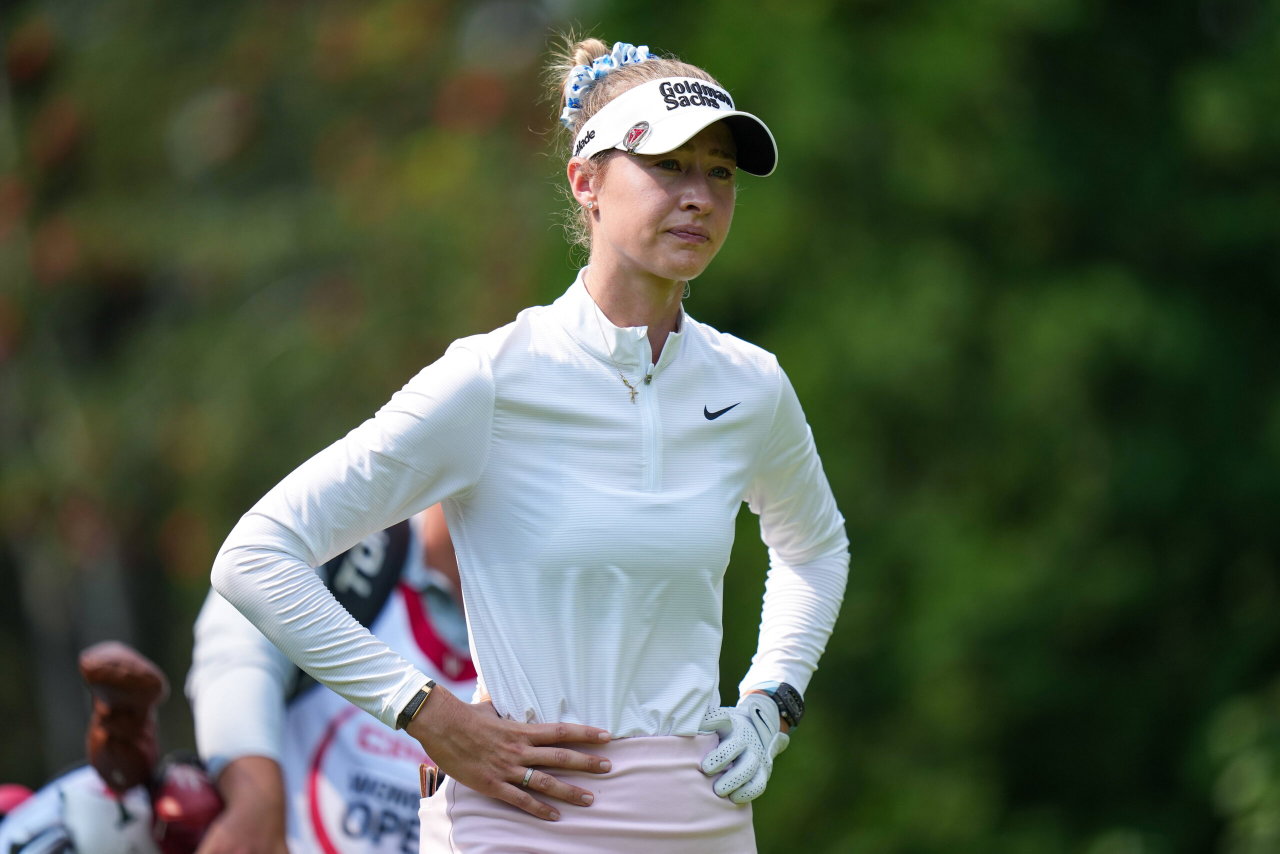
Nelly Korda faces a demand no male peer does: save women’s golf. The world No. 1 is being held to a standard no male peer faces, expected to carry an entire tour’s commercial weight on top of winning tournaments. After an eight-week competitive break, she has faced mounting criticism for bypassing the LPGA Tour’s four-event autumn Asian swing and opting out of WTGL’s debut season, the women’s indoor team golf league backed by TMRW Sports.
Watch What’s Trending Now!
Speaking on The Shotgun Start podcast alongside Andy Johnson, Brendan Porath, and Joseph LaMagna, journalist Kevin Van Valkenburg rejected that expectation. He noted that critics have repeatedly demanded Korda “do more and do this and do that,” arguing instead that her primary job is to compete at the highest level rather than single-handedly solve the LPGA’s structural problems.
Why the Scottie Scheffler Comparison Fits
To illustrate the double standard placed on Korda, Van Valkenburg drew a parallel to men’s world No. 1 Scottie Scheffler, who has faced similar complaints for playing a selective global schedule. “Like it’s not their job to promote golf or like people are complaining about Scotty needs to play around the world, whatever,” Van Valkenburg said. “Scotty’s only job is to win the tournaments that he enters.”
Van Valkenburg applied that exact standard to Korda while arguing her off-course efforts go largely unappreciated. “I don’t know that I really buy that argument that the number one player has to promote the game,” he said. “I think Nelly’s tried and done that and still doesn’t really get enough credit for what she’s done.”
Beyond tour dominance, both stars share the exhausting reality of serving as the public faces of their respective circuits while guarding their mental energy. At the Open Championship, Scheffler explained how relentless visibility drains an athlete: “I think just being in the spotlight all the time puts a burden on a player in this day and age. Everything is being recorded. When they say hello to you, they’ve got their cell phone out.”
Korda has echoed that exact fatigue, noting how sponsor duties and constant public demands accumulate behind the scenes. “It accumulates, and I would say, as an introverted person, like, the days, everything that I have to do, it just drains my batteries a little bit,” she said. Yet despite her introverted nature, Van Valkenburg pointed out how far she has stepped outside traditional golf media: “And I think if you sort of been paying attention, she has really tried hard to sort of come out of her shell and like promote the game. And you know, she did the Sports Illustrated swimsuit issue; she did the Met Gala; she has done a bunch of goofy comedy podcasts recently.”
Those appearances included attending the 2024 Met Gala, posing for the 2025 Sports Illustrated Swimsuit issue, joining Caleb Pressley’s Sundae Conversation (a clip that drew over 500,000 views), and recording a podcast with the Jonas Brothers.
The LPGA Cannot Rely on One Superstar
The scrutiny surrounding Korda’s availability intensified after LPGA Commissioner Craig Kessler recently compared her to Tiger Woods, calling her “the Tiger Woods in many ways of our tour.” That framing naturally elevated expectations, particularly when Korda declined to join WTGL, a venture where fellow star Rose Zhang admitted Korda “would obviously be very good for the game.”
Van Valkenburg pushed back sharply against the idea that Korda owes her presence to a startup league or should bear responsibility for propping up international television markets. “And I think she can’t save the LPGA from its past mistakes,” he said. “And it’s not her job to show up for WTGL, frankly.”
Treating Korda’s schedule as a substitute for deeper roster storytelling, stronger broadcast production, and consistent league marketing exposes an institutional vulnerability. She can elevate the sport when she tees it up, but she can’t compensate for years of commercial missed opportunities.
Managing Burnout vs. Competitive Costs
Critics who questioned Korda’s absence from the autumn Asian swing overlooked both her established scheduling habits and the physical toll of elite golf. Korda has routinely bypassed the fall Asian stretch before targeting the tour’s final two events in Florida, and she stepped away after September’s Solheim Cup specifically to address mental burnout. “There are girls that play 30 events because it’s their rookie year,” Korda explained. “My body just can’t do that.”
Far from protecting commercial perks, her selective 17-event calendar carried a steep competitive price. Despite posting the tour’s lowest scoring average at 69.38, Korda fell five rounds short of the 70-round minimum required to win the Vare Trophy. Winning that scoring title would have automatically granted her the 27th and final point needed for LPGA Hall of Fame induction, forcing her instead to earn that milestone through a tournament victory.
Even with a lighter workload, Korda dominated 2026, capturing four titles, including back-to-back majors at the Chevron Championship and U.S. Women’s Open, and clinching her second Rolex Player of the Year Award by 77 points over Haeran Ryu. When she finally returned to Pelican Golf Club for The ANNIKA, she spent pre-round time with a pediatric patient before firing a bogey-free 7-under 63. The performance proved that stepping back was never a retreat from competition, reinforcing Van Valkenburg’s core point: Korda is already holding up her end of the bargain, and it is up to the LPGA to build a sustainable stage around her.