
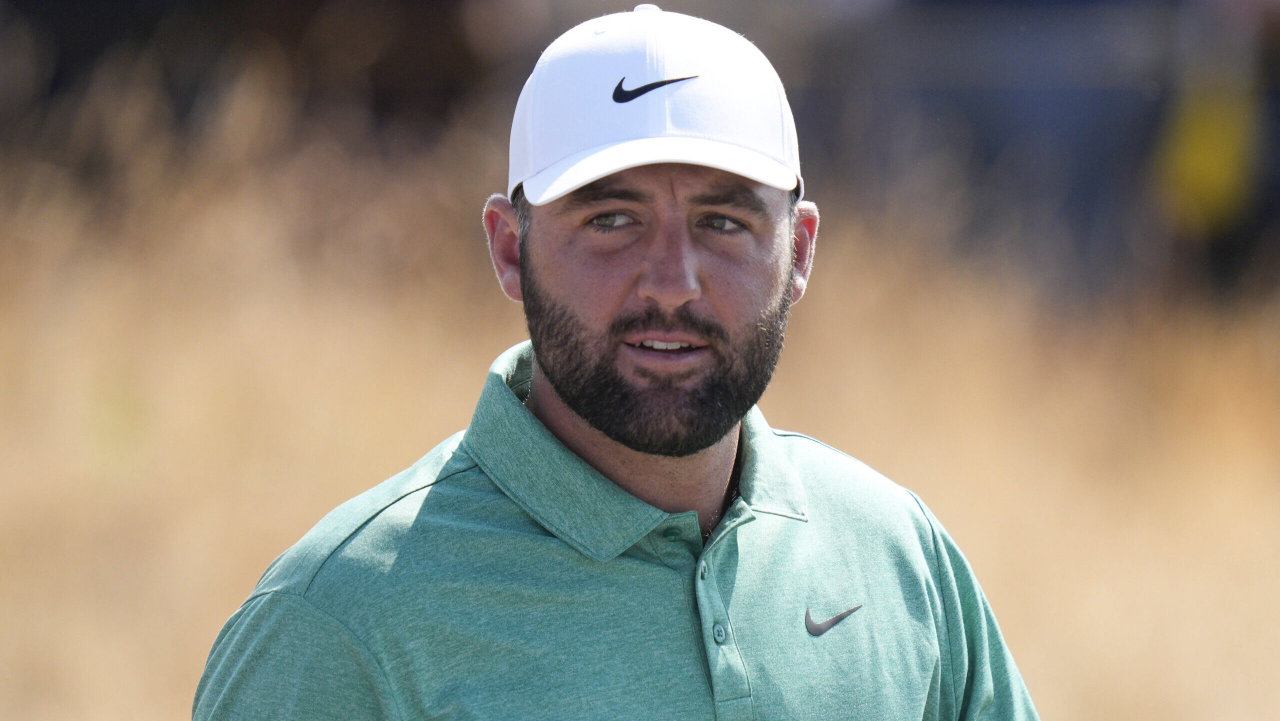
Defending champion Scottie Scheffler’s final round at The Open hit an unexpected snag on the 17th. After badly missing right off the tee, his second shot flew into a gated hospitality and grandstand area left of the green. The ball was never found, prompting a lengthy discussion with a rules official before the World No. 1 received free relief under the temporary immovable object (TIO) rule. During the press conference on Sunday, Scheffler explained why he told officials to stop searching.
Watch What’s Trending Now!
“The rules official said it landed just barely left of the grandstand thing,” he said. “And Teddy had a beat right on where it was coming down. So when we get up there, it’s past the fence that marks the TIO, so he said anything that’s in there is part of the TIO. So then we tried to figure it out. I said, if I find it, does that help me? Can I drop it? Since that would be about 50 yards closer to the hole.
“He said, ‘Yes, you can then use that spot, but you might have to go to the other side of the TIO,’ which I didn’t know exactly where that would be, and that’s not a great angle coming across there. So, [I] decided to stop the search and go back and drop it doing point-of-entry TIO relief. Actually, I did that once this year during the Byron as well. Not something I’m proud of, but I was familiar with… I stopped them.”
The TIO is used in most professional tournaments, including The Open, and gives players free relief from temporary man-made structures like grandstands, TV towers, hospitality tents, or scoreboards that are not permanent parts of the course. Regular immovable obstructions get you relief for physical interference with your ball, stance, or swing.
Meanwhile, the rule also allows line-of-sight relief if the obstruction blocks your direct view or path to the hole. To take relief, you drop within one club-length of the nearest point of complete relief, ensuring you escape both physical and visual interference. This is exactly what helped Scottie Scheffler on the 17th hole, and fans criticized the R&A for it.
Regardless, he recovered quickly after that. Despite the hiccup, he managed to score a birdie on the hole. The next hole was much more straightforward, as he finished the round with a 3-under par 67. Despite that, he couldn’t climb on the leaderboard high enough to break into the top three.
In the end, he had to settle for a tie for 4th place. This means the World No. 1 failed to win a single major tournament this season. Yet, interestingly, Scheffler’s situation is reminiscent of what Jordan Spieth endured in 2017.
Scottie Scheffler fell short, but Jordan Spieth didn’t
In the final round of the 2017 Open Championship at Royal Birkdale, Jordan Spieth was involved in a similar situation at the par-4 13th hole. Spieth was leading the tournament when he sliced his drive wildly right. The ball ricocheted off a spectator’s body and lodged in thick rough on a steep dune.
After assessing his terrible lie, he took an unplayable lie penalty and elected to drop far back along the line to the hole. This placed him on the driving range. However, equipment trucks and temporary structures blocked his line to the green. And this is where things got interesting.
These were classified as TIOs, so Spieth received additional line-of-sight relief. He moved sideways along an equidistant arc until the obstructions were clear, then hit a strong recovery shot onto the green and saved bogey. In the end, he went on to win the Claret Jug by three shots.
While it worked out for Spieth, Scheffler had to settle for T4. Instead, the Claret Jug went to Ryan Fox, who captured his first major championship.