
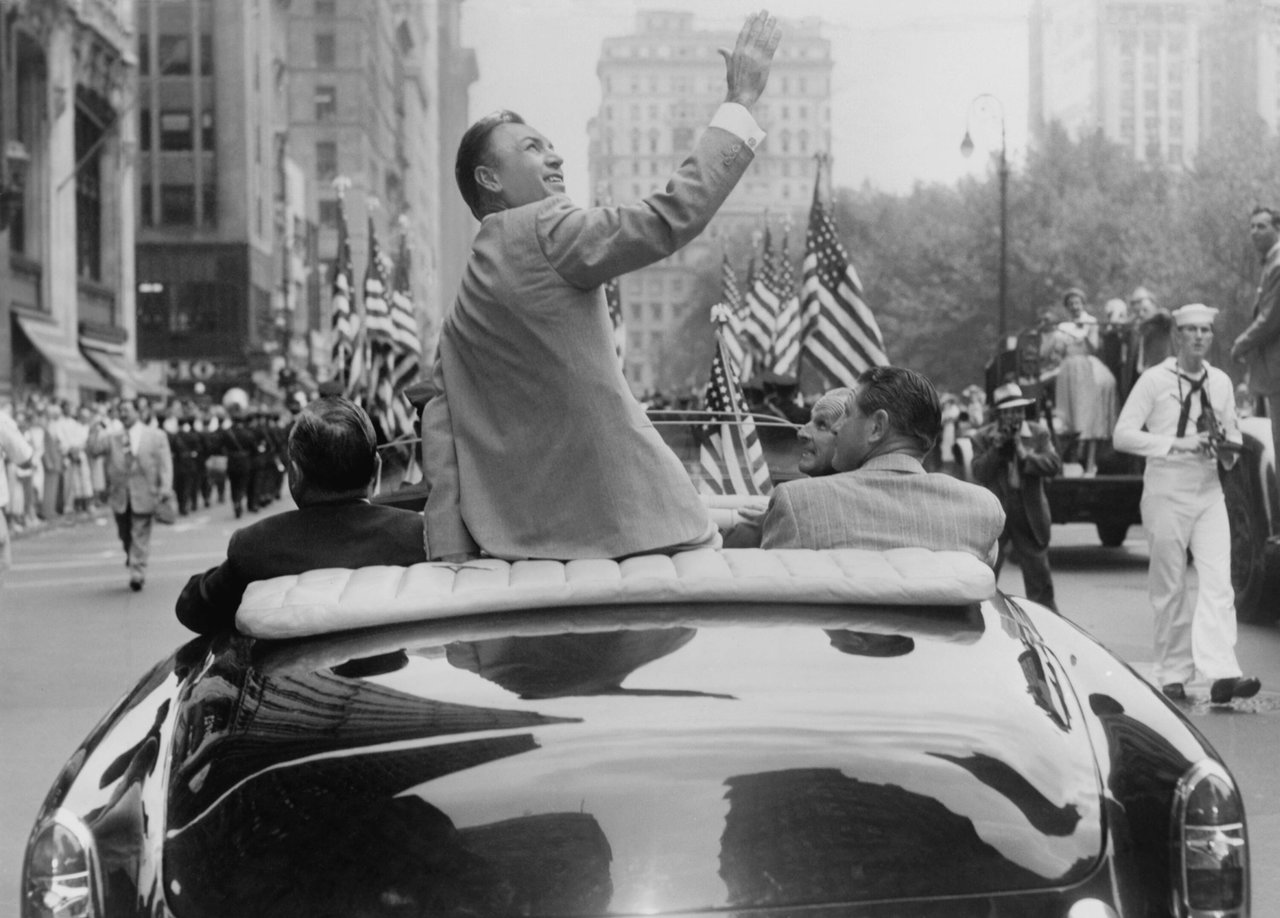
Ben Hogan’s name has become almost mythical in golf, and for good reason. He once returned from a crash that nearly ended his life to reclaim his place at the top of the sport. That alone would be the most unbelievable chapter in most golfers’ careers. For Hogan, it’s just one of three. As the golf world remembers him on the anniversary of his death, July 25, these aren’t exaggerations passed down through decades of retelling; they’re documented. The Hawk never built his legacy on flashy celebrations. Here are three such facts about him that no one would believe if they weren’t on the record.
Watch What’s Trending Now!
When a near-fatal crash couldn’t end Ben Hogan’s zeal for victory
Tiger Woods’ 2021 crash nearly ended his career. In 1949, Ben Hogan faced a similar moment. The 64-time PGA Tour winner was in a near-fatal accident in Texas when his car collided head-on with a Greyhound bus. This left him with multiple fractures, including injuries to his ankle, collarbone, and pelvis.
Doctors questioned his chances of even walking again, let alone playing professional golf. But what followed was one of the greatest comebacks in sports history. Speaking about it, Woods himself admitted in 2018 that it is “one of the greatest comebacks there is, and it happens to be in our sport.”
It took Ben Hogan less than a year to be back on a golf course and to prove everyone wrong.
Within 16 months, he claimed his first title after the accident, and it was a major nonetheless. With a total of 287 (+7) across four rounds of 72-69-72-74, Hogan tied for the lead at the 1950 U.S. Open after regulation. A picture of his 1-iron approach on the 18th hole now decks the gallery at the USGA Museum.
He then defeated Lloyd Mangrum and George Fazio to win the 18-hole playoff the next day, a victory forever remembered as the “Miracle at Merion.” After Merion, Hogan won 10 more titles through 1959, including the Masters and the U.S. Open in 1951 and 1953 and The Open in 1953.
Ben Hogan had to qualify for The Open despite winning two majors
Today, a major victory is all it takes to automatically qualify for all other majors for the next five years. But it was different back when Ben Hogan was playing, and he had that experience firsthand. He arrived in the UK as arguably the best golfer in the world, with back-to-back major wins at Augusta National and Oakmont. But he still had to compete in The Open Championship qualifying before teeing it up at Carnoustie.
The Open’s governing bodies made no exceptions for reputation; even Hogan had to qualify. But he didn’t just qualify; he defeated runners-up Antonio Cerda, Dai Rees, Frank Stranahan, and Peter Thomson to win the event. In 1953, Hogan won the Masters, U.S. Open, and Open Championship in the same year, a feat fans labeled the Hogan Slam. It was also his only Open Championship appearance until that time.
A career Grand Slam in a single season was impossible for Hogan, since the PGA Championship conflicted with Open qualifying. According to the USGA, both events were scheduled around the same week, and the transatlantic journey made it impossible for Hogan to play in both tournaments. And since Hogan never played the Open Championship prior to that and the PGA Championship had an arduous match-play format, The Hawk eventually chose to aim for the Claret Jug instead of the Wanamaker.
In addition, this Open Championship win helped him complete his career Grand Slam. At the time, he was only second to Gene Sarazen to reach that mark. Gary Player, Jack Nicklaus, Tiger Woods, and Rory McIlroy have now joined the two.
The swing change that made Ben Hogan aim for just one side of the fairway
As someone with 64 wins on the PGA Tour, including nine majors, fans would think that Ben Hogan would be able to strike golf balls in every direction he wanted. Despite his versatility, Hogan deliberately rebuilt his swing to produce only controlled fades.
The reason was simple. He used to hook his tee shots when he first started playing, and he hated it.
”I hate a hook. It nauseates me. I could vomit when I see one. It’s like a rattlesnake in your pocket.” Larry Dorman, in his 1997 obituary of Ben Hogan in the New York Times, quoted the nine-time major winner as saying.
Hogan explained the thinking behind it himself in his book, Five Lessons: The Modern Fundamentals of Golf, writing, “This is a game of misses. The guy who misses the best is going to win.”
If every miss finished on the same side of the fairway, the game became more predictable, and those tighter mechanics let him minimize costly mistakes. Perhaps that’s the reason Jack Nicklaus used to watch Hogan practice on the range. While many golf veterans lean on artistry, Hogan’s approach turned his swing into something closer to geometry, the same discipline that carried him through his comeback after the crash.
The rebuilt swing allowed him to hit perfect fades. A key reason it is often said that Ben Hogan eliminated one side of the fairway altogether. That sounds like an exaggeration but is actually a fact.
From earning his place at The Open to rebuilding his body and swing after a life-threatening crash, Ben Hogan never relied on shortcuts. His relentless pursuit of excellence is exactly why, decades after his passing, his career continues to blur the line between myth and reality.
Hogan passed away on July 25, 1997, at his home in Fort Worth, Texas, at 84, following a stroke after years of declining health. Even in his final chapter, the man who out-worked every setback left behind a career too extraordinary to be anything but true.