
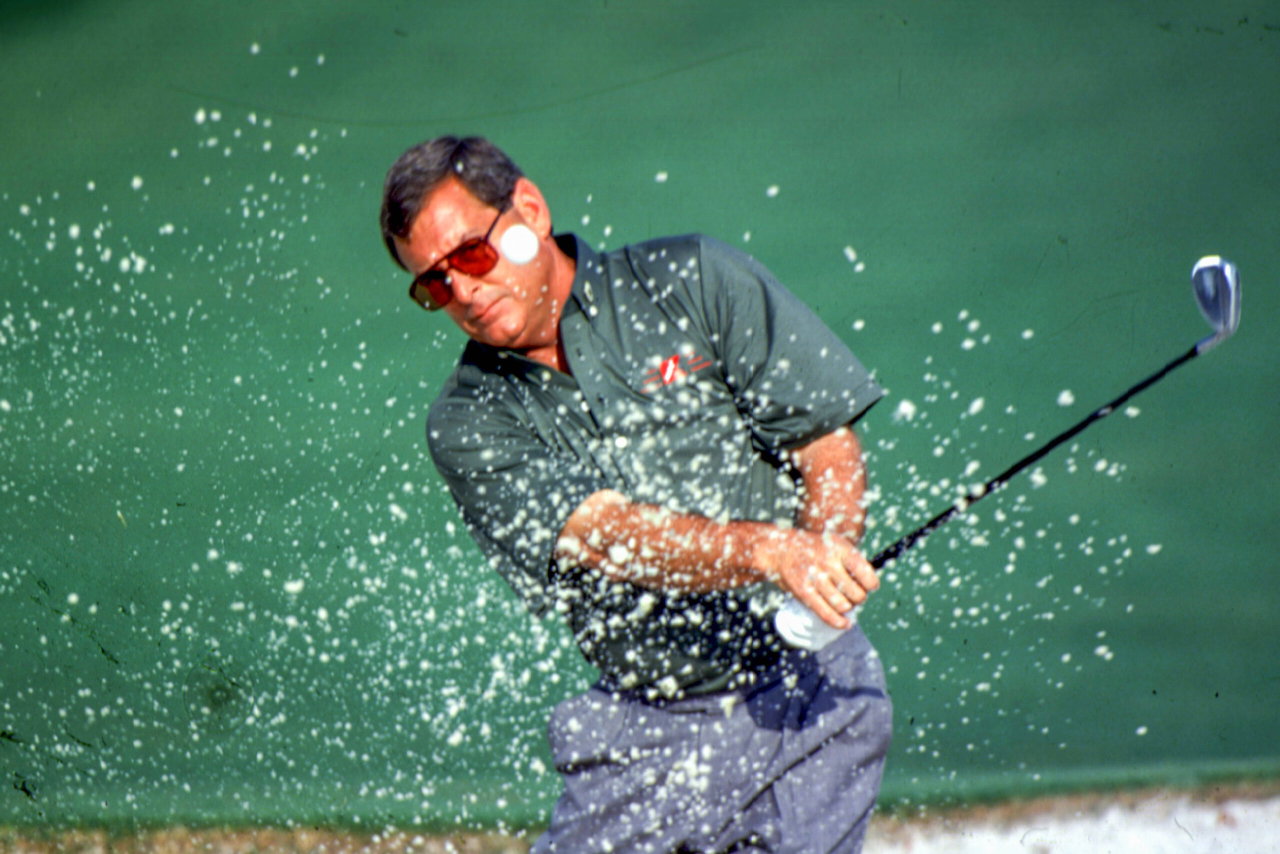
A putter flew into the air above Augusta National’s 11th green at the Masters. A 27-year-old golfer was already walking towards the hole, celebrating a moment he could hardly have imagined. He had never played the Masters before, but he was about to make history.
Watch What’s Trending Now!
That American golf legend was Frank Urban “Fuzzy” Zoeller Jr. On April 15, 1979, he became the first player since 1935 to win the Masters on his debut. He would have turned 75 on Wednesday, but he passed away on Thanksgiving morning last year at the age of 74. Since that memorable Sunday, 47 Masters tournaments have been played, but no first-time participant has ever managed to repeat his achievement.
Fuzzy Zoeller, the Man Who Never Looked Ahead
Golf was part of Fuzzy Zoeller’s life from an early age. He grew up next to Valley View Golf Club in New Albany, Indiana, and remembered feeling drawn to the game when he was just 8 years old. He enjoyed playing every sport, but golf soon became his favourite. Even then, he had to deal with a little teasing. Some of his high school classmates called golf a sissy game. Zoeller later joked that those same classmates were now playing golf every day.
However, his journey to the Masters was not easy. He failed to qualify for the PGA Tour at Q-School in 1973 but made it through the following year. He then spent four years as a professional without winning a tournament. His breakthrough finally came in January 1979, when he won the San Diego Open. That victory earned him his first invitation to Augusta National.
His playful nature also made him stand out. During the Par 3 Contest years later, Zoeller announced that he would make a hole-in-one on the ninth hole before even hitting his shot. Arnold Palmer took the bet and ended up paying him $1,000. Zoeller carried that same sense of humour into his first Masters Champions Dinner as host in 1980. According to Augusta Chronicle’s Doug Stutsman, he even gave Palmer a bottle of Grecian Formula as a joke gift.
A Rookie With a Local Guide At the Masters
Behind Zoeller’s historic Masters win was a man who knew Augusta National better than most. His name was Jerry Beard, and he would play an important role in helping the young golfer find his way around the course.
Beard had worked as a club caddie at 20 previous Masters tournaments. The two met by chance on the Sunday before tournament week. Beard remembers their first meeting happening on Sunday, while Zoeller recalled it as Monday. However, both agreed that it was simply luck of the draw. They played only the back nine together.
Zoeller quickly began testing his new caddie’s knowledge. On the 10th hole, he asked Beard if he could pull the right clubs. At the 12th green, he wanted to know if Beard could read putts. Beard gave him the right line, and Zoeller made the putt. That was enough to earn his trust.
According to Beard, Zoeller told him, “It was his game.” Zoeller did not even have a yardage book.
Back then, Augusta National required players to use one of its club caddies. That changed in 1983, when players were allowed to bring their own caddies. Tom Watson was among those who pushed for the change. Looking back, Zoeller described having Beard by his side as a blessing.
He told Golf Digest, “It was like a Seeing Eye dog leading a blind man.”
Carl Jackson, who watched the two from the gallery, also remembered how well they worked together. He said Beard read every putt for Zoeller. Their partnership became an important part of the story behind one of the most memorable Masters debuts.
The Sunday That Came Apart
American golfer Ed Sneed looked like the clear favourite to win the Masters heading into the final round. He started Sunday with a five-shot lead over Tom Watson and Craig Stadler, while Fuzzy Zoeller was six shots behind, tied for fourth. But the weather at Augusta National had other plans. Strong winds came from different directions, making the course difficult to control. Sneed struggled to handle the conditions early. According to The Washington Post’s Barry Lorre, his tee shot on the par-3 fourth hole landed 45 yards short of the green. Still, he managed to reach the 16th tee with a three-shot lead.
While Sneed struggled, Zoeller kept his game steady. He picked up birdies on the 13th, 15th and 17th holes to finish with a 70. His total score of 8 under par, 280, put him in a strong position. Watson also finished at 8 under after shooting a final-round 71.
The two waited in the scoring tent as Sneed played the final three holes. But the pressure proved too much. Sneed three-putted the 16th, missed a three-foot putt on the 17th and watched his six-foot putt on the 18th stop at the edge of the hole. Those mistakes brought him level with Zoeller and Watson at 280.
For the first time, the Masters was heading towards a sudden-death playoff. The format had been approved in 1976, but it had never been used before. Now, three players were about to make history.
Two Holes, One Putt
The playoff gave Fuzzy Zoeller another chance to make history, but the first extra hole nearly ended his hopes. The three golfers began on the 10th, where Zoeller hit an 8-iron to around 15 feet below the hole. Watson and Sneed left their shots about 12 or 13 feet above it. Zoeller missed his putt and thought he had lost his chance. However, both of his opponents missed theirs too, keeping all three in the playoff.
The 11th hole brought another big moment. According to Beard, Zoeller’s drive rolled down the hill and finished about 35 yards beyond Watson and Sneed. Beard suggested using a sand wedge, but Zoeller chose a knock-down 8-iron instead. It was the only time he used that shot during the week. The ball landed safely below the hole.
Beard gave him one final piece of advice: “Two balls right and don’t leave it short.”
Watson had already missed his birdie putt, while Sneed was out of contention. Zoeller followed Beard’s advice and rolled the ball into the hole. He then tossed his putter into the air, leaving Beard to retrieve it from the fringe.
Watson had another chance to stay in the playoff but could not take it. After missing a makeable birdie putt on the 10th, he also missed a 20-footer on the 11th. Zoeller, meanwhile, trusted Beard to read the line. He struck the putt, watched it drop, and knew he had won the Masters.
He threw his putter into the air, jumped with excitement and danced across the green. The Washington Post captured the moment by describing him as a man playing the lead in “To Here From Obscurity.” At just 27, Zoeller had gone from an unknown Masters debutant to the tournament’s champion.
What Everyone Said Afterward
For Ed Sneed, the defeat was difficult to accept, but he handled it with grace. He said he never felt he had lost control of the tournament and did not believe he had hit his final putts badly. Still, he knew the experience would stay with him for a long time. Tom Watson, who had also experienced the pain of losing a big lead, walked over to Sneed on the 18th green before congratulating Zoeller on his victory.
For Zoeller, the win was almost too surprising to believe. Looking back at Sneed’s five-shot lead, he admitted, “To be frank, I didn’t think anybody else had a chance.”
He also wished his wife, Diane, could have been there to share the moment. She was back home in New Albany, expecting their first child that week. Zoeller even joked that he hoped his Masters victory would not bring the baby early.
Years later, Fuzzy Zoeller told Golf Digest what went through his mind as he watched the winning putt roll towards the hole. He remembered all the years he had spent practising on putting greens and imagining himself making a Masters-winning putt. Some people believed the title had simply fallen into his hands. But Zoeller did not agree.
He had a simple answer for them: “It’s never handed.”
A Rookie, a Rarity
Zoeller’s victory was not just another Masters win. It was a moment that became part of the tournament’s history. Interestingly, he was the first player since Gene Sarazen in 1935 to win the tournament on his first appearance. The tradition of awarding the green jacket to the champion had started in 1949, making Zoeller the only Masters debutant to win one.
Looking back at that achievement, Zoeller once shared a simple message in the Masters guide:
“I’m one kid who grew up to see his dream come true.”
Nearly five decades later, his record still stands. The Associated Press reported this spring that no first-time Masters participant had won since Zoeller in 1979. Before him, the last player to achieve it was Sarazen in the tournament’s second year. Rory McIlroy won his second green jacket in April, but his victory also meant that Zoeller’s unique record remained untouched.
Bigger Than 30 Seconds
Zoeller’s career was remembered for more than his Masters victory. His legacy also carried a difficult chapter. His comments about Tiger Woods during the 1997 Masters drew widespread criticism and followed him for the rest of his life. Zoeller’s daughter, Gretchen, told Golf Digest that it sometimes felt as though 30 seconds had overshadowed 30 years of her father’s life.
Carl Jackson, who spent decades working in Augusta National’s caddie barn, also spoke about Zoeller’s character. He told the Augusta Chronicle that Zoeller was wrong that day but had always treated people well. Jackson added that he could not remember anyone having a bad word to say about him. Jerry Beard also defended Fuzzy Zoeller, describing him as a prankster who did not realise he was being recorded. However, Beard acknowledged that such comments should not be made carelessly. Zoeller later apologised publicly and withdrew from the Greensboro event that week.
His final appearance at Augusta came during the 2025 honorary starter ceremony. Standing beneath the oak tree near the clubhouse with a cup of coffee, he watched Gary Player and Tom Watson hit their opening drives. Looking at the scene, he asked, “Does it get any better than that?” He then walked into the clubhouse, flew to Florida, and went fishing.
Zoeller passed away later that year. His son-in-law, Chase Wright, told the Augusta Chronicle that he died from cardiac arrest and a broken heart following the death of his wife, Diane, in 2021 after her battle with Alzheimer’s disease.
Even in his later years, Fuzzy Zoeller remained surprised that nobody had matched his achievement. At 67, he told the Caddie Network that he could hardly believe no other Masters rookie had won the tournament since him. On Wednesday, that record still belonged to him.
And perhaps that is the image Augusta will always remember: a putter flying through the air, a young golfer dancing across the green and a Masters debut that turned into history.