
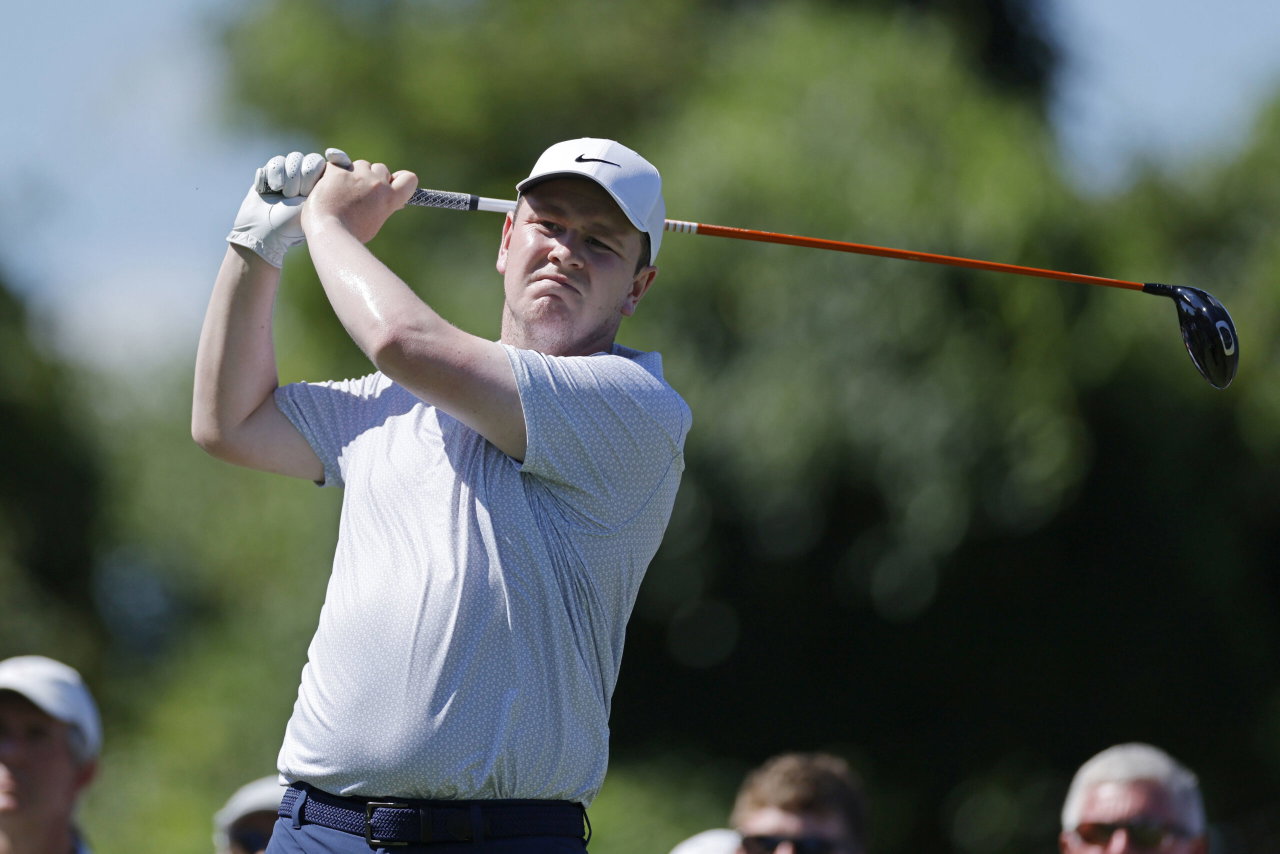
On the 8th hole at the Dunhill Links Championship, Robert MacIntyre settled over the ball and could still hear something he felt was too close. He stepped off, came back not fully committed and hit a bad shot. On the 18th, he backed away from a putt for the same reason.
Watch What’s Trending Now!
The Scot’s objection is about distance, not television. He accepts that broadcasting brings money and everything that comes with it. His point is that drones do not need to be so close, because even his own camera has enough zoom to see the golf shot from that distance.
BBC Sport Scotland reported that a DP World Tour rules official spoke to MacIntyre after he directed his frustration at a camera operator during his opening round at Carnoustie, and he was plain about what the drone’s closeness does to him: “It drives me insane,” he said.
The sequence of events shows how the issue built up. MacIntyre says he raised the drone with a rules official twice before the shot on the 8th, then gave the nod before hitting. He could still hear the drone, which he felt was too close. A warning that changes nothing on the course is a warning that has failed.
It comes down to the sound. MacIntyre says a drone holding still is fine. Wind is another matter, because it buffets the drone as it tries to stay in position.
“It’s like a revving of a car right near where you’re trying to hit,” he said.
That fits how drones work. To stay in place, a drone keeps adjusting its rotor speeds, and in gusts the corrections get bigger and faster, so the pitch keeps shifting. A shifting buzz is harder to tune out than a steady hum.
Reading the Shot Through Inputs and Outputs
Nobody outside a player’s head can say what a pre-shot routine really holds. Analysts get around that by watching the edges only. What surrounds the player at address is the input, and what the strike looks like afterwards is the output. Add or remove something on the input side, and any change in the output points back to it.
MacIntyre’s account supplies both ends: a drone he could hear as the input, and a bad shot as the output. Divided attention links the two, since he described hitting the shot while “just thinking about the drone”.
Each step-off throws away the rhythm he had built over the ball. He has to find that focus all over again while still annoyed, so the next swing is rarely as good as the one he walked away from.
A single round could be an outlier, so a second case helps. MacIntyre described his reaction as long-standing: “I’ve had previous for it.” At the 2024 RBC Canadian Open, which he won, he also complained about drone noise and asked a rules official to step in. Asked in his interview whether Tyrrell Hatton had also been upset, he said he didn’t know. Repeated reactions suggest the input is the variable, not one bad day.
On a broadcast monitor, none of this shows up. The picture is a clean angle of the shot, with no sign that the golfer’s attention has drifted upwards. The cost lands on the player, and only when he complains does the crew hear about it.
One fix could be to put a number on the problem. The DP World Tour could impose a minimum distance between drone and player, wider when it’s windy, since gusts are what turn a hum into a racket. With a set figure, crews and players stop haggling mid-round and both know where the line sits.
The tour could also keep a simple record of each incident, noting how close the drone was, what the wind was doing, and whether the player backed off or hit a bad shot. Even a few rounds of that would show if trouble really starts when the drone is nearest. If the numbers point that way, a rule would then have evidence behind it. If they don’t, coverage carries on as before, and proximity at least has a proper answer.