

Scottie Scheffler is the definition of “coming so close, yet feeling so far,” with how many times he has finished 2nd in his career. And especially in the US Open, when he finished 2nd in 2022. But this time, he has more riding on the line than just this win.
Watch What’s Trending Now!
“This game obviously means a lot to me as a player, and it’s been a huge part of my life for a long time,” talking about his bid for a Grand Slam this season.
Scottie Scheffler enters the U.S. Open at Shinnecock Hills carrying the weight of a career-defining opportunity. A win here would make him the seventh man to complete the career Grand Slam in the modern era.
Imago
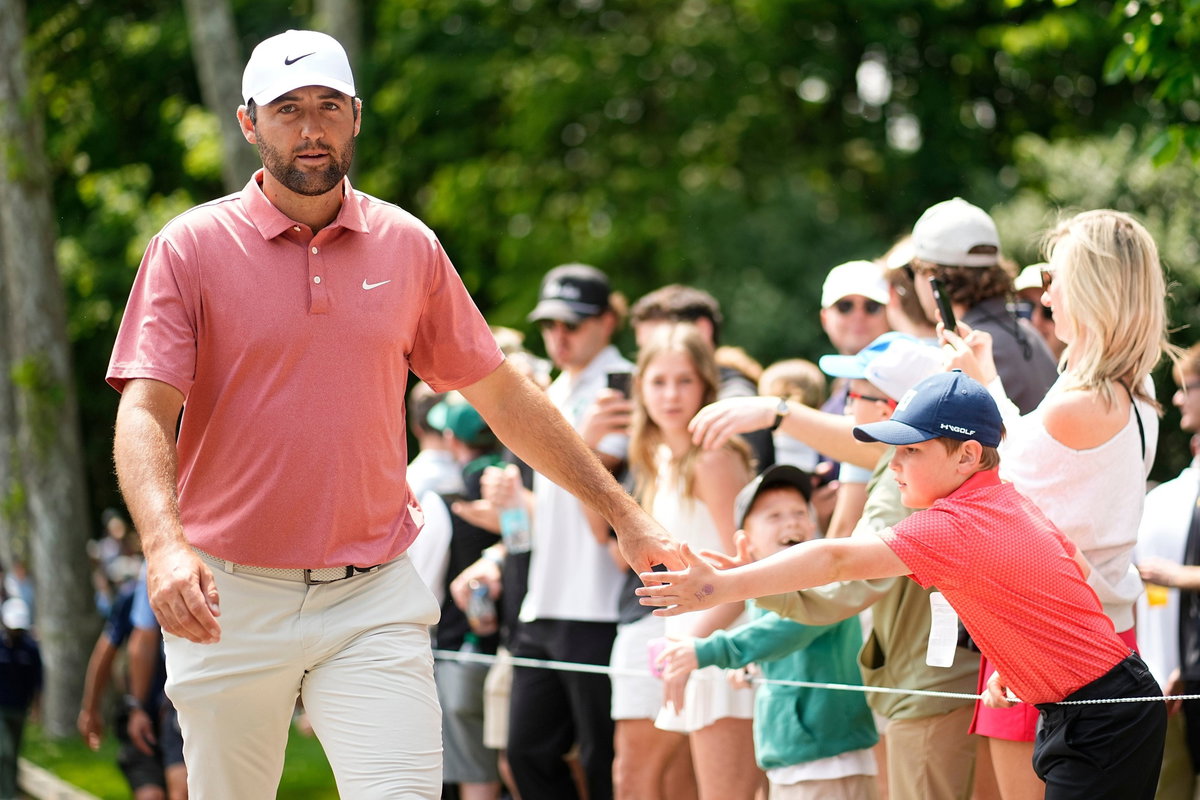
Scottie Scheffler shares a moment with a young fan as he walks to the third tee during the third round of the 2025 Memorial Tournament.
Rory McIlroy reached that same peak in 2025 after winning the Masters, joining legends like Tiger Woods and Jack Nicklaus. Scheffler already holds four majors, including two Masters, a PGA Championship, and an Open Championship.
This week, he stands one step away from joining that most exclusive group in golf.
The significance is personal for Scottie Scheffler, even if he refuses to treat it as a driving force. He has said that the Grand Slam has never been his main motivation in golf. His focus has always been on becoming the best version of himself, rather than chasing milestones.
Still, the reality is simple: a U.S. Open win would instantly rewrite his place in history. Anything less keeps him outside a club that only 6 men have ever entered.
That club of six includes Gene Sarazen, Ben Hogan, Gary Player, Jack Nicklaus, Tiger Woods, and Rory McIlroy. Each of them finished their career by capturing all four majors at different points in time.
McIlroy took 11 attempts to complete the set, finally breaking through at Augusta in 2025. Only a small group of active players is still chasing that final missing major today. Scheffler, Jordan Spieth, and Phil Mickelson are the only ones still sitting one win away.
For Scottie Scheffler, the U.S. Open has always been the hardest piece to complete.
He has finished runner-up twice, including a narrow miss at Brookline in 2022. In 2023, he finished third, just behind Wyndham Clark and McIlroy in a tight Sunday battle. Since then, he has had strong finishes but also a few shaky weeks under U.S. Open pressure.
He has never played Shinnecock Hills in competition before, adding another layer to the challenge.
This is where the pressure becomes real, because missed chances in this game tend to linger. Scheffler has said finishing second does not always feel like failure, but context changes everything.
In a tournament this important, another near miss would feel heavier than anything before it. Shinnecock has a history of turning small mistakes into defining moments on Sunday. One win would change everything for Scottie Scheffler, but another miss would make the wait even harder.
What makes this US Open harder for golfers?
Shinnecock Hills Golf Club sits between Peconic Bay and the Atlantic Ocean with constant coastal wind pressure. The land spreads across a 260-acre sandy ridge that stays fully exposed through every round.
The course has hosted U.S. Opens across three different centuries since its early days. Players arrive knowing the ground and weather together will shape every single shot played.
Wind becomes the main challenge at Shinnecock because it never stays in one direction for long.
William Flynn designed the course using triangular hole groups at 4-6, 10-13, and 14-16. These layouts force players to constantly face shifting wind angles from different directions on each hole. Historian Wayne Morrison notes this setup stops players from settling into any steady rhythm.
The hardest stretch comes through holes 9 to 11, where elevation and visibility create real pressure. Hole 10 plays with a blind tee shot that drops and rises across uneven ground quickly.
Hole 11 is a 157-yard par-3 with a hidden green surrounded by deep bunkers and slopes. At the 2004 U.S. Open, it played at a 3.332 scoring average, showing its extreme difficulty.
Course conditions add another layer because fairways often create optical illusions from the tee box.
Greens are heavily sloped and can reject well-struck shots depending on speed and firmness. The USGA faced criticism in 2004 and 2018 when conditions became too extreme for consistent play. Since then, they have tried to balance setup while respecting Flynn’s original design intent.
Shinnecock has produced only a few under-par totals across recent U.S. Open editions at the venue. The debate always returns to whether setup should favor difficulty or fairness in changing winds. The 2026 U.S. Open marks another return, with plans already set for future championships in 2036.
Every visit confirms the same truth that land and wind together control how this course plays.