
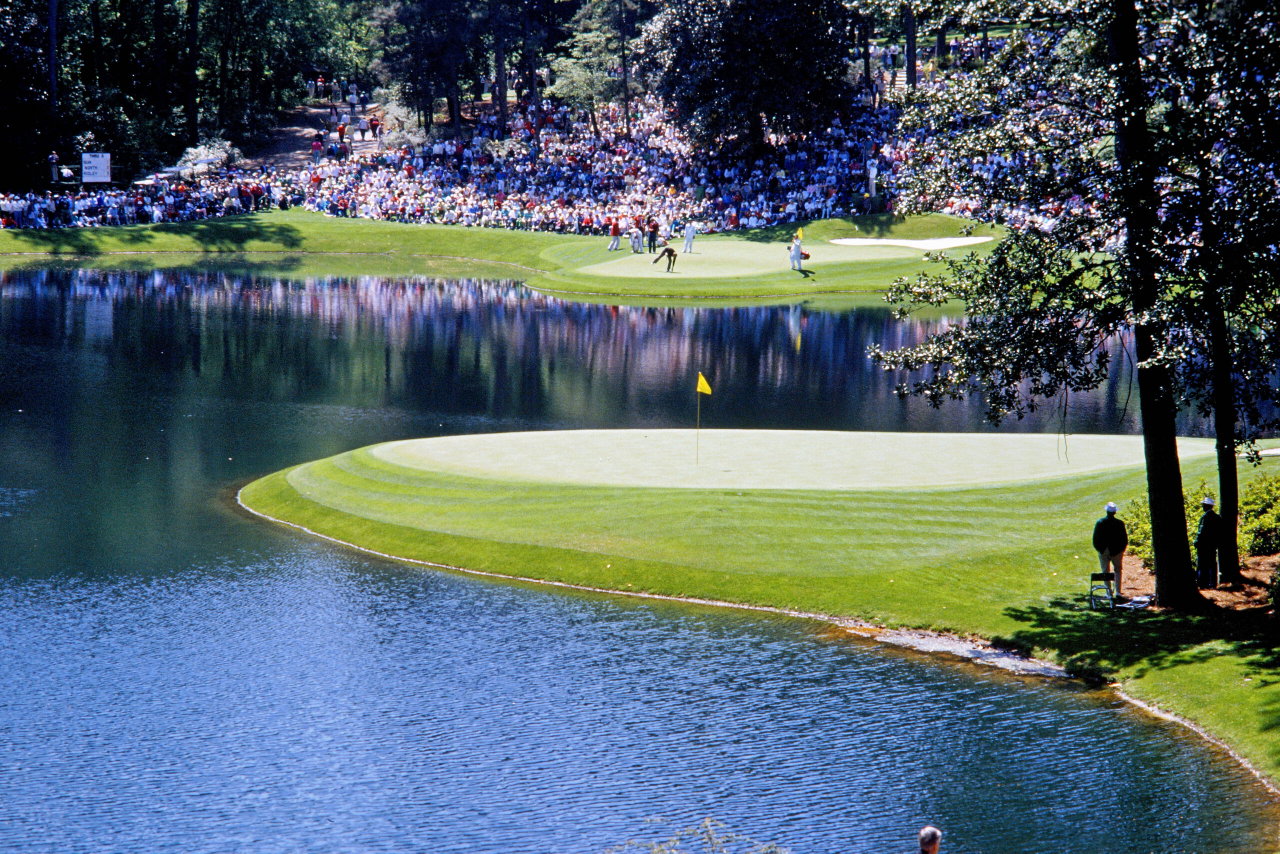
Picture the first full week of April without the Masters. No azaleas on screen, no roars at Amen Corner, and no green jacket ceremony. That world was very nearly the plan. And a small letter dated April 13, 1933, was the reason behind that possible world.
Watch What’s Trending Now!
Waiting on that letter’s reply were Bobby Jones and Clifford Roberts, the two men behind Augusta National, as they wanted the U.S. Open at their brand new course. But why did Augusta National’s founders want the U.S. Open so desperately? To understand that, we have to go back to the club itself.
Before Augusta Had the Masters
Bobby Jones had retired in 1930 when he was just 28, fresh off a Grand Slam, with one ambition left: to build a course of his own. That dream became Augusta National, designed with architect Alister MacKenzie and opened in January 1933.
Running the business side was Clifford Roberts, a New York investment banker who had already sunk nearly $30,000 of his savings into the project. Naturally, they were passionate about pushing it forward.
Unfortunately, the timing could not have been worse. The Depression had turned golf into a luxury, and the club’s big launch, a private train of New York businessmen, was washed out by a cold rain. Given the circumstances, only one guest had signed up as a member. Months went by, and by March, Roberts was warning creditors that the club owed about $31,000 on top of a $60,000 mortgage, and he was paying workers out of daily greens fees that, on a good day, came to roughly $48.
So the brand-new course didn’t need a few more visitors. It needed a big spotlight. And that one ray of hope appeared sooner than the founders had expected.
That came in February 1933, when Prescott Bush, chairman of the USGA’s tournament committee, played on their course. Afterward, Roberts reported that Bush had floated the idea of Augusta hosting the 1934 U.S. Open. Roberts himself dated the idea to late 1932, so the “suggestion” may have been quietly planted.
Either way, the prize was enormous. A U.S. Open would bring national attention, new members, and perhaps USGA money for coursework. It also suited Jones personally, since neither the Open nor the U.S. Amateur had ever been played further south than Illinois. He had long wanted to change that.
With so much at stake, Roberts went to work. He asked sportswriter Grantland Rice to lobby USGA officials and was prepared to put Jones on a train to visit them in person. Although years later Roberts wrote that the club hadn’t pushed that hard, the matter is debatable. Regardless, they wanted the Open that badly, which made the reply all the more painful.
Rejection & Renovation
That reply came in the form of a letter dated April 13 from USGA president Herbert Jacks. It was courteous but final.
The USGA was “favorably inclined toward the move in the near future,” but certainly not in 1934.
And the reasons were mostly practical. Augusta is at its best in late March or early April, about three months before the U.S. Open’s usual date, and moving the championship would have upended the USGA’s sectional qualifying. Jacks also pointed out that northern club pros would have to head south early and spend money to prepare. Other accounts stress the punishing summer heat in Georgia. So sources differ on which worry weighed the most in that decision.
With that list of reasons, the effect was the same. For a club running on fumes, the no came as a heavy blow.
Roberts remained deeply disappointed, but he didn’t stay away from the idea for long. If Augusta couldn’t host someone else’s championship, he reasoned, it could host its own. From there, he told his club benefactor that the rejection might work out for the best, since a regular annual event would do more for the club than a one-off Open. And he moved quickly to put that idea into fruition.
By 1933, he had told the PGA, whose schedule carried a brief note about a tournament at Augusta National on March 22–25. That small mention was the first official sign of what could become the Masters. An invitation also solved a problem the Open never could.
Because of his instructional films and club deals, the USGA no longer considered Jones an amateur, and he refused to turn pro, so he could never have played in an Open. But in an event of his own, he could play. And a field with Jones in it would instantly become the most talked-about tournament in golf. Very quickly, he leveraged that advantage.
And it worked. With the plan in place, the first tournament arrived on schedule. Horton Smith won with a 284 and took home $1,500. Jones, back after four years away, shot 294 and tied for 13th. His putting let him down, though his gallery still grew by the final day.
Financially, the week was modest for the course. Tickets brought in about $8,011, and Roberts had to borrow 66 chairs from two local funeral homes to seat spectators. Even so, the tournament helped grow membership to 18 to 20 members and brought in more than $6,000 in initiation fees, and that was enough to keep the club alive.
As success grew, it raised a smaller, yet more prominent, question: what to call it? Roberts wanted “The Masters,” but Jones thought that was far too immodest.
The official name therefore stayed “Augusta National Invitation Tournament,” although the press, players, and public used “Masters” anyway. Eventually, Jones gave in during 1938, and the name became official for 1939.
Today, it wouldn’t be an exaggeration to say it has become a synonym for golf.
The Masters is the youngest of golf’s four majors, with the U.S. Open 39 years older. When it earned major status is still debated. Some say it was instant, while writer Herbert Warren Wind placed it in 1954.
What isn’t debated is the irony: the USGA’s rejection helped Augusta National create a tournament that no governing body could ever take away from it. In the end, a rejection over timing and logistics became the foundation of golf’s most tradition-rich week.