
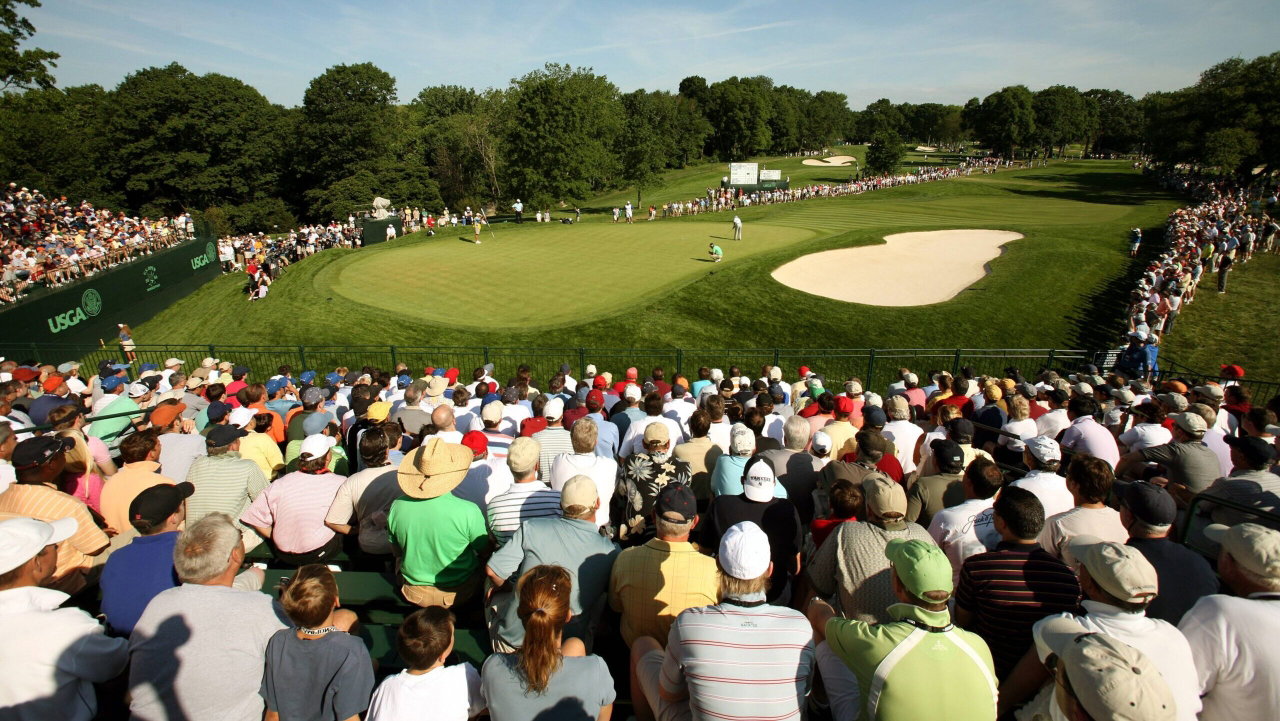
Jack Nicklaus needed just one putt on the opening green at Winged Foot Golf Club during the 1974 US Open. Instead, he watched his ball roll past the hole, down the slope, and off the green. If one of golf’s greatest players could misjudge the surface so badly, the rest of the field had reason to worry.
Watch What’s Trending Now!
The opening round of the 1974 U.S. Open confirmed those fears. Nobody broke par, and only Gary Player matched it. Forty-four players shot 80 or worse. At the end of four punishing days, Hale Irwin lifted the trophy with a 287 total, seven over par. More importantly, he had won without shooting an under-par round.
The 74th U.S. Open, held June 13–16 at Winged Foot’s West Course in Mamaroneck, New York, became known as the “Massacre at Winged Foot.” The nickname, immortalized by sportswriter Dick Schaap’s book Massacre at Winged Foot: The U.S. Open Minute by Minute, captured a championship in which survival mattered more than attacking the course.
But the severity had a purpose, according to the officials responsible for the setup. They wanted to identify the most complete golfer under major-championship pressure. The question was whether Winged Foot delivered a fair test of skill or pushed the game beyond reasonable limits.
Many professionals, including World No. 1 Scottie Scheffler, complained about pin locations at Aronimink Golf Club during the 2026 PGA Championship. He called most of the pins “kind of absurd” and said they were the hardest he had seen since joining the PGA Tour. Similarly, Shane Lowry, Patrick Reed, Chris Gotterup, and many others shared their views about the difficult setup at Aronimink.
The Winged Foot setup in 1974 was even worse.
The West Course measured 6,961 yards and played to a par of 70. Those figures alone did little to explain the challenge awaiting the field. Deep rough, narrow fairways, and firm, fast greens combined to punish even small mistakes.
The field’s scoring average, therefore, reached 76.73, or 6.73 strokes above par.
Irwin’s winning rounds of 73, 70, 71, and 73 reflected the conditions. He finished two strokes ahead of runner-up Forrest Fezler, who posted 289, nine over par. Jay Haas, the low amateur, finished at 307, 27 over par.
The numbers tell the story better than any description of the course’s reputation. Thus, at Winged Foot, avoiding costly mistakes proved more valuable than producing spectacular scores.
The rough was one of the championship’s most punishing features. Ted Horton, Winged Foot’s superintendent in 1974, later recalled the club’s pride in introducing uniform six-inch rough for the Open.
Many speculated that this setup was the USGA’s way of taking revenge on Johnny Miller’s 63 a year earlier. During the 1973 US Open, Miller shot an eight-under-par 63 in the final round at Royal Oakmont to win the major championship. In fact, American professional Tom Weiskopf even went on to say that “It was a typical knee-jerk reaction by the USGA.”
However, Sandy Tatum, then chairman of the USGA’s championship committee and responsible for the setup, explicitly denied the connection.
“What happened the year before had nothing whatsoever to do with the setup of Winged Foot,” Tatum said.
Players remembered even more severe conditions in certain areas. Johnny Miller estimated that the grass ranged from six inches to a legitimate 10 inches. Irwin recalled tangled grass extending more than a foot beyond the bunkers behind the second green.
“It was easily the most difficult golf course I had ever seen,” Hale Irwin said.
David Graham, who finished tied for 18th, offered a concise assessment to The New York Times.
“If you missed the fairway, you were lucky to find your ball,” he said.
Thick grass frequently prevented players from advancing the ball far enough to attempt a normal approach shot. A missed fairway could force a short recovery, effectively costing a stroke before a player had another chance to reach the green.
Miller illustrated the difference with his own retrospective estimates. He believed a player hitting from 100 rough lies at Winged Foot would average about 80 yards of advancement, compared with approximately 140 yards at Oakmont in 1973.
The rough also made practice hazardous. Steve Melnyk recalled starting a practice round on the 10th hole with six balls. After losing two tee shots in the right rough, he had exhausted his supply by the 17th. He had not even hit a ball out of play, yet his practice ended after only seven and a half holes.
Nicklaus himself was shocked. Recalling his incident on the first green, he said, “Next thing I knew, the ball kept rolling and rolling and rolled right off the green.”
His misjudgment made an immediate impression on Hubert Green, who wondered what ordinary players could expect after watching Nicklaus struggle.
Green later recalled thinking, “My God, what are we mere mortals going to do out here?”
Green compared the experience to facing Muhammad Ali in his prime. He described the repeated need to get back up after being knocked down. Yet his own performance showed that the course was still playable. After opening with an 81, he returned a 67, which the Golf Digest oral history identifies as the championship’s lowest round.
Jack Nicklaus also offered a more measured verdict than the incident alone might suggest. He enjoyed difficult conditions, didn’t think the setup was wrong, and didn’t believe he had complained. Still, he acknowledged that things had gone slightly beyond the organizers’ control.
A demanding course is part of the U.S. Open’s identity, but the severity at Winged Foot raised questions about where a legitimate challenge ends and excessive punishment begins. Now, the venue is set to host the event again in 2028. It will be the club’s seventh staging of the championship. But we will have to wait to see if the setup remains that challenging.