
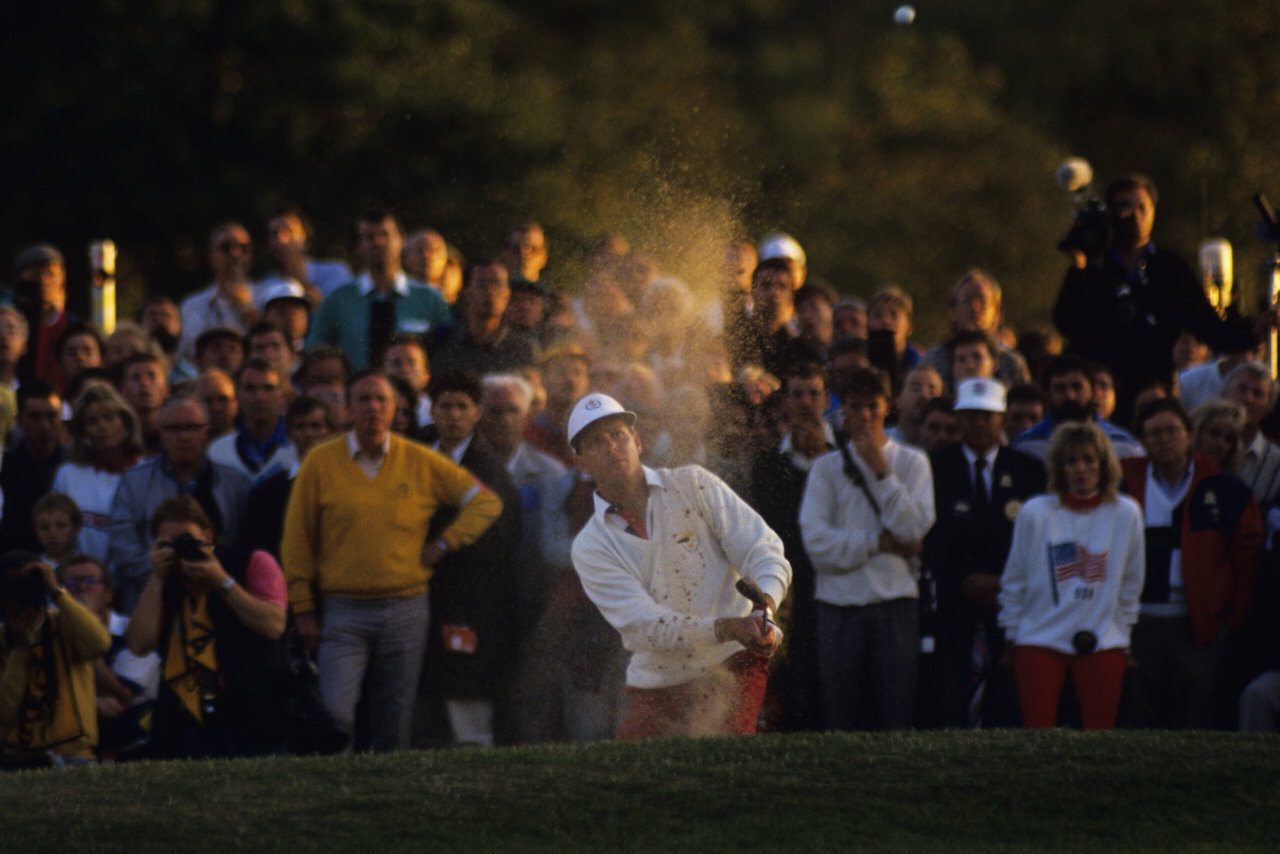
Behind the 18th green at Pinehurst No. 2, a bronze figure balances on one leg, putter hanging from his left hand and right fist thrust out in front of him. Golfers finishing their rounds often stop to copy the pose, but rarely does anyone need to ask who it is. It is Payne Stewart, immortalized in the moment he celebrated his winning putt at the 1999 U.S. Open. And this week marks 27 years since the golf world lost the three-time major champion.
Stewart left the golf world just four months after that victorious putt, at 42, in one of the strangest and most heartbreaking tragedies the sport has ever seen.
To revisit how and what happened, it helps to start from the summer of 1999.
Watch What’s Trending Now!
Stewart’s Rise in Golf
Stewart was a player fans felt they knew, even from a distance. His plus-fours and tam-o’-shanter cap were impossible to miss. Occasionally, Stewart also wore the colors of NFL teams on the course. His wardrobe made him famous before the results did, with many kids even wearing a similar costume every day.
Although he became the fashion icon for many, fans’ love for him wasn’t limited to just his style. In fact, when fans wrote letters after his death, they wrote about a swing that looked effortless, his classic loud laugh, and a man who made time for his people and fans. One recalled being a kid working a Honda Classic in 1988 and saw Stewart as the only player who bothered to learn his name.
As for how he won fans over with his performance, well, that’s another story. Between 1982 and 1987, Stewart had finished second six times and even earned a name for himself, “Avis,” which he disliked. Moreover, his father, Bill, who was instrumental in introducing him to golf, died of cancer in 1985.
So when his final big win came, it was at Bay Hill in 1987, and he gave the entire $108,000 winner’s check to a hospital in his father’s memory. And as if he caught a streak, he continued to win the 1989 PGA Championship and 1991 U.S. Open. The 1998 Open at Olympic Club, however, was a heartbreak, where he led for three rounds, shot 74, and lost to his friend Lee Jansen. But he had handled that loss with so much grace that he won over fans, even the ones who had never really supported him.
And that is why Sunday in 1999 at Pinehurst was so big. It was June 20, and he was back in the final pairing at the same championship, with golf icons Tiger Woods, Phil Mickelson, and Vijay Singh chasing him. He holed key putts on the 16th and 18th, and all that remained on the 18th was a 15-foot putt, the longest ever made to win a U.S. Open on the last hole. And, splendidly, Stewart did it.
As the putt dropped, he cried and hugged his longtime caddie, Mike Hicks, then took Phil Mickelson’s face in both hands. In September came the Ryder Cup at Brookline, and by October Stewart was one of the most admired players in the game.
The October 25 Crash
Then came the morning of October 25th. Stewart boarded a Learjet 35 in Orlando bound for Dallas, where he planned to meet SMU, his alma mater, about building a home course for his golf team. From there he would head to Houston for the Tour Championship.
With him were his agents, Robert Fraley and Van Andren, golf course architect Bruce Borland, and pilots Michael Kling and Stephanie Bellegre.
Just about eight minutes after 9:19 a.m. takeoff, Kling acknowledged an instruction to climb to 39,000 feet. That was also the last time anyone here heard from the aircraft. The jet climbed past its assigned altitude, and instead of turning west to Dallas, it kept flying northwest.
Soon enough, Air Force and Air National Guard F-16s took turns flying alongside it. The pilots reported the same thing: both engines were running, windows iced over, and no movement inside. Even cable news followed the jet across the state after state, while the country waited for an answer that never seemed to come.
After an excruciatingly long three hours, 54 minutes, and roughly 1,500 miles, the fuel ran out, and the jet went down in a field near Mina, South Dakota. Unfortunately, Stewart and all of his five members on board did not survive the crash.
The National Transportation Safety Board later concluded that the cabin had lost pressure early in the flight, leaving everyone aboard incapacitated by oxygen deprivation. Investigators could not determine what caused the loss of cabin pressure.
The Tributes That Followed
The news devastated the golf community. Players and colleagues struggled to process the sudden loss of someone who had been competing at the highest level only weeks earlier. Dustin Leopard stepped away from the course to compose himself after hearing the news. Members of the European Ryder Cup team, gathered in Spain, were also stunned, with José María Olazábal fighting back tears. Hundreds of fans contacted ESPN seeking confirmation that the reports were true.
Tiger Woods captured the sense of loss felt across the sport when he said,
“There’s an enormous void and emptiness I feel right now.”
The Tour Championship in Houston went ahead, but the PGA Tour canceled the Pro-Am and arranged a memorial service at First Baptist Church in Orlando on Friday, October 29. Around 100 players flew in to pay their respects. Paul Azinger, a close friend of Stewart’s, rolled up his trousers into makeshift knickers before delivering the eulogy.
Among his words was a simple line that reflected the way many remembered Stewart:
“Payne Stewart loved life.”
The tributes continued at the Tour Championship that weekend. With permission from Stewart’s wife, Tracy, Stuart Appleby wore one of Stewart’s signature outfits during Sunday’s round. Many players wore shorts in his honor, while Stewart’s place in the field was left open as a mark of remembrance.
The PGA Tour established the Payne Stewart Award in 2000 to recognize players who demonstrate character, sportsmanship, and a commitment to charitable work. Later that year, at the U.S. Open at Pebble Beach, 21 players hit balls into the Pacific Ocean in his memory.
Nearly 27 years later, Stewart’s absence is still felt, but his memory remains closely tied to the game he loved.