Imago
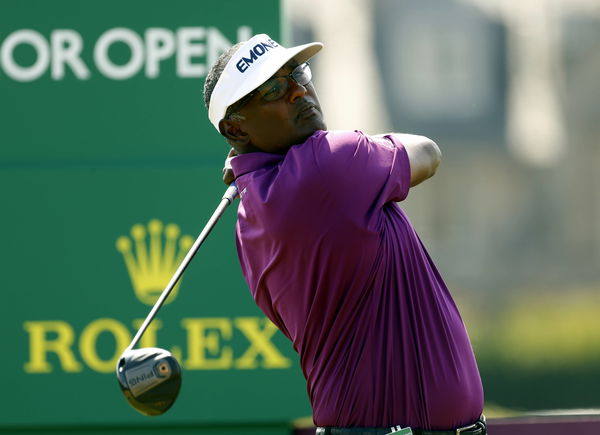
27th July 2018, Old Course at St Andrews, St Andrews, Scotland; The 2018 Senior Open Golf Championships, 2nd round; Vijay Singh (FIJ) plays his tee shot on the 2nd hole PUBLICATIONxINxGERxSUIxAUTxHUNxSWExNORxDENxFINxONLY ActionPlus12050812 AlanxMartin
Imago
27th July 2018, Old Course at St Andrews, St Andrews, Scotland; The 2018 Senior Open Golf Championships, 2nd round; Vijay Singh (FIJ) plays his tee shot on the 2nd hole PUBLICATIONxINxGERxSUIxAUTxHUNxSWExNORxDENxFINxONLY ActionPlus12050812 AlanxMartin
What happens when a multi-billion dollar sports league can’t keep track of its own exemption rules—and a working pro’s paycheck hangs in the balance?
Watch What’s Trending Now!
“We were told VJ would not bump players, not bump graduates, not taking a spot,” Brendan Porath said on The Shotgun Start podcast’s January 2026 episode. “He got in. He’s ahead of Isaiah Salinda.”
The hosts had received a tip from a listener. Vijay Singh, they were informed, used the Top 50 Career Money exemption in both 2022 and 2023. The problem? That exemption is a one-time, one-year benefit. Once used, it’s gone. Porath reached out to a Tour contact to verify. The response confirmed what he suspected.
“Apparently, these things happen,” Porath reported. “There are clerical errors.”
The deconstruction of that statement requires context. The Top 50 Career Money exemption allows players ranked among the all-time earnings leaders to regain full exempt status for one season of their choice. Singh ranks sixth with $71.2 million. The exemption is not renewable. If Singh burned through it in 2022 and 2023, how did it reappear on his 2026 eligibility?


🚨😳⛳️ #NEW — 62-year old Vijay Singh has opted to use his career money list exemption for 2026 and has already committed to next week’s Sony Open in Hawaii. Singh has not competed on TOUR since 2021.
Do you agree with this move or is he taking up a spot in events? pic.twitter.com/52qVBFiDqh
— NUCLR GOLF (@NUCLRGOLF) January 7, 2026
Porath laid out the precedents. “Like last year, MJ Daffue was on the KFT, PGA Tour, not exempt after his major medical expired. They missed that. Cameron Percy was in one of the opposite field events that had zero status.”
The MJ Daffue incident is documented. In August 2025, Daffue found himself tied for fourth at the Korn Ferry Tour’s Pinnacle Bank Championship. One problem: he wasn’t supposed to be in the field. After his major medical exemption expired following the ISCO Championship, the Tour failed to update his eligibility category. Daffue was accidentally coded into a higher-priority slot. The rightful first alternate, Rayhan Thomas, sat on the range all day waiting for a withdrawal that never came. His father had flown in from Dubai. Thomas drove home after the last tee time went off.
The Tour acknowledged the error. It worked with Thomas to find an “equitable solution.” But the damage was done—a clerical mistake had cost a player a start he had earned.
Porath connected the dots to Singh’s situation. “I don’t know if this is purely that VJ is using a rightful career money exemption, and he didn’t burn through the first two, or he has a third somehow. But he’s playing the Sony this week. I know that much. And Isaiah Salinda was sweating bullets to get in.”
The substantiation is brutal. Salinda, 27, finished 103rd in the 2025 FedEx Cup standings. He holds a conditional status for 2026—meaning every start matters. A 62-year-old who hadn’t played a standard PGA Tour event since the 2021 Honda Classic occupied a spot in the 120-player Sony Open field ahead of him.
The stakes contrast sharply. Singh has no FedEx Cup implications. Salinda is fighting for card security and income. One player’s entry is ceremonial. The other’s absence is existential.
Co-host Andy Johnson didn’t hedge on the broader critique. He declared that the exemption is “an idiotic rule” that “shouldn’t exist.” The hosts called for an audit of similar exemptions, stating the system is “a mockery.”
The transition from clerical suspicion to broader critique sharpens around an unwritten code that once governed legacy player behavior.
Why Vijay Singh’s Sony Open entry breaches golf’s gentleman’s agreement
For decades, an informal understanding governed how Lifetime Members and Career Money exemption holders played. They would compete selectively—never at the expense of grinders fighting for status. The “gentleman’s agreement” preserved meritocracy’s appearance even when the rulebook allowed loopholes.
Singh’s entry violates that spirit. Whether the exemption is legally valid or a clerical oversight, the outcome remains the same: a 62-year-old with no competitive stake displaced a player whose career depends on every start.
Salinda eventually got into the Sony Open as the first alternate after Kevin Yu withdrew. But the margin between competing and watching is measured in single names on a list. David Lipsky, who finished 91st in the 2025 FedEx Cup standings, became the new first player out. For players in the 101-125 FedEx Cup range, conditional status means living in perpetual uncertainty.
The contrast with Matt Kuchar sharpens the critique. Kuchar, 13th on the all-time money list, faced the same decision this offseason after finishing 118th in FedEx Cup points. He declined to use his exemption, opting instead for conditional status. He calculated that the exemption would only net him three or four additional starts—none of them Signature Events. He’ll save it for later.
Singh made the opposite choice.
The PGA Tour markets itself as a merit-based system. The 2024 restructuring slashed exempt cards from 125 to 100 players, tightened field sizes, and positioned the league as a leaner product. Only the fittest survive.
Yet edge-case exemptions and administrative errors undermine that narrative. The Tour has offered no public explanation for Singh’s entry. It hasn’t clarified whether the exemption is legitimately available or whether another clerical error slipped through.
Johnson and Porath aren’t accusing Singh of wrongdoing. They’re questioning a system that allows a 62-year-old Hall of Famer to enter ahead of a 27-year-old fighting for his career—and then offers no transparency when the eligibility math doesn’t add up.
The PGA Tour is fighting for credibility on multiple fronts. It cannot afford administrative failures that cost working pros their paychecks.
Related Newsletters