
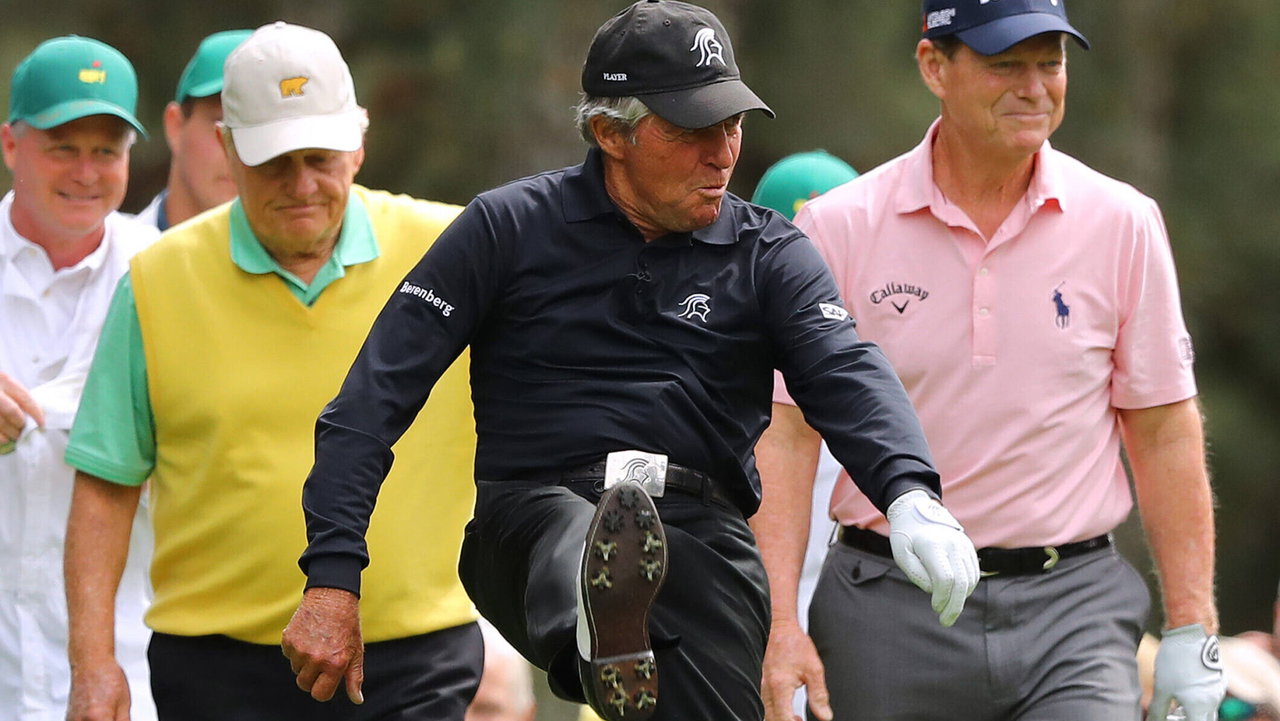
Despite nine major titles and a career Grand Slam on two different tours, one missing trophy still gets under Gary Player’s skin. The South African lost the 1969 PGA Championship by a single stroke, and in recent years he has insisted it should have gone differently. At 91, he is telling that story again on The Golfer’s Journal podcast with host Tom Coyne, released on November 12.
Watch What’s Trending Now!
Player leaves no doubt about who he blames. Recalling that week in Dayton, he said: “Like I lost the PGA to Raymond Floyd in Dayton, Ohio, 1969. They threw ice in my eyes, telephone books in my backswing at the top of my backswing, charged me on the greens, tore up the greens, threw balls between my legs, screamed on my backswing, and I lost the tournament by one shot.”
That is a heavy claim. It deserves a closer look at what happened at NCR Country Club.
Raymond Floyd, then 26, won the first of his four majors, one stroke ahead of runner-up Player. Floyd finished at 276 (8-under). He held a five-shot lead after the third round and shot a 74 on Sunday, which let Player back into the hunt.
The finish was tight. Floyd bogeyed the 13th and 15th holes, but Player bogeyed the 16th and then birdied the 17th. Floyd held on to win by one stroke.
The main disruption came during the third round. Protesters gathered at the tournament and focused on Player because he was from South Africa. Jack Nicklaus was also targeted that day. He later said, “Gary had the worst distraction in Dayton.”
The incidents were still serious. A rolled-up program was thrown at Player, ice was tossed into his face, and a protester threw a golf ball onto the green as he lined up a putt. Player made birdie anyway. He later described it as “the toughest round I’ve ever played.”
Player has also described telephone books being thrown at him, a detail that Golf.com’s reporting includes but not every account does.
To understand why Gary Player became a target, it is important to look at what was happening in South Africa at the time. Apartheid laws kept sport divided by race, and anti-apartheid activists wanted the world to take a stand against it. They believed that allowing South African teams to compete abroad gave the country a chance to hide its racist system behind sport.
One group leading that fight was the South African Non-Racial Olympic Committee (SANROC), formed in 1962 under Dennis Brutus. It worked to get South Africa banned from international sports and organized protests wherever its teams competed.
Player was one of South Africa’s biggest sporting stars, so he became a target too. In 1966, he wrote, “I am of the South Africa of Verwoerd and apartheid.” Years later, in 2014, Player said the protesters targeted him simply because he was South African, not because of his personal views.
Look at his scorecard. Player shot 71-65-71-70, so his Saturday round was six shots worse than his Friday 65. That could signal how much the disruption cost him, but it is only an inference, and nobody can prove it.
Gary Player has no such doubts. In 2019, he said he would definitely have won without the protesters, which would have given him 10 majors. The podcast widens that belief. Player said, “if I’d been born in America not even a question I would have won at least three more majors.”
He ties that conviction to his South African nationality in that era.
He has also described the pressure as going beyond Dayton. He said armed policemen once slept in his rental house at the Masters in that same period, and he has said he holds no bitterness over it.
Whether a handful of protesters decided a one-shot margin is a question the record can’t answer. Floyd’s name is on the trophy. Yet the 1969 PGA Championship remains the major Player points to by name.
What the podcast makes clear is that, for Gary Player, the debate is already settled. And with his stated goal of teeing it up at 100 years old, he has plenty of time left to keep making the case.