Imago
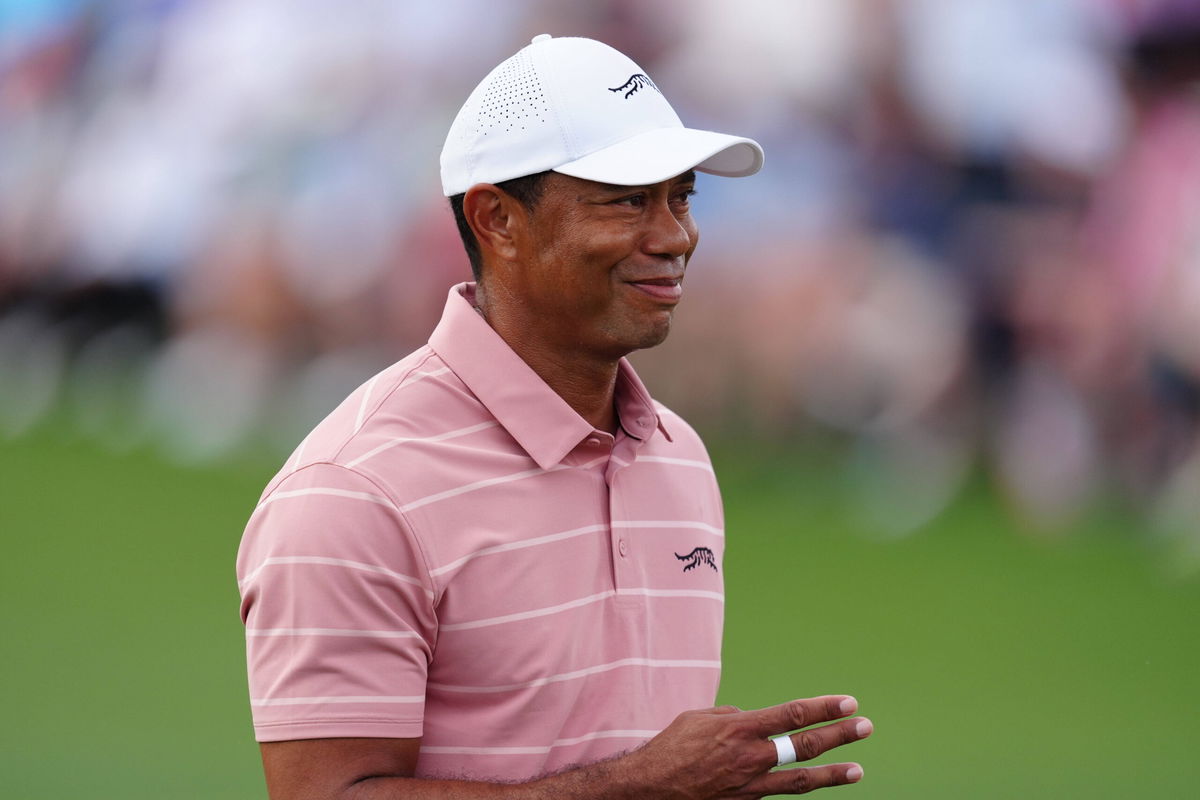
The Masters Tiger Woods USA in action during Round 1 of the The Masters, Augusta National Golf Club, Augusta, Georgia, USA. 11/04/2024. Picture Fran Caffrey / Golffile.ie All photo usage must carry mandatory copyright credit Golffile Fran Caffrey Copyright: xFranxCaffreyx *EDI*
Imago
The Masters Tiger Woods USA in action during Round 1 of the The Masters, Augusta National Golf Club, Augusta, Georgia, USA. 11/04/2024. Picture Fran Caffrey / Golffile.ie All photo usage must carry mandatory copyright credit Golffile Fran Caffrey Copyright: xFranxCaffreyx *EDI*
Imago
The Masters Tiger Woods USA in action during Round 1 of the The Masters, Augusta National Golf Club, Augusta, Georgia, USA. 11/04/2024. Picture Fran Caffrey / Golffile.ie All photo usage must carry mandatory copyright credit Golffile Fran Caffrey Copyright: xFranxCaffreyx *EDI*
Imago
The Masters Tiger Woods USA in action during Round 1 of the The Masters, Augusta National Golf Club, Augusta, Georgia, USA. 11/04/2024. Picture Fran Caffrey / Golffile.ie All photo usage must carry mandatory copyright credit Golffile Fran Caffrey Copyright: xFranxCaffreyx *EDI*
Tiger Woods was 24 when he became the youngest player to complete the career Grand Slam, winning the Claret Jug at St. Andrews. He held all four major titles before most of his peers had even won a second. That record has lasted for twenty-six years. What is less often mentioned is that Woods himself still treats that week in Scotland as separate, stating that he has never found that level of control again in any tournament since.
Watch What’s Trending Now!
Golf Channel’s docuseries The Tiger Effect: 30 Years of Influence released its fourth episode on February 28, 2026, built around a conversation between Woods and Jordan Spieth. When Spieth asked where the Grand Slam completion ranked among his career achievements, Woods did not pause.
“Winning — I get chills — about winning the career Grand Slam at St. Andrews, at the home of golf, is as good as it gets,” he said. “I had it on a string. Whatever shot I wanted to play, I could play.”
Woods then admitted something rare for him. He is not known for talking about his own limits.
“I’ve never had any other tournament like that.”


“I had it on a string.” 🔥😤
Was 2000 Tiger the best golf ever played?
In Episode 4 of “The Tiger Effect: 30 Years of Influence”, Tiger reflects on completing the career Grand Slam at St. Andrews.
Golf Channel | @TGRFound pic.twitter.com/TtkDHf4QYF
— Golf Channel (@GolfChannel) February 28, 2026
This is the same player who won nine times in a single season, shot 269 at St Andrews without finding a single bunker, and held all four major titles at once. His dominance was clear, and he understood it. But he did not claim that level of success could be repeated. That honesty says more about his character than any record.
Spieth, himself a major champion who watched Woods change the face of professional golf, manages to get to the core of a question that formal interviews often miss. Here, it is one generation directly asking another about the limits of the game, and getting a straightforward response. The series, produced by Golf Channel and the TGR Foundation, is a formal record of Woods’ impact on golf over thirty years. Episode 4 does not treat the 2000 Open Championship as just another win. Instead, it singles out that week as a defining moment that the sport keeps returning to.
The numbers from that week at the Old Course put Woods’ comments in perspective. He shot 269, nineteen under par, which was the lowest 72-hole total in major history for fifteen years. He won by eight shots over Thomas Bjørn and Ernie Els, and did not find a single one of the 112 bunkers in four rounds.
Woods has spoken before about playing St. Andrews in the Dunhill Cup, where the conditions were so tough that a six iron off the first tee skidded across ice and went far past the target. His win at St. Andrews was not just another trophy; it was the third step in a run that changed golf history. He started with the 2000 U.S. Open at Pebble Beach, winning by fifteen shots. Then came the PGA Championship at Valhalla, decided in a playoff against Bob May. The 2001 Masters finished the sequence, making Woods the only player in the modern era to hold all four major titles at once.
That admission means more when you consider everything else that happened during that season.
Tiger Woods’ 2000 PGA Tour season: Still the standard no player has matched
In 2000, Tiger Woods played 20 PGA Tour events, winning nine of them. That is a 45% win rate. He finished in the top five 17 times and earned over $9 million in prize money. His scoring averages, 68.17 actual and 67.79 adjusted, remain PGA Tour records.
His strokes gained total across that year’s four majors reached 81.3, the highest single-season figure recorded since the first Masters in 1934. His bounce back rate, measuring how often a player converts birdie or better immediately after a bogey, came in at 36.5%, against a PGA Tour field average of 18.6% that season.
Scottie Scheffler’s 2025 adjusted scoring average was 68.13, the fifth-best in PGA Tour history. Woods holds four of the top five spots and three of the next four. The numbers speak for themselves.
The season belongs to history, documented and beyond revision. The feeling Woods described to Spieth — every shot on a string, every trajectory already decided before the club made contact — has, by his own account, never come back.
Related Newsletters