
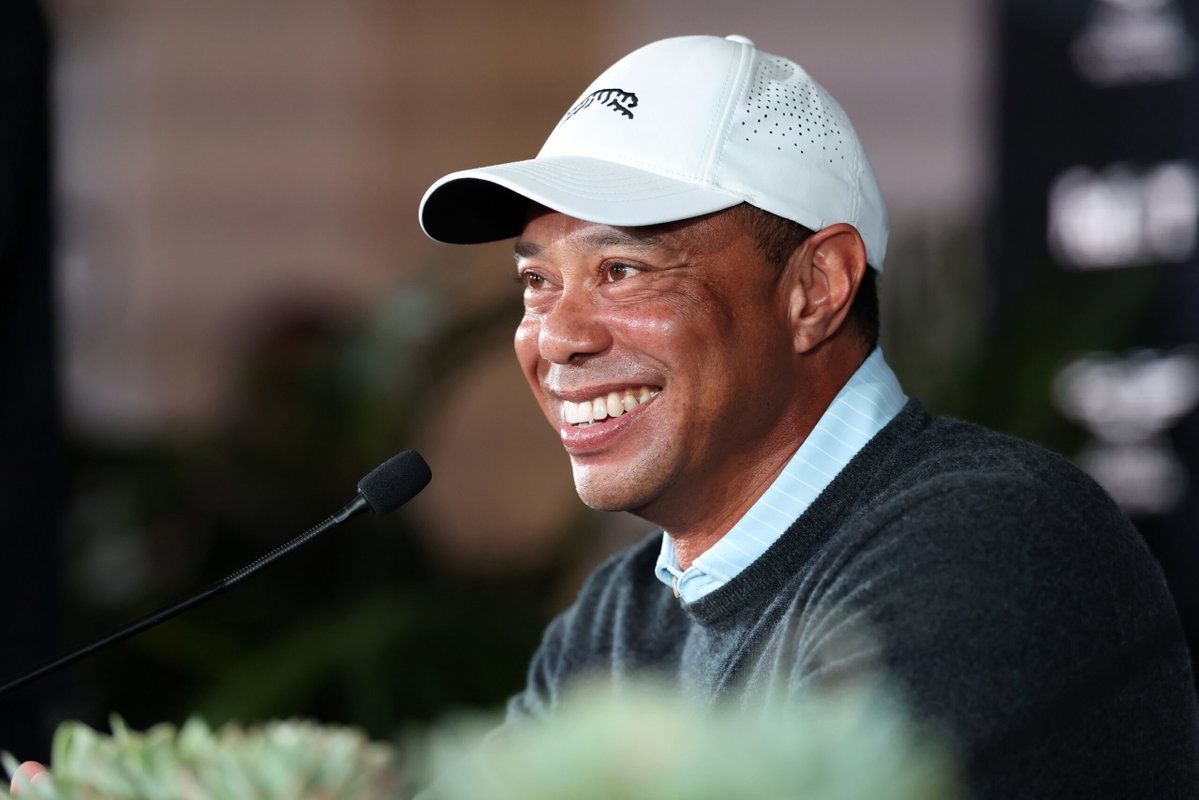
Just 48 hours after appearing before a Florida judge and accepting a five-year driving ban, Tiger Woods made his first public appearance since the hearing at Stanford Stadium on Friday night. He was there to watch the Cardinal take on Miami alongside Bay Area rap legend E-40. But with the court ruling still fresh, his unexpected appearance and demeanor raised plenty of questions.
Watch What’s Trending Now!
TWLegion first shared the moment on X. The post said, “Good to see Tiger out and about following court.” The photo was credited to @E40, E-40, who was at Stanford for more than just a football game. The Bay Area rap icon had been booked as the night’s halftime performer as Stanford celebrated the 20th anniversary of his landmark album My Ghetto Report Card.
The connection between Woods and E-40 also appears to be tied to the event rather than any publicly documented longstanding friendship between the two. E-40 has deep ties to Bay Area sports and culture, while Stanford Athletics had specifically brought him in for the occasion. The rapper is also an established entrepreneur beyond music, with ventures spanning wine, spirits and food. In a 2025 interview with Entrepreneur, E-40 said he became “a millionaire, a multi-millionaire, at a young age.” Woods’ appearance with him came just two days after his plea deal over a March 27 crash near his Jupiter Island home.
The crash had initially led to DUI and refusal-to-test charges. On Wednesday, Tiger Woods pleaded no contest to reduced charges of reckless driving and careless driving. Judge Darren Steele gave him concurrent five-year suspensions of his driver’s license.
He also fined Woods $1,000 for reckless driving and $500 for careless driving. The total came to $1,500, and the judge made the consequences of violating the suspension clear. He told Woods, “If you drive for any reason at all, you will be going back to jail.”
Woods attended the hearing with his attorney, Douglas Duncan, and his girlfriend, Vanessa Trump. He did not speak to reporters as he left the courthouse.
The DUI charge was dropped after prosecutors determined they could not prove impairment beyond a reasonable doubt. State Attorney Thomas Bakkedahl said two forensic toxicologists reviewed the case and found there was not enough evidence to prove Woods was impaired. They believed Woods had developed a “pharmacological tolerance” to hydrocodone after taking the drug for years to manage chronic pain. Prosecutors had also obtained records showing the medication was lawfully prescribed.
Bakkedahl also defended the decision despite the criticism it received. He said he was not worried about what others thought and believed he had made the right call. “I did what I think is right,” he said. At the same time, he stressed that Woods, as one of the most famous people in the world, had a greater responsibility than most people when it came to getting behind the wheel.
Woods’ longtime manager, Mark Steinberg, also responded through the AP. He said the decision did not mean Woods was free from responsibility. “Tiger is not absolved of accountability and he surrendered his license for the next five years,” Steinberg said. Woods had given up his driver’s license for five years and was continuing his treatment while focusing on his overall health.
That context followed Woods into Stanford Stadium. While his court case had reached its resolution on Wednesday, his first notable public appearance afterward came at a place deeply connected to his career. Woods enrolled at Stanford in 1994 on a golf scholarship and spent two years studying economics while representing the Cardinal.
During that time, he won 11 college tournaments, earned First-Team All-American honors twice and captured the 1996 NCAA individual championship before turning professional later that year.
Nearly three decades later, Woods was back inside Stanford Stadium, but this time there was no tournament to play and no golf club in his hands. He was simply in the stands for a football game.
There was little for the former Stanford star to celebrate on the field, either. Miami routed Stanford 45-6, turning Woods’ return to his former university into a lopsided night for the Cardinal.
There was also an interesting detail about the timing. While Woods was at the game in Palo Alto, his 17-year-old son Charlie Woods was competing at the Junior Players Championship at TPC Sawgrass in Florida. Charlie was four shots behind the leader heading into the final round. Tiger was not there, with his mother, Elin Nordegren, walking the course with him instead. Charlie had also just confirmed a new equipment deal with TaylorMade, the same company that sponsors his father.
Tiger’s absence was not new. He has spent much of 2026 away from competitive golf while dealing with his health and recovery. It just happened that his court hearing and Charlie’s tournament fell within two days of each other.
The Stanford appearance also comes at an interesting point in Woods’ golf career. He turned 50 in December 2025, making him eligible for PGA Tour Champions, where players are permitted to use carts. That could eventually offer Woods a more realistic route back to competitive golf given the physical toll of his injuries and surgeries.
Woods has not played a traditional PGA Tour event since the 2024 Open Championship. Earlier this year, however, he left the door open to a return to the Masters. Asked in February whether Augusta was off the table, Woods simply answered, “No.” He also acknowledged that his latest back procedure had made a return challenging.
That makes his current situation more complicated than simply a five-year driving suspension. The ban does not necessarily prevent Woods from returning to golf, and Florida officials have indicated that he can still use a golf cart. But there is no confirmed date for his next competitive appearance.
For now, Woods’ return to Stanford offered a rare glimpse of him away from the courtroom and the golf course. Two days earlier, he had been facing the consequences of a case that began with a rollover crash and ended with a five-year driving suspension. By Friday night, he was back at a university that helped shape his career, watching football from the stands as one of Stanford’s most famous former athletes.