
Imago
February 22, 2026, Pacific Palisades, California, USA: Tiger Woods speaks during the award ceremony after Jacob Bridgeman won the final round of the 2026 Genesis Invitational golf tournament on Sunday, February 22, 2026, at the Riviera Country Club in Pacific Palisades, California. JAVIER ROJAS/PI Jacob Bridgeman Wins The 2026 Genesis Invitational PUBLICATIONxINxGERxSUIxAUTxONLY – ZUMAp124 20260222_zaa_p124_165 Copyright: xJavierxRojasx
Imago
February 22, 2026, Pacific Palisades, California, USA: Tiger Woods speaks during the award ceremony after Jacob Bridgeman won the final round of the 2026 Genesis Invitational golf tournament on Sunday, February 22, 2026, at the Riviera Country Club in Pacific Palisades, California. JAVIER ROJAS/PI Jacob Bridgeman Wins The 2026 Genesis Invitational PUBLICATIONxINxGERxSUIxAUTxONLY – ZUMAp124 20260222_zaa_p124_165 Copyright: xJavierxRojasx
It was in the late 1990s when Tiger Woods burst onto the scene. He dominated the leaderboards with ease. Additionally, that young boy reshaped golf’s cultural landscape. Golf as a sport was long viewed as a largely inaccessible field for minorities. Not just because it was expensive, but also because the traditional elitist image of golf was still prevalent. Woods’ stellar performance in the 1997 Masters challenged the age-old traditional image of the sport. At the same time, another golfer of color, Michael Campbell, too, was navigating the changing landscape. And as he achieved his first major win, defeating Woods, a small gesture from the legend left an indelible mark on his heart.
Watch What’s Trending Now!
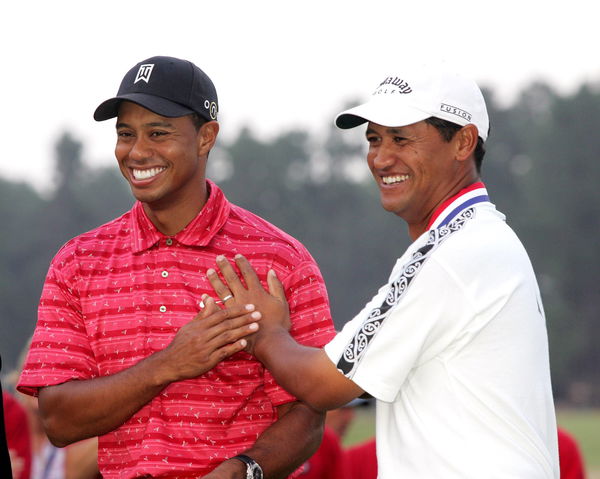
“If you look on previous presentations of a major, second’s never there, right? Only the number one, the winner. So Tiger was next to me at the prize giving. He came second, but he was right next to me, and I said to him, ‘mate, what are you doing here?’”, shared Campbell, taking a tour down memory lane.
Narrating the story, he continued, “You know, he goes, well, I’m going to show you my respect, and that’s the biggest compliment you can ever receive from the GOAT, you know. For Tiger to be next to me, sharing this moment, a special moment for me, was a big deal. So it was, yeah, it was an incredible gesture from Tiger.”
“I couldn’t afford golf clubs.” 💔⁰
Michael Campbell opens up about his journey from New Zealand to beating Tiger Woods at the 2005 US Open 🏆
⁰
📺 Final Cut: Episode 1 | Out now on YouTube. pic.twitter.com/QcFGACbVZy— Legends Tour (@euLegendsTour) March 5, 2026
Campbell played in 55 majors throughout his career. In 2005, he secured a win in the US Open, toppling Tiger Woods, bagging $1.17 million. Defeating the maestro back in that era made the win even more special for the Kiwi. He referred to the moment he shared with Woods in the greens of the Pinehurst Resort during the 25th US Open and reflected on the warm gesture of the American golfing GOAT.
Growing up in New Zealand, Campbell pursued golf at a time when the sport felt distant for many in his community. Belonging to the Maori community, he faced several barriers. Adding to that, his financial condition, too, held him back. But he was determined to push through.
“For a Māori to play golf is very unusual, because back in the days, back in the 70s and 80s, no Māoris played golf. Back in the day, it was like a white man’s sport, right, and very expensive to play, and I couldn’t afford clubs, you know. I mean, the first time I had a full set of clubs was when I was probably about 15 years old,” shared 57-year-old Campbell.
To him, the club-and-ball sport was a dream. Like many boys in New Zealand, his dream was to play for the national rugby team (the All Blacks). But he realized that he wasn’t big, strong, or fast enough to succeed in rugby at that level. And that was when he chose golf.
Additionally, before stepping on the greens, he followed a different profession. And the story behind his ascent in golf would indeed leave you amazed.
Michael Campbell reveals surprising job he had before turning pro golfer
In a recent interview, Campbell opened up about his past profession. While sitting for a candid conversation alongside other professional golfers, he was asked to share about his previous jobs or career.
Imago
Tiger Woods und Michael Campbell – aufgenommen bei der US Open 2005 in Pinehurst am 19. 06. 2005 , Pinehurst North Carolina U S A 00009
He started off by saying, “I can’t believe I’m going to say this.” Then he added, “To earn a bit of extra money, I used to be a cage dancer.”
As Campbell shared, he was a cage dancer at a nightclub before he picked up his clubs to compete as a professional. This even left the other golfers and the interviewer in shock. Campbell’s unlikely journey from a nightclub cage dancer to a major golf champion indeed makes his rise in professional golf even more remarkable.
Related Newsletters