
Imago
Golf ball on green grass ready to be struck on golf course.
Imago
Golf ball on green grass ready to be struck on golf course.
While stuck in iron play, many golfers struggle between a crisp shot and a disappointing chunk. But solving that doesn’t really require more power in the swings. Instead, it needs a few corrections in the swing setup. After all, it’s all about low-point control and clubface discipline. Here are five practical drills that can help you compress the ball better and eliminate fat shots for good.
Watch What’s Trending Now!
1. Use a doorframe to fix your swing path
This is arguably the simplest drill to build a technically sound takeaway and downswing path, especially for players troubled with inconsistent contact. To set things up, you need to stand beside a doorframe (it can also be an imaginary one) with the lead foot and lead shoulder lined up against the inside of the doorframe. And when you bring the club down on a downswing, try to push the lead leg into the inside of the doorframe.
You can feel the lead side getting heavier during the downswings. This helps in working on the lead side early in the downswing. What makes this drill effective is that it forces proper sequencing and structure early in the swing. And that directly impacts where the club bottoms out.
Most fat shots occur because of poor positioning at the top. It could be because of lifted arms or swaying off the ball. But the doorframe encourages a more connected turn, where the chest, arms, and club move together to align with the frame early on in the downswing.
2. Use an alignment stick to keep your head stable and eyes on the ball
The alignment stick is designed to address one of the most common causes of inconsistent ball striking. And that’s excessive head movement. For a technically sound swing to hit the ball first and then the ground, the head should act as the reference point for the center of the swing arc. And moving the center means moving the entire arc.
View this post on Instagram
To set up this drill, all you have to do is place an alignment stick vertically in the ground, just ahead of the ball. And when you stand over the ball, the alignment stick should visually run through the middle of the golf ball. But as you practice the backswing, the stick and ball should stay aligned, even if your body is rotating. It means the head remains still, and so does the swing arc.
3. Train the clubface through impact
This is possibly the most important aspect of a swing to ensure the club hits the ball before the ground. The face angle of the club dictates the start line and the quality of a strike. You can even build on this technique using a folded towel in practice. The goal? It’s to rehearse a repeatable impact position where the handle leads the movement of the club, leaving the clubface angle stable.
Most fat shots occur because golfers tend to flip their wrists to square the face at the last moment in the downswing. That’s where the low point moves backward, adding loft and resulting in weak or heavy contact. The correct kinematic sequence would be to lower your body at initiation, rotate the torso to build up potential energy, and then move your hands into the strike.
To reinforce this movement, you can practice with slow-motion half swings. During the downswing, the clubface should be horizontal to the ground and may point slightly downward. There are three checkpoints that you should make. One, the weight must favor the lead side. Second, the hands should be ahead of the ball. And third, there should be a flat-to-slightly bowed lead wrist.
4. Train the low point: Ball first, ground after
Low point control is the foundation of consistent iron play. You can practice this technique by putting a towel or a line a couple of inches behind the ball. If you strike the towel, it indicates that your low point is occurring before the ball. And it would lead to a fat shot.
It’s usually the weight distribution and shaft lean at impact that affects the position of the low point. Ideally, the pressure should shift slightly towards the lead side during a downswing, with the hands arriving before the clubhead. And the result is a compressed strike followed by a divot that starts in front of the ball, not before it. That’s the ideal sign of a proper iron shot.
5. Rory McIlroy’s ball-first trick
During an interview, Rory McIlroy shared his clever technique for achieving a flawless ball-then-turf contact. Well, he tends to focus on a spot in front of the ball. And landing the shot at that exact spot becomes the only goal for him. With that, he ends up with a guaranteed clean shot.
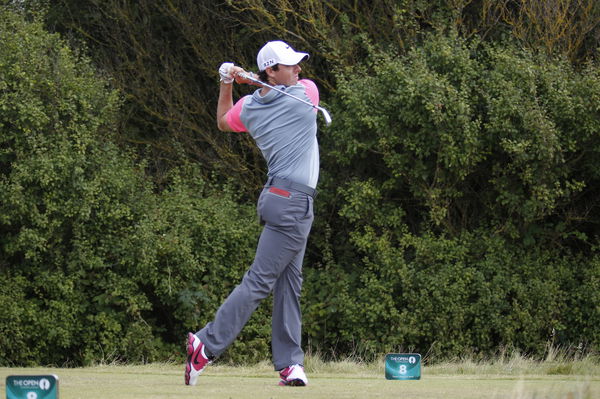
Imago
The 2014 Open Championship Rory McIlroy on his way to winning on the final day at the The Open Championship, Royal Liverpool, Hoylake, July 2014 Copyright: xMarkxNewcombex
To practice that accuracy, you can put a small dot a couple of inches in front of the ball. And instead of focusing on the ball, put your entire focus on the dot. This lets the body organize itself better, resulting in a ball-first, ground-second strike.
Written by

Edited by

Riya Singhal