
Imago
Man Putting on Golf Green PUBLICATIONxINxGERxSUIxAUTxONLY Copyright: xHorstxKlemm/xGreatstockx SP-088-0023G
Imago
Man Putting on Golf Green PUBLICATIONxINxGERxSUIxAUTxONLY Copyright: xHorstxKlemm/xGreatstockx SP-088-0023G
Putting is one of the crucial aspects of being a good golfer. So, how can you do it correctly? Well, one way is to work on your wrist movement. The reality is simple: your wrists move in every putting stroke. Now, you have to see if the movement is improving your game or not.
Watch What’s Trending Now!
Here are the 5 drills that can make your wrist movement smooth and help you reach the top of your putting game.
1. The T-Peg gate drill: Control your putter path
The online instructor Rob Cheney shared some tips on the YouTube channel Hack Motion. As per him, you put two tees on each side of the head of your putter. This makes a path for your clubface to follow. The drill focuses on a key issue: keeping your wrists from moving up or down during the stroke.
He explained, “If you want to control the amount of ulnar and radial deviation in your stroke, meaning the amount of upward or downward hinging of the wrists, having a gate for your putter to move through is the best exercise I can prescribe for you.”
Beginners should start with a wider gate. Players with more experience use tighter tolerances. As you get better, close the gap.


“As you progress and improve with this exercise, you’d want to be getting the T-pegs closer and closer together so that you’re getting the absolute centre of the putter when you strike the ball every single time,” he added.
This consistency affects both speed and direction control.
2. Practice without a target: Master your mechanics first
The next tip Cheney gave was not to stand next to a hole and worry about how many times you make it and how many times you miss it. Practice your strokes without aiming at anything. When there’s a hole, you stop thinking about the process and start thinking about the outcome, which often means giving up good technique.

Imago
LOUISVILLE, KY – MAY 17: Tiger Woods places his ball on the mark before putting on No. 2 during the second round of the PGA, Golf Herren Championship, May 17, 2024, at Valhalla Golf Club in Louisville, Kentucky.Photo by Matthew Maxey/Icon Sportswire GOLF: MAY 17 PGA Championship EDITORIAL USE ONLY Icon240517056
As he said, “Sometimes that can be very beneficial. It can really allow you to work on some feels and the mechanics that you’re trying to train.”
That way, you’re no longer judging success by whether the ball drops, but by whether you’ve executed the movement correctly. This accelerates skill development.
“Take that as an idea that maybe next time you practice your putting, don’t go and stand next to the hole and try to hole everything. If you’re working on some mechanics, literally go through the drill that you’re trying to do and take away the focus of the hole,” he added.
Build the foundation first. Results follow once the mechanics are good to go.
3. The suspension point drill: Find your center
The next piece of advice came from Danny Cowell and Kerrod Gray. According to them, one must record their stroke from the front. Make a line from the end of the shaft of your putter. This line checks your consistency. If it moves around while you’re putting, you’re adding variables that make it impossible to putt the same way every time.
The setup is straightforward: “If they simply just get a line, if they’re using an analysis tool, drew it from the end of the putter, more up towards the centre of the sternum.”
This reference point should remain stable throughout your motion. Check it in the backstroke, at address, and in the follow-through.
“A great visual reference that players can use there is simply just by videoing themselves from face on, drawing a line from the end of the putter shaft, try get that somewhere…just forward of center…in the backstroke within reason if they were to draw that line, same sort of position and then on the follow through, same sort of position.”
When this line stays stable, you’ve achieved harmony between body rotation and wrist action.
4. The alignment stick drill: Connect body and hands
The next tip from the playbook is to insert an alignment stick into your putter grip so it reaches your sternum. The stick gives you instant feedback as you stroke. If it moves around on your chest or pokes different spots, you are losing connection.
Imago
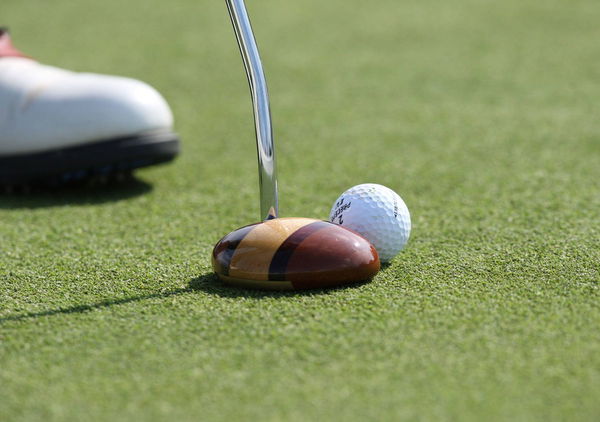
Bildnummer: 03940484 Datum: 10.09.2008 Copyright: imago/Chai v.d. Laage
Holz Golfschläger mit Ball; Vdig, quer, close, Detail Equipment, Spielgerät Sportgerät, Ball Golfball Schläger Schlägerkopf Mercedes Benz Championship 2008, European PGA Tour, ProAm, Pro Am, Köln Puhlheim Gut Lärchenhof Golf Herren Einzel Einzelbild Aktion Objekte Symbolfoto
Image number 03940484 date 10 09 2008 Copyright imago Chai v D Laage Wood Golf clubs with Ball Vdig horizontal Close Detail Equipment Gaming device Sports equipment Ball Golf ball Rackets Racket head Mercedes Benz Championship 2008 European PGA Tour ProAm Pro at Cologne Puhlheim well Lärchenhof Golf men Singles Single Action shot Objects Symbolic image
This is how it works: “If you used to drop the putter down and you used to get an alignment stick, if you used to stick the alignment stick from there, which would then stick into the sternum, as you would make your stroke, that alignment stick would follow.”
The stick tells you if you’re keeping the right connection between your body turn and your wrist movement. And the drill’s worth comes from how it feels.
“Just making a few strokes that will feel more or less movements depending on what their tendencies are. But again, it’s just giving them a feeling of…how the body and wrist position would feel.” You can do this at home without hitting balls.”
The feedback alone gives you the right feeling.
5. Keep your wrists soft; embrace natural movement
Don’t completely lock your wrists; leave them a little free. Because if you lock them, it kills the feel and makes things tense, which makes it hard to control distance. When you try to be delicate or accurate, you never stiffen your joints. Think about how you move when you do everyday things.
“In everyday life, with a creative pursuit, any other sport, use your fingers and the micro moves and the muscles to get a feel. You don’t have a throw from point A to point B and lock up your wrist.”
A small, natural hinge lets you feel the weight of the putter head and control its release through impact.
The goal is to find the right balance: “it’s a harmony of this upper body rotation, a softening of the wrists, and then it feels like it flows really beautifully back and forth. Feeling that upper body turn, wrists are nice and soft, not trying to get too stiff here. Feeling the weight of the putter head swing, I think, is a nice feel.”
These tips will help you master your putting game. Implement them and become the best.
Related Newsletters