
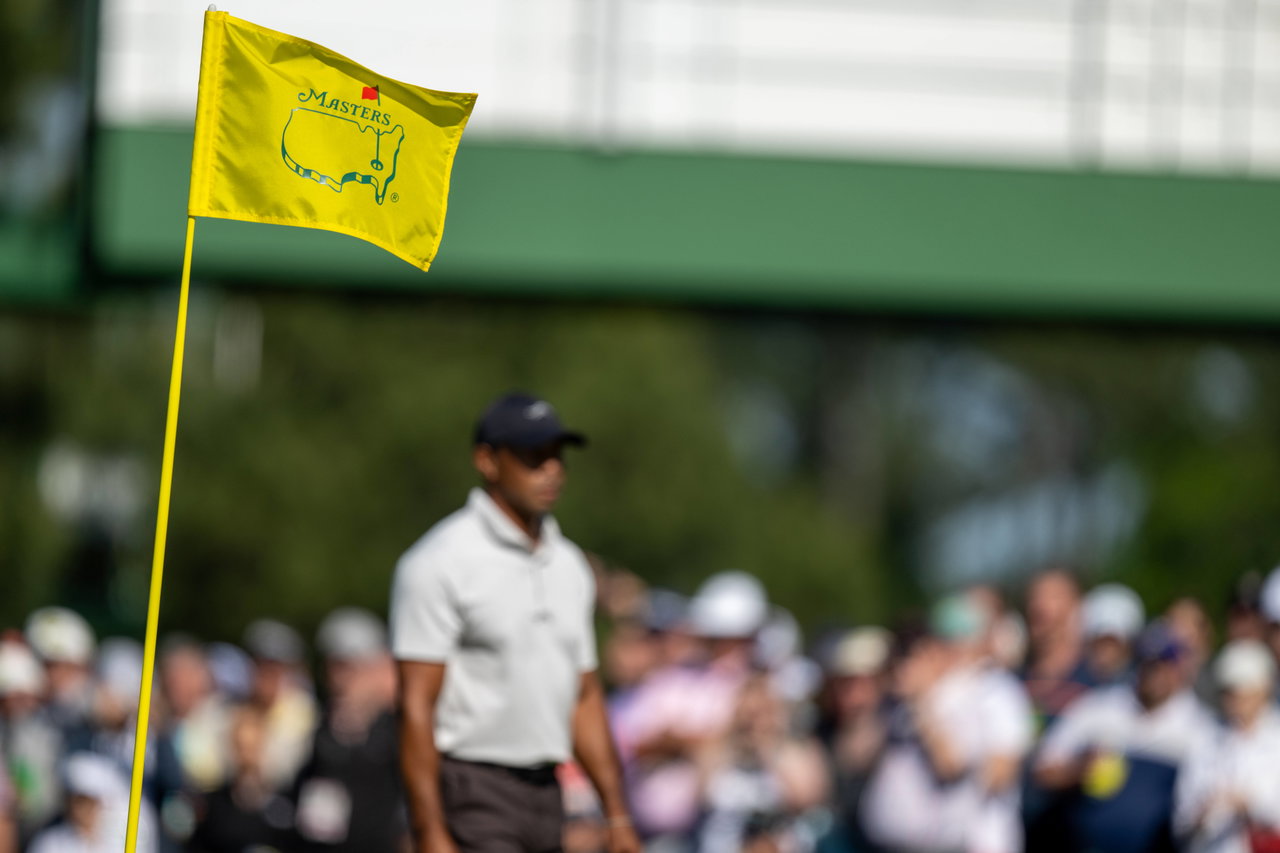
Every April, the world’s best golfers step onto one of the most beautiful yet brutal stretches. At the heart of it sits a 155-yard par-3 that has ended more Masters dreams than any other hole. This is Golden Bell, and it is anything but gentle. So, let’s learn more about this.
Watch What’s Trending Now!
Why is the 12th hole at Augusta National Golf Club called Golden Bell?
Every hole at Augusta National is named after a different flowering plant, and this has been the case since the course was first built. Clifford Roberts and Bobby Jones, the founders, embraced the land’s history as the site of Fruitland Nurseries. The names were chosen to show how the hole and the plant that grew there were both natural.
It wasn’t always called Golden Bell on the 12th. Originally called the Three Pines Hole, it was later renamed Golden Bell, which is much easier to say than its botanical name, Forsythia intermedia. This change was made to match each hole’s name to the surrounding plants.
There are names for every hole on the course that come from trees and bushes that grow on the hole. Some examples are magnolia, pink dogwood, flowering crabapple, and azalea. The tradition of naming gives Augusta its unique look and feel.
What is the golden bell at Augusta National?
Golden Bell is the 12th hole at Augusta National Golf Club. It is a par-3 that is usually 155 yards long. Even though it’s the shortest hole on the course, it is known for how hard it is and how precise it needs to be.
It is the center of Amen Corner, the most famous part of golf. This set of holes has historically had an impact on the results of The Masters Tournament.
Golden Bell isn’t just known for how far it is; it’s also known for its reputation. Many people think it is one of the most famous and closely watched holes in the sport, where every shot matters.
What is the role of the Golden Bell in the Masters Tournament?
Golden Bell does not simply punish bad shots. It punishes hesitation, poor wind-reading, and even good shots struck at the wrong moment.
In 1959, Arnold Palmer was seeking back-to-back Masters and had a two-shot lead in the final round, standing on the 12th tee. He took a triple bogey and could not recover.

12th hole at Augusta National 70 years apart. Still amazes me how much it has changed.

In 2016, Jordan Spieth held the final-round lead standing on the 12th tee. He had just made bogeys at the 10th and 11th holes, and his situation worsened with a quadruple-bogey 7 at the 12th. In the span of three holes, Spieth went from holding a five-stroke lead to trailing by three strokes.
In the 1996 Masters, Greg Norman’s double-bogey 5 on the 12th included a tee shot into the water. It marked the first time since Thursday that Norman, who had a six-shot lead entering the final round, had not led the Masters. He would not lead again, finishing second to Nick Faldo on a Sunday that saw an 11-shot turnaround at the top of the leaderboard.
Where is Golden Bell located on the course?
Golden Bell is framed by vibrant azaleas and bordered by Rae’s Creek in front. It is a deceptively serene setting that hides one of the game’s most nerve-wracking shots. The tee shot must carry over the water to a green that is narrow and angled, leaving almost no room for a ball drifting short or wide.
The iconic Ben Hogan Bridge, dedicated in 1958 to recognize the Texan’s then-record score of 274 in 1953, serves as a walkway across Rae’s Creek to the green. Players cross the bridge only after committing to the shot, making it one of golf’s most theatrical walks.
With its swirling winds, the 12th hole forces a player to commit to a number. The tee shot at 13 tempts you into shaping the ball around Rae’s Creek for a chance at eagle. Sitting between a punishing par-4 11th and a scoring opportunity at the par-5 13th, Golden Bell arrives at exactly the moment when players most want to protect their card. That timing is what makes it so unforgiving.