
Imago
TIGER WOODS Arnold Palmer tips his hat to the crowd before he tees off on the first hole during the Pro-Am tournament at the Arnold Palmer Invitational at Bay Hill Club & Lodge in Orlando, Florida, Wednesday, March 25, 2009. Stephen M. Dowell/Orlando Sentinel/MCT Orlando FL USA EDITORIAL USE ONLY Copyright: xx 1071223 StephenxM.xDowellx krtphotoslive349544
Imago
TIGER WOODS Arnold Palmer tips his hat to the crowd before he tees off on the first hole during the Pro-Am tournament at the Arnold Palmer Invitational at Bay Hill Club & Lodge in Orlando, Florida, Wednesday, March 25, 2009. Stephen M. Dowell/Orlando Sentinel/MCT Orlando FL USA EDITORIAL USE ONLY Copyright: xx 1071223 StephenxM.xDowellx krtphotoslive349544
In 1961, a meeting in Ligonier, Pennsylvania, was stuck. Crossed golf clubs were dismissed as too common, and Laurel leaves were already taken. Arnold Palmer, frustrated, stepped outside into the rain. When he returned, he brought back the idea that would become one of the most recognizable marks in sports.
Watch What’s Trending Now!
Palmer saw a woman open a multi-colored umbrella as she got out of her car. He suggested using it as the logo for Arnold Palmer Enterprises. There was immediate doubt, with concerns that an insurance company had probably already trademarked it. Lawyers checked and found no one had claimed a multi-panel colored umbrella. The four-panel design in red, yellow, white, and green was available. Palmer later described the idea plainly.
“The umbrella was just an idea I came up with late one afternoon so I could hurry a meeting along.”
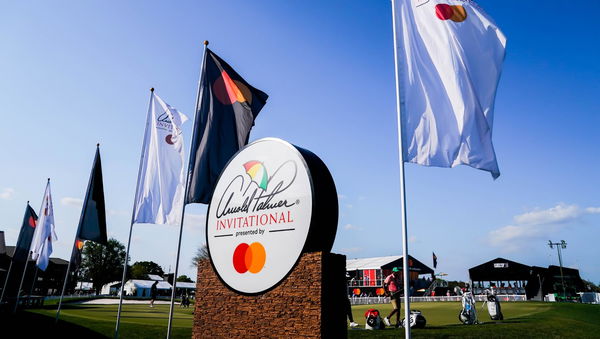
Imago
Mandatory Credits: via Arnold Palmer Invitational
In the same year, Bay Hill Golf Club opened in Orlando, Florida. Palmer would later buy the course in 1975 and make it the permanent home of his main PGA Tour event.
By 1967, Palmer had 13 businesses under the umbrella logo, including dry cleaning, ice skating rinks, and apparel. The logo was officially trademarked in 1968, but had already been in use since its creation.
Today, Arizona Iced Tea produces over 400 million cans of Arnold Palmer-branded drinks each year, and the brand has 400 retail locations in Asia. The umbrella logo is on the Bay Hill championship trophy, the Pro-Am hardware, and the red cardigan awarded to winners after Palmer’s death in 2016.
The meaning of the umbrella logo developed over time. Fans began to see it as a symbol of Palmer’s protective role in golf, a view that grew naturally without any official push from Arnold Palmer Enterprises.
Arnold Palmer’s Umbrella and Golf’s Other Accidental Icons
The PGA Tour’s logo, a golfer mid-swing, has always been a composite. The Tour says there is no single player or moment behind it. Over the years, fans have guessed Ben Hogan, Bobby Jones, and Johnny Miller, but the Tour has never confirmed or denied any of them.
The official line is that the silhouette was meant to be timeless, not tied to any one player. That decision has left things ambiguous, and the Tour has never moved to clarify it. For an organization representing hundreds of professionals, that may be exactly what they want.
Merion Golf Club’s wicker basket flagstick, designed by head professional Bill Kittleman in the early 1900s, became the club’s defining secondary mark without that outcome ever being the intention.
Wick Golf Club in Scotland, founded in 1870, chose a Norse longship carrying Odin’s Raven, drawn directly from Viking history along its northern coastline.
Many of golf’s most lasting symbols were started by accident. A design committee could not agree, or someone needed a flagstick that worked. Sometimes, a club just used what was around. These symbols were not planned out in detail. They just happened, like most good things do.