
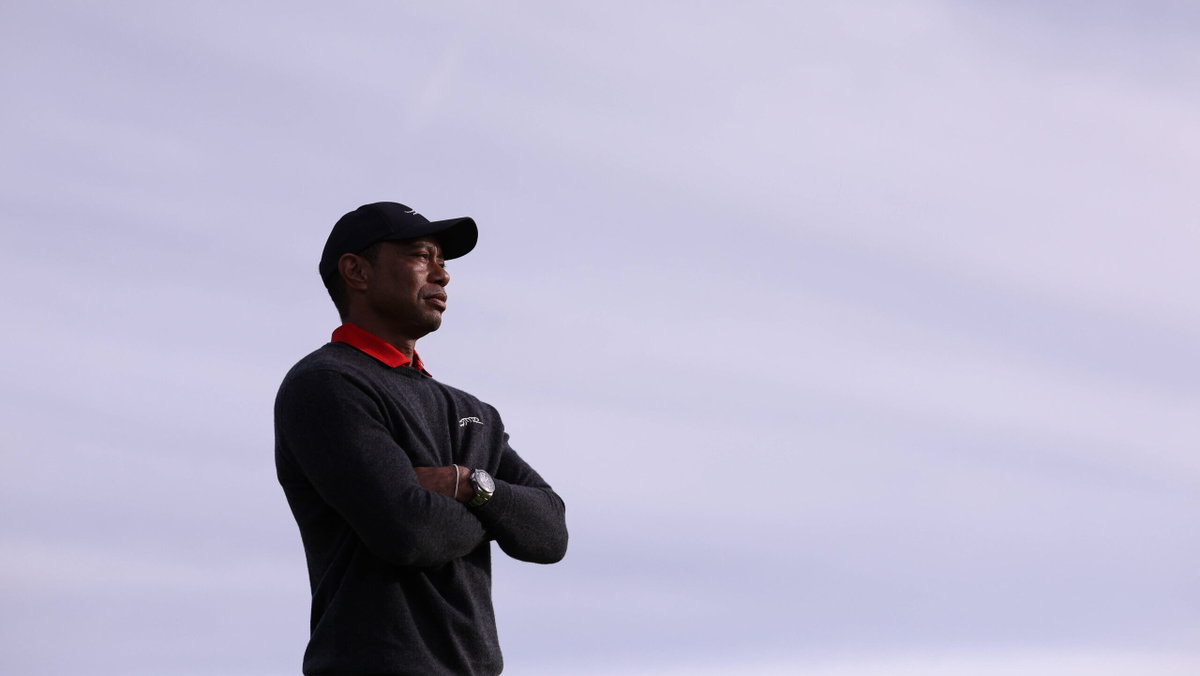
The summer of 2000 in golf felt less like a sport and more like a coronation. Tiger Woods had already won the U.S. Open at Pebble Beach by 15 shots and the Open Championship at St. Andrews by eight. Coming into Valhalla Golf Club in Louisville, Kentucky, the world was watching a man who simply didn’t seem beatable. Then came Bob May.
Watch What’s Trending Now!
Woods won the 2000 PGA Championship at 18-under-par 270, defeating May in a three-hole aggregate playoff. Woods went birdie-par-par in the playoff to edge May, who matched pars on all three holes. It was his third consecutive major title of the year. Tiger Woods had to birdie seven of the final 12 holes in regulation just to force extra holes, something no opponent had pushed him to in any previous major.
That week, Sunday dawned in Valhalla with the air of an ending age. In the first two rounds, Woods was paired with Jack Nicklaus, who was playing his final PGA Championship. It was the first time the two had competed together in a tournament. Woods opened with a 66, sharing the first-round lead, then shot a 67 to take the outright lead. Nicklaus missed the cut by a shot and praised Woods afterwards.
“He is so much better than I thought he was. It just absolutely amazed me.”
When Nicklaus walked off after round two, he recalled thinking, “Man, you need to pass the baton. You can’t compete in this anymore.” The man who showed him that was Tiger Woods.
Meanwhile, Bob May had opened with an even-par 72, five shots back. Nobody was particularly watching him. He was a 31-year-old golfer who had split time between the PGA Tour and European Tour without a single PGA Tour win and was ranked 48th in the world. But he and Woods went back further than most people knew. The two had first crossed paths as juniors in Southern California.
Imago
Credit: IMAGO / Icon Sportswire
May established himself as the junior star in Southern California, while a young Woods was still limited to playing only nine holes. Woods grew up chasing May’s records. So, when they met at Valhalla, Bob May was candid.
“I was hoping maybe I could get a chance to get back at him.”
He shot a bogey-free 66 in the final round, his third straight 66 of the week. He led from the second hole of the day, going two shots up on Woods through six holes while Woods dropped two bogeys. The galleries, who barely knew his name at the start of the week, were cheering for him by Sunday afternoon. Bob May later turned to Tiger Woods and asked him an important question.
“Is this what you get every week?”
Woods clawed back, birdieing seven of the last 12 holes, but May met him at every turn. Both shot a 5-under 31 on the back nine in regulation, with no bogeys between them. On the 18th, both men reached the par-5 green in two. May holed an 18-foot birdie putt from the fringe, fist-pumping as he retrieved the ball. Woods, needing a birdie to stay alive, faced a slick, sliding 7-footer. He made it. Woods later called it the most important putt of his career.
“Considering the circumstance, the pressure, how fast that putt was, and the break, that was the one,” he told Golfweek. “Dead center.”
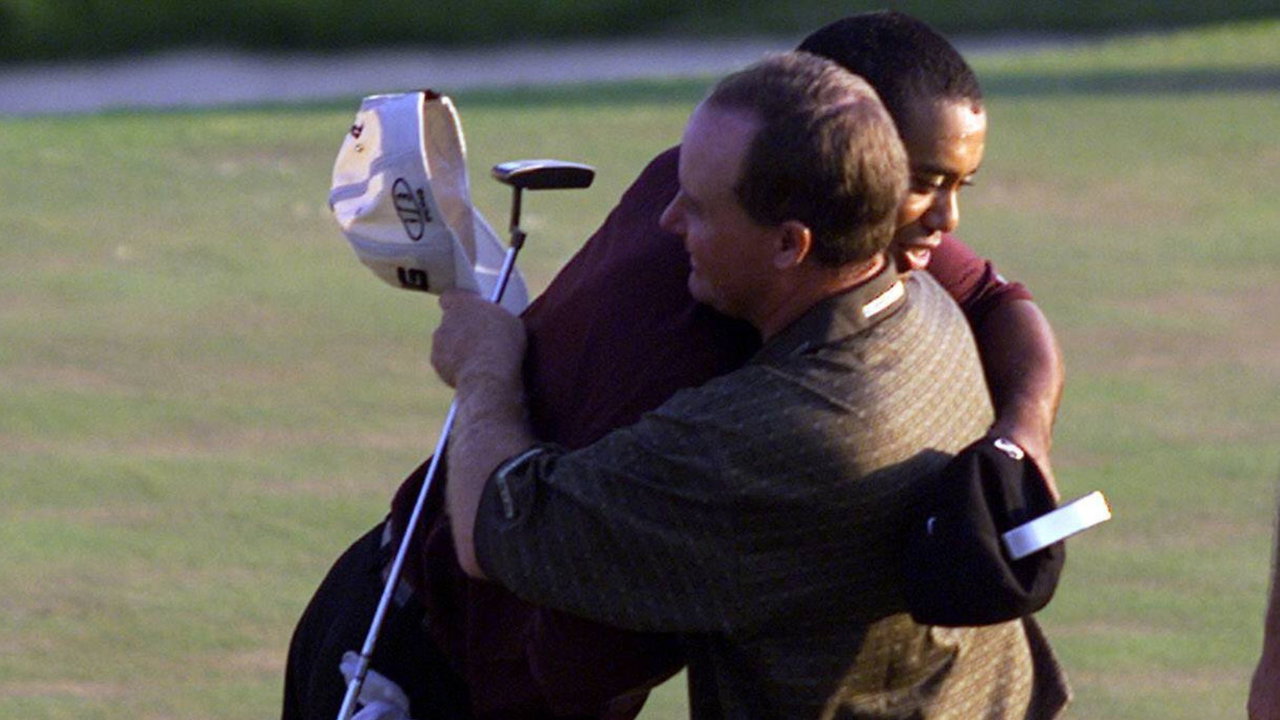
The playoff began on the 16th hole, and it was here that the defining image of the week was created. Woods hit a 2-iron to the fairway, hit his approach onto the green, and rolled in a 25-footer for birdie. The golfer didn’t just sit and watch. He quick-stepped after the ball to the hole and pointed as it fell.
The records: The third leg of the Tiger Woods slam
With that win, Tiger Woods became the first player since Ben Hogan in 1953 to win three professional major championships in a single season. He had held at least a share of the lead in every round of the tournament.
The victory also meant Woods held the scoring record in all four majors, having won three of them in nine weeks. His combined score across the four 2000 majors was 35 shots better than any comparable run in history. It was the third leg of what would be called the Tiger Slam. When he added the Masters in April 2001, Woods became the first player ever to hold all four major trophies simultaneously.
Woods’s coach, Butch Harmon, said after the round, “What Bob May did was unbelievable. It’s too bad they can’t give out two Wanamaker Trophies.”
May finished with $540,000, a runner-up, and something harder to quantify.
“If I had won, it would have been a dream come true,” he said. “Not only to win a major, but also to beat perhaps the best golfer ever. I went head-to-head with him and lost in a playoff.”
For one week in August 2000, the game offered something it rarely did—a fair fight.