Imago
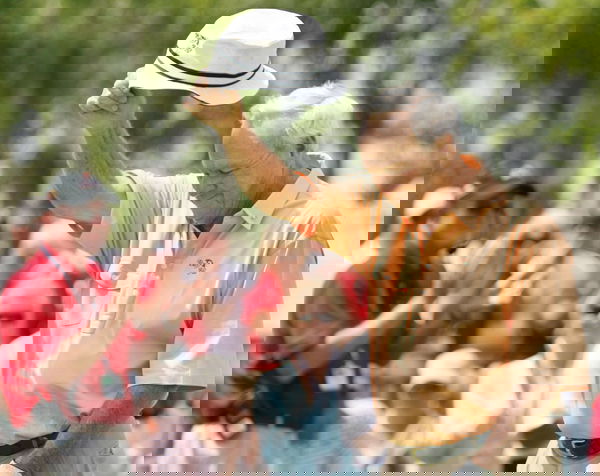
TIGER WOODS Arnold Palmer tips his hat to the crowd before he tees off on the first hole during the Pro-Am tournament at the Arnold Palmer Invitational at Bay Hill Club & Lodge in Orlando, Florida, Wednesday, March 25, 2009. Stephen M. Dowell/Orlando Sentinel/MCT Orlando FL USA EDITORIAL USE ONLY Copyright: xx 1071223 StephenxM.xDowellx krtphotoslive349544
Imago
TIGER WOODS Arnold Palmer tips his hat to the crowd before he tees off on the first hole during the Pro-Am tournament at the Arnold Palmer Invitational at Bay Hill Club & Lodge in Orlando, Florida, Wednesday, March 25, 2009. Stephen M. Dowell/Orlando Sentinel/MCT Orlando FL USA EDITORIAL USE ONLY Copyright: xx 1071223 StephenxM.xDowellx krtphotoslive349544
In the late 1950s, businessmen Tom Barnes and Tom Dore first started the construction under architect Dick Wilson after being fascinated by the potential of the area. Then, in 1961, Bay Hill first opened its gate. There hasn’t been much development that happened in the first few years until Arnold Palmer visited the club to compete in a charity exhibition in 1965.
Watch What’s Trending Now!
Palmer shot 66 in the match on February 28, 1965, to tie the course record and beat Jack Nicklaus by seven shots. Palmer immediately fell in love with the raw beauty of the rolling hills of the course and famously told his wife, Winnie, that he had just played the best golf course in Florida, and he wanted to own it.
And in 1970, Palmer showed he meant every word he said when he signed a five-year lease on Bay Hill with an option to purchase. Five years later, he exercised that option and made Bay Hill his winter home. Bay Hill’s rustic locale appealed to Palmer, and he brought a PGA Tour event in 1979. And Bay Hill became a PGA Tour venue with an event that formerly played at Rio Pinar Country Club.
“I realized that this indeed was a way I could give something valuable back to the PGA Tour, which has been so very good to my family and me,” Palmer said of his decision.
Throughout the year, he redesigned the course and modified it several times with the help of golf architect Ed Seay. And in 2007, the PGA Tour officially renamed the event in Palmer’s honor. Working with Seay, the legendary golfer tinkered with the holes almost every single summer. For instance, he converted Wilson’s 18th hole from a par 5 into a brutal par 4, which played to a new 60-yard-long green that curved along a pond.


Many legends have conquered these tough fairways to win the famous red cardigan throughout the years. Most famously, Tiger Woods won here a record eight times during his most dominant years and stands foremost among them. Arnold Palmer himself won twice. Some other legends on the list are Jack Nicklaus, Sam Snead, Ernie Els, Fred Couples, and Payne Stewart. Rory McIlroy took the title in 2018 shortly after Arnold Palmer’s death. And the #1 Scottie Scheffler is a two-time winner, with victories in 2022 and 2024.
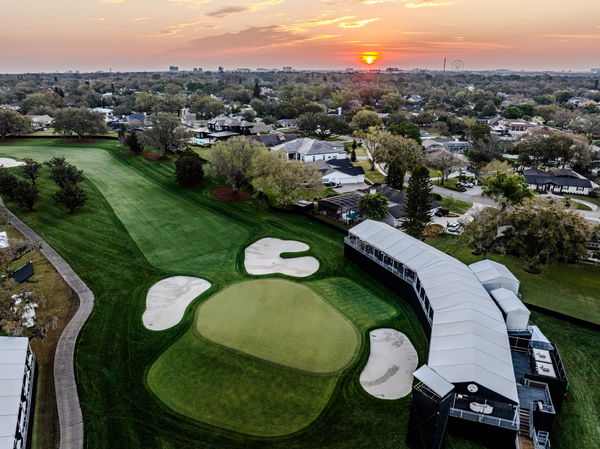
In 2024, the Arnold Palmer Invitational became one of the exclusive Signature Events on the PGA Tour with a lucrative $20 million purse, where the winner will walk away with $4 million. And this year, the event returns to Bay Hill once again on March 5.
Everything we have discussed so far is about the famous era after Arnold Palmer arrived. But the history before Palmer’s arrival is just as interesting and quite mysterious.
The secret architect of the Bay Hill course: Who actually built this magic place?
Bay Hill’s design is always debated because of its similarities with The Dunes Club at Myrtle Beach, designed by Robert Trent Jones. But who the actual architect of the Bay Hill’s design is is equally debated. Ron Whitten from Golf Digest always gave credit to Wilson for the design in his book The Golf Course, which was first published in 1981. But the authorship of Bay Hill has been contested for years.
Another architect named Thomas F. Barnes, who saw Whitten’s book, claimed he actually designed the entire Florida course. But Whitten, as a lawyer at the time, tracked down 2 eyewitnesses to find the real story behind these claims. Robert C. Mathews was one of those who lived at Bay Hill at the time and later became a part of the “Nashville group” of investors who gave Barnes the money to construct the course.
“After we put the money up,” Mathews told Whitten. “Barnes went to Japan and Europe using our money, so we kicked him out.”
He later confirmed who actually designed Bay Hill, saying, “Barnes had an architect; I can’t remember who it was, but we objected to him. ” So then Barnes suggested Dick Wilson, and we approved.”
Another witness was Bob Simmons, a club pro-turned-course builder who had his own golf design firm by then, based in Kokomo, Ind. Simmons had a similar and strong opinion about the design claim.
“That’s a damned lie, and you can quote me on that,” Simmons said when informed that Thomas Barnes was insisting he designed Bay Hill.
The mystery grew in 1993 when a local newspaper, the Orlando Sentinel, published a two-page article by staff writer George White entitled “Who Built Bay Hill,” with a big picture of Barnes holding open a scrapbook. Barnes pointed to old articles that called him the creator of the course. But those stories used Barnes as the only source for that specific information.
And as the story unfolded, it wasn’t tough to understand who the actual architect of this famous course was.
Back to the current story, one can watch every story unfolding in the API 2026 in these famous courses starting this Thursday on the Golf Channel. But before that, fans can enjoy the Featured Groups events featuring Rory McIlroy, Xander Schauffele, Scottie Scheffler, and several others.
Related Newsletters