
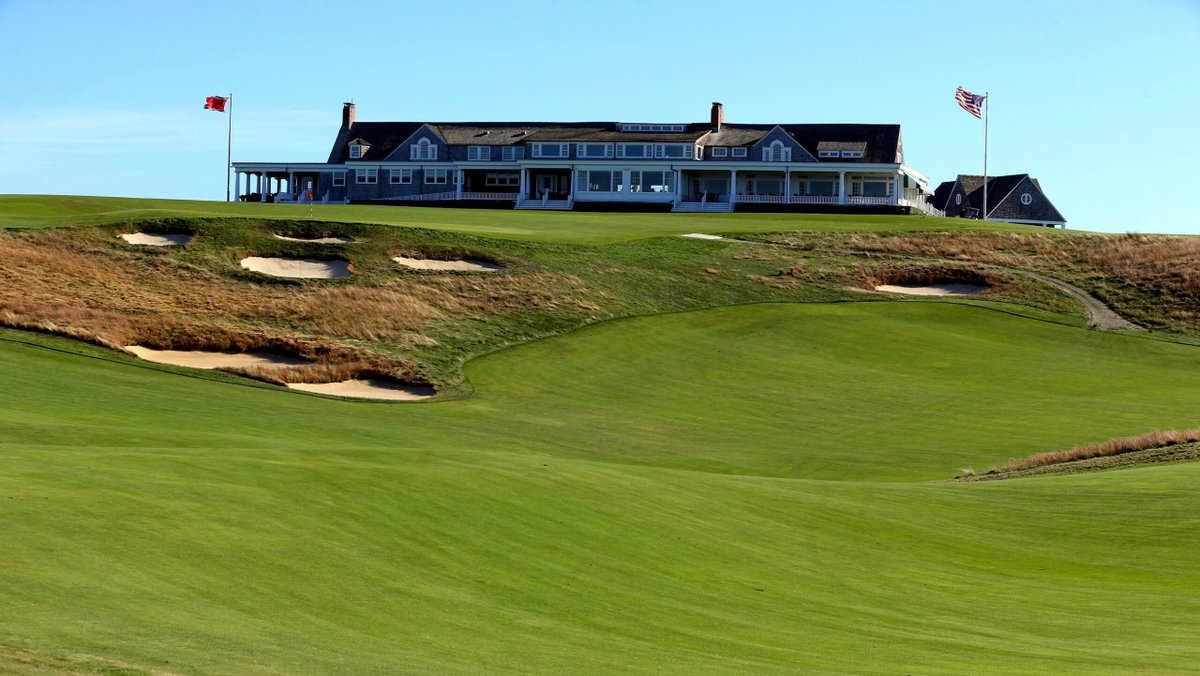
The USGA’s history with the Shinnecock Hills goes way back. America’s oldest incorporated country club hosted the second US Open and second US Amateur in 1896. Overall, this week marks the 10th time Shinnecock has held a USGA Championship. The course has previously held championships like the U.S. Women’s Amateur (1900), U.S. Senior Amateur (1967), the Walker Cup (1977), and five U.S. Opens (1896, 1986, 1995, 2004, and 2018). As the Shinnecock Hills gets ready to host the 126th edition of the U.S. Open as well, let us get to know a bit more about this golf course.
Watch What’s Trending Now!
Prestigious history of the Shinnecock Golf Club
Originally, Shinnecock was a twelve-hole golf course and was designed by Willie Davis. It was expanded to eighteen holes in the spring of 1895. It was then revised four times, and the present course was designed by William Flynn.
Flynn did his work in 1931 and was known to incorporate natural features in his designs. There is a stretch of three holes here that form a triangle, and it is configured in such a way that no matter how little or how much wind there is, golfers will face shot-making challenges.
The Course Setup of the 2026 U.S. Open Venue
Shinnecock Hills is a par 70 course at 7,440 yards. As per the PGA Tour, this is the same distance the course played in the 2018 U.S. Open, but one big difference is that the fairway lines now extend closer to the bunkers.


Shinnecock Hills then… and now. 1896 ➡️ 2026

Three Most Difficult Holes at the Shinnecock
11th Hole
It is a par-3 hole that stretches to 157 yards. Lee Trevino famously called it ”the shortest par 5 in golf.”
What makes this hole difficult is that it has the smallest green, only 4,280 square feet, but it is also the elusive one. All thanks to a 17-foot climb from tee to green. This hole punishes approach shots upon landing.
The 11th hole is protected by four deep bunkers at the front. Golfers can aim long and left to avoid trouble, but that leaves a difficult recovery shot that must be played over obstacles. It can be hard to judge it accurately. The green sits at the highest point on the course, about 72 feet above sea level. Because of its elevated position, it is the most exposed area on the course and is often affected by strong winds. Overall, success at “Hill Head” depends as much on staying calm under pressure as it does on making a good golf swing.
14th hole
This is par 4, stretched at 520 yards, and is the toughest hole in relation to par at the 2026 U.S. Open.
According to the PGA Tour’s Bradley S. Klein’s report, it was also the most difficult hole during the 2018 U.S. Open, as players averaged 4.74 strokes on this hole.
This one plays downhill from the tee, dropping about 40 feet to the fairway. The fairway creates a major challenge as it slopes from right to left, even though the hole bends slightly from left to right. Golfers can try to carry the bunker on the right side of the fairway with a 284-yard drive, but that brings a deeper bunker on the left into play.
If the drive finds the fairway, golfers will have to hit an approach shot that is around 200 yards. This shot will have to be uphill, and bunkers guarding the greens will have to be avoided. Green is less complicated here, but missing the fairway off the tee often leads to a bogey or even worse.
16th hole
This one is a par 5 and is 614 yards. There are twenty bunkers on this hole, and half of them are on the putting green, and the remaining half are scattered strategically at the tee shot and second shot landing zones. Players have to be really careful throughout to avoid the bunkers.
With such a difficult and iconic course, who do you think will emerge victorious at the U.S. Open 2026? Share your picks below.