
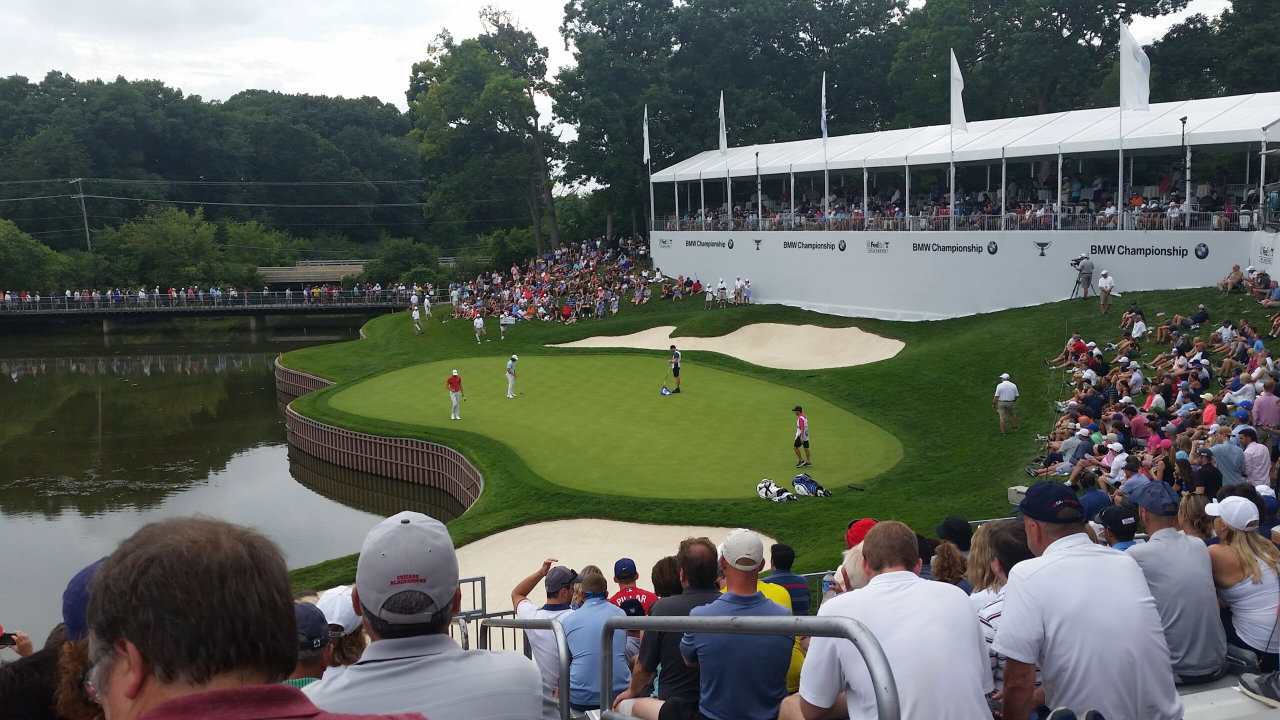
Medinah will host the 16th Presidents Cup in 2026. The club has already hosted the U.S. Open, PGA Championship, and Ryder Cup—a historic first. Its famed Course No. 3 has a storied history of hosting iconic tournaments and major championships. It hosted the U.S. Open in 1949 (Cary Middlecoff), 1975 (Lou Graham), and 1990 (Hale Irwin); the PGA Championship in 1999 and 2006 (both won by Tiger Woods); and the Ryder Cup in 2012. As Medinah Country Club prepares to host its first Presidents Cup, let’s take a closer look at this iconic golf course.
Watch What’s Trending Now!
The Historic Legacy of Medinah
The Medinah Shriners, members of the Ancient Arabic Order of the Nobles of the Mystic Shrine, founded Medinah Country Club in 1924 as a private country retreat and golf destination in suburban Chicago, Illinois.
Medinah Country Club has over 1,100 members across 640 acres, featuring three golf courses, Lake Kadijah, swimming facilities, a golf learning center, a golf shop, a gun club, a racquet center, and a distinctive Byzantine-style clubhouse inspired by a mosque, with Moroccan domes, minarets, and Moorish architectural details.
Renowned Scottish golf architect Tom Bendelow designed Medinah’s three 18-hole courses:
- Course No. 1: Opened in September 1925.
- Course No. 2: Opened in 1926 and restored to its original design in 2017.
- Course No. 3: Opened in 1928 and went on to become one of the world’s most celebrated championship courses.
The Course at the 2026 Presidents Cup
The Presidents Cup will feature a significantly transformed Medinah Country Club Course No. 3, redesigned by OCM in 2024 with larger greens, expanded bunkers, wider fairways, and extensive areas of long fescue rough.
The organizers have selectively cleared tree lines around multiple holes to open vistas, extend fairways, and better showcase Medinah’s rolling topography.
The previous layout featured three par-3s playing directly toward Lake Kadijah. The revised course replaces them with a short, flexible par-3 that runs alongside the lake, creating greater directional variety and a more dynamic routing.
The layout introduces a potentially drivable diagonal par-4 that rewards long hitters, while the revamped 18th has been lengthened by 50 yards to create greater tension and more dramatic match-play finishes.
Plus, the developers restored and enlarged the original intricate bunker forms, which added greater strategic challenge for elite international and U.S. team players.
Medinah Course No. 3: Holes That Demand the Most
Hole No. 5
No. 5 at Medinah gives the players their first par five of the round. At 536 yards, it is within reach in two for everyone, but the elevated, bunker-protected green makes the approach anything but straightforward.
The strategic decision begins on the tee. Players face a strategic choice: attack with a driver and iron, or lay back with a hybrid for control. That will influence captain pairings and could decide early matches.
It is also a hole that could influence each captain’s team selections, particularly when pairing players with contrasting styles. With eagle very much in play, the side that can take advantage of No. 5 could gain an early edge in the match.
And the challenge is as much psychological as physical. In a team match, a shaky start can quickly become costly, with two holes—and potentially two points—gone before a side could settle.
Hole No. 17
As the round closes, No. 17 could prove decisive in several matches.
No. 17 is another superb par-3, demanding a full 193-yard carry over water to a green guarded by bunkers short right and back left. The prudent play is toward the back left portion of the green, away from the water and the more dangerous pin position.
Trailing teams must challenge the pin, bringing water into play—a high-risk, high-reward decision.
That is where Medinah can bite. A bold decision can instantly change the match, and some contests may conclude before the players reach the 18th tee.