
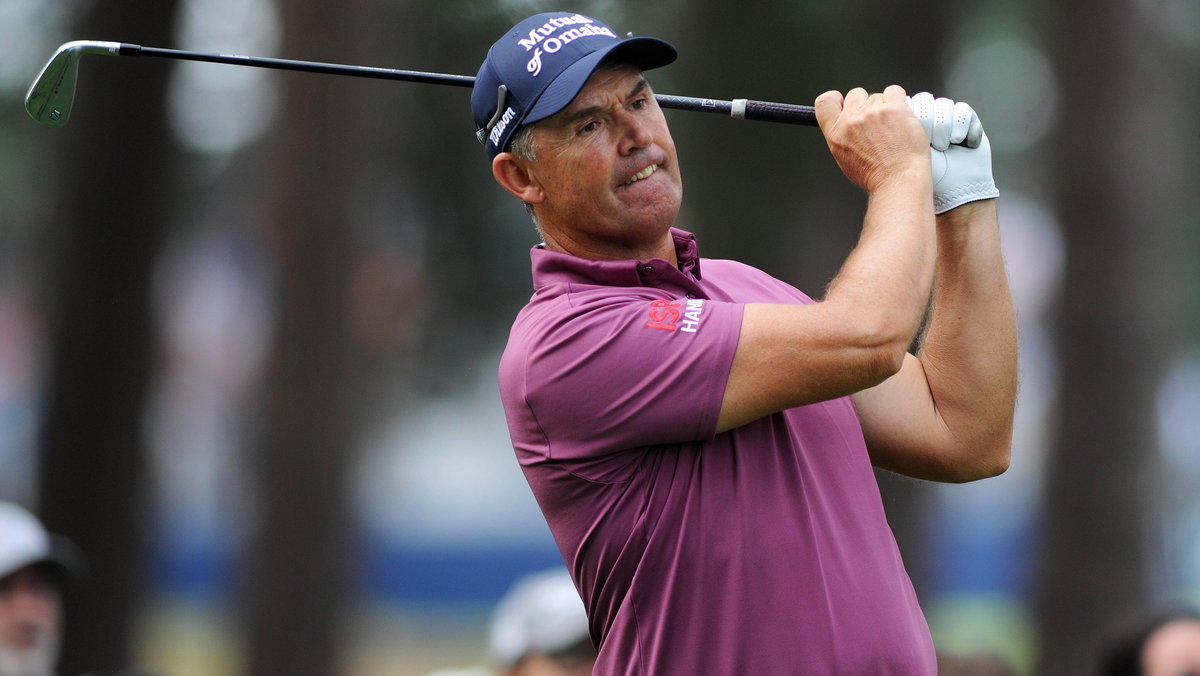
There are still 39 months before the golf ball rollback takes effect for both professional and recreational players. Yet, the rule has already sparked a divide among fans. While some believe it is a necessary step for the sport, others see it as an attempt to undermine the game. Amid the debate, Ireland’s Padraig Harrington is clear about one thing: how the change will affect the enjoyment of golf.
“So happiness and our idea of playing well is 100% related to what we expect at that moment,” Harrington said in an interview with Kick Point: The Golf Gear Show. “… It’s all relative to what we expect at that moment. So once the equipment is rolled back, within a couple of weeks or months, [it] won’t make a shred of difference to anybody’s enjoyment of the game.”
Harrington explained that a golfer’s sense of achievement depends on their expectations rather than the distance they hit the ball. For instance, if two players typically hit the ball 300 yards, hitting it 310 yards would feel like an accomplishment. However, if the rollback reduces their usual distance to 280 yards, hitting it 290 yards would still provide the same satisfaction.
He added that the same principle works in reverse: if a golfer expects to hit the ball 350 yards but manages only 340, they would feel disappointed, even though that distance is considerably longer than what they might achieve with rolled-back equipment.
The idea was first introduced in March 2023 by the USGA and the R&A to address the growing distances golfers were hitting the ball. The proposed rollback, introduced through a Model Local Rule (MLR), was intended for elite professional competitions. Its primary goal was to protect historic golf courses and preserve the strategic variety of the game.
The proposal would change the Overall Distance Standard (ODS) testing conditions used to determine whether a golf ball conforms to the Rules of Golf. By testing balls at higher swing speeds, manufacturers would have to redesign them to travel shorter distances under the new conditions. The impact was expected to be greatest for the longest hitters, while remaining relatively minimal for most recreational golfers.
However, the proposal quickly sparked controversy and drew considerable backlash. In December 2023, the governing bodies abandoned the elite-only approach in favour of a universal rollback that would apply to all golfers. Under the revised plan, the new testing standard was scheduled to take effect in January 2028 for professional golfers and January 2030 for recreational players.
But on the eve of the U.S. Open, the USGA, R&A, PGA Tour, and DP World Tour issued a joint statement announcing that the current ODS testing approach would remain unchanged until January 2030. The decision followed industry feedback favouring a single implementation date over the proposed phased rollout.
That said, while Padraig Harrington doesn’t appear too bothered with the rule, some PGA Tour pros have some problems with it. According to Golfweek, Justin Thomas questioned whether a golf ball rollback was necessary in the first place. He believes most Tour players share his view that the ball is not a problem.
In his eyes, course architecture is the bigger point of concern. Thomas pointed to architects removing hundreds of trees from courses, arguing that such changes have a greater impact on strategy and how players approach a course. Meanwhile, Maverick McNealy questioned both the need for a rollback and whether the proposed changes would achieve their purpose.
Even if distance gains need to be addressed, McNealy believes the governing bodies have taken the wrong approach. He argued that the proposed testing changes would not deliver the desired results.