
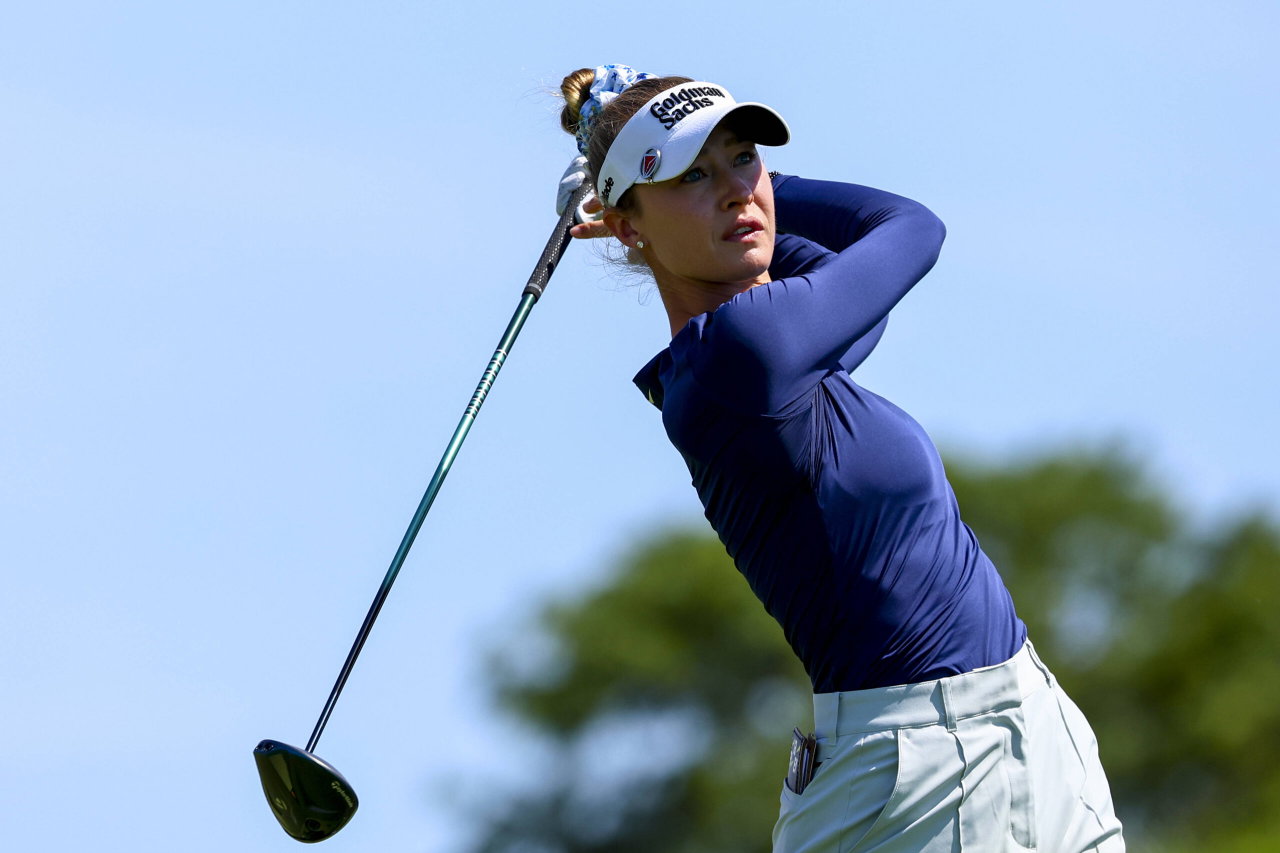
Nelly Korda knows what a flow state feels like when she’s swinging well. She also knows exactly what would break it. The world No. 1 recently sat down with WHOOP founder and CEO Will Ahmed on his podcast. The conversation turned into a candid breakdown of just how personal a golf swing, or the sport for that matter, really is.
Watch What’s Trending Now!
Ahmed brought up the mental side of the game. He asked if she ever thinks in real time about coming a little more inside because of what she needs to feel. Korda’s answer was immediate. “Yeah, flow state for sure,” she said.
Asked to imagine narrating a swing thought mid-motion, she made a swish sound before responding. “Then I would be like, four right, four left. Like that’s the worst recipe for me.” She then added that great athletes often struggle to become coaches because it’s hard to explain what you’re feeling, since it’s just very unique to every person.
Hearing that, Ahmed directly asked her, using Bryson DeChambeau‘s approach to tournaments as an example, whether it looks completely crazy to her. Korda chuckled before answering, “Yeah, I don’t relate to kinda what he does,” she said. “But everyone, I would say everyone, has their own recipe, right? And whatever you kind of toss in, you gotta be confident in what you do, and it works for him. But it definitely wouldn’t work for me.”
The word “recipe” is the real crux for Korda here. She didn’t dismiss DeChambeau’s methods in particular. Instead, she believes that importing someone else’s system wholesale would actively wreck what she has. In fact, it would do the same to any player. Following Bryson’s mechanical count-it-out approach would be, in her framing, a recipe for disaster, not because the method is wrong, but because it was never built for her style of game.
Notably, this isn’t the first time Korda has drawn the exact contrast. In an interview with Goldman Sachs CEO David Solomon, she said she can’t be a “robot” golfer the way DeChambeau is, pointing out that leaning too hard into swing data costs her the instinct she relies on. Earlier, in an appearance on the Golf Channel with Gary Williams, she was even more blunt about it. She explained that when she starts feeding herself technical numbers, she loses her feel entirely. DeChambeau, by contrast, treats himself as a “great experimenter,” constantly tinkering with launch monitors and data, as many are aware.
Moreover, Korda has incorporated her own quirks into her game as well. On the Pat McAfee show earlier this year, she credited a childhood cue from her father for the tempo that now defines her swing. He’d simply say “Coca-Cola” during practice. It’s a rhythm cue with no numbers attached, and Korda said it’s still the foundation of her swing today. When she moves her club backwards, it’s with the rhythm “Coca,” and when it comes forward, it’s “Cola” for her.
Another piece of her feel is trust in repetition rather than adjustment. The world No. 1 has said she can spot the smallest flaws in her own swing in real time, whether her hips are a touch too tall or her tempo is slightly off. Yet she consistently chooses to revert to the same tendencies rather than chase a technical fix. That instinct to stay with what’s already working, even when she can see the imperfections, is the clearest evidence of the philosophy she laid out.
Confidence matters just as much as the cues and techniques, Korda adds. Beyond her feel-based swing, Korda has spoken about a ritual that she leans on: a bathroom Post-it note. She relied on it during the 2026 U.S. Women’s Open run. She writes herself a positive note each morning and sticks it to the mirror, a habit she picked up from watching other athletes.
“I travel with Post-it notes and stick them to the mirror when I get ready, and I write myself a positive note, and that’s my thought for the week,” Korda said. By her own account, it was central to the mindset shift that carried her to the title.
That being said, Nelly Korda isn’t alone in defending a feel-based approach. Sergio Garcia has made a similar case for his own swing, one that coaches have long flagged as unconventional. He said outright that his swing isn’t perfect and that he knows it, but that golf is played largely by feel, and if something works, there’s no reason to change it.
As more players lean into DeChambeau-style data and launch-monitor tinkering, Korda’s stance is a bet that feel still beats formula — and her results so far back it up.