
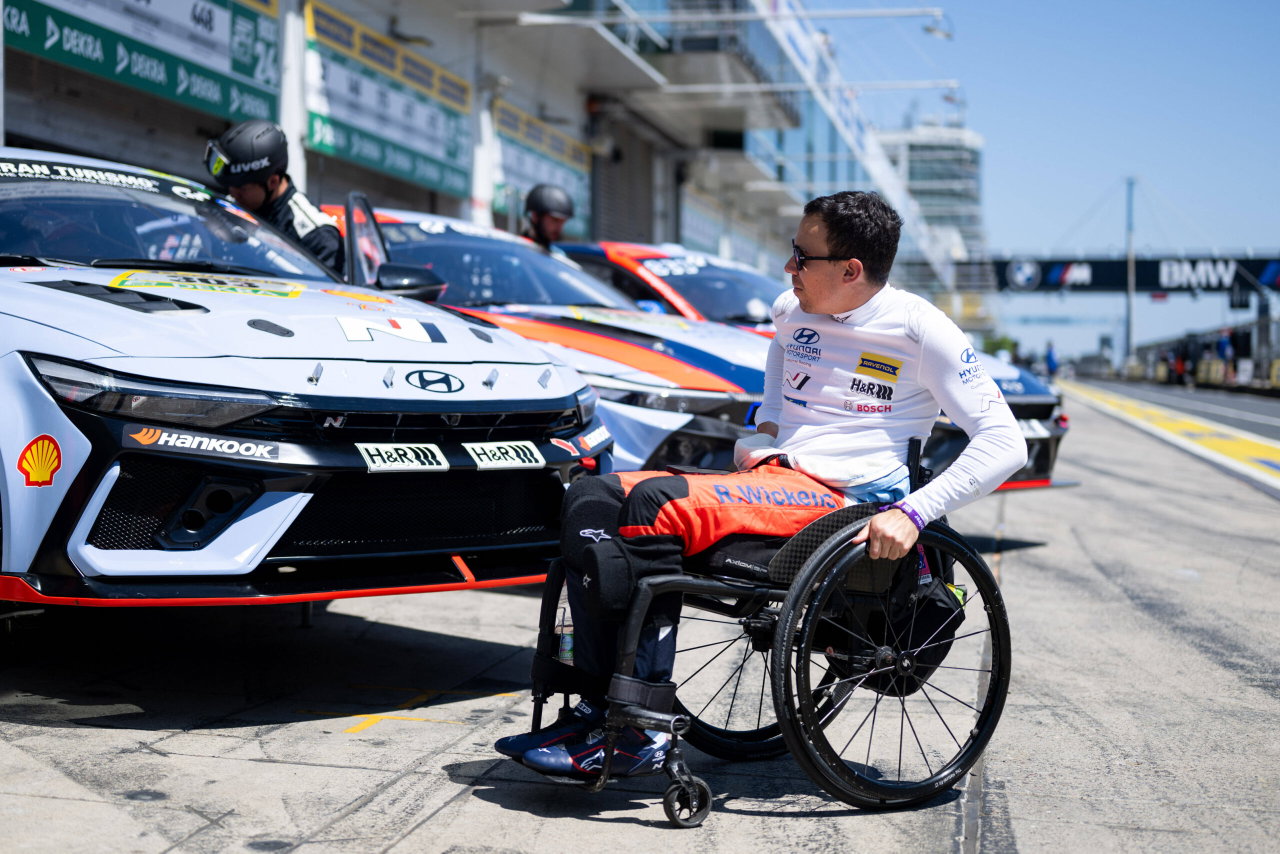
When Robert Wickens said he would return to racing, it was a promise that few could have imagined the full scale of. A life-altering accident at Pocono in 2018 left the Canadian with a spinal cord injury, forcing him to confront a challenge unlike anything he had faced in his racing career. But walking away from the sport was never the plan. What followed was a determined return to competition, one that saw him relearn the demands of racing and gradually work his way back to the highest levels of motorsport.
Watch What’s Trending Now!
Now, nearly a decade after the accident, Wickens has reached another major milestone. The former IndyCar star will return to full-time competition in 2027, joining the IMSA WeatherTech SportsCar Championship grid with Hanley Motorsports Incorporated. The programme also brings him back to the Rolex 24 at Daytona, a race he last contested in 2017. It is a long-awaited return, but for Wickens, the opportunity to keep racing has always been the goal.
After teasing a big announcement on November 23, the Canadian racer finally revealed his comeback checklist, ticking off the final two milestones on his list for now: competing at the Rolex 24 at Daytona and returning as a full-time driver. In his X post, the driver can be seen ticking the goals off his list, with returning to racing and getting back to Victory Lane already checked above the two new goals. But behind every milestone on that list lies a journey that began with an accident that changed his life and threatened to bring his racing career to an end.
On August 19, 2018, Wickens was competing in the ABC Supply 500 at Pocono Raceway when an incident on Lap 7 changed the course of his life. Battling Ryan Hunter-Reay through Turn 2, the two cars made contact, sending both towards the outside wall. Wickens’ No. 6 Honda rode over Hunter-Reay’s car before launching into the air and striking the catch fencing. The impact tore through the barrier, sending debris across the circuit and bringing the race to an immediate halt. His car eventually came to rest on the track, its survival cell separated from much of the wreckage.
The AMR IndyCar Safety Team and track medical staff attended to Wickens before he was transported by helicopter to Lehigh Valley Hospital in Pennsylvania. He had sustained a devastating list of injuries, including a thoracic spinal fracture and spinal cord injury, a neck fracture, fractures to both legs, both hands, his right forearm and elbow, four broken ribs, and a pulmonary contusion. He underwent surgery to stabilize his spine, with titanium rods and screws inserted during the procedure. Further operations followed to address his other fractures.
Was Jeff Gordon the Biggest Victim of NASCAR’s Format Changes?
Wickens spent 10 days in a medically induced coma. The spinal cord injury had left him paralysed from the chest down. He would later describe the process of understanding his injury as gradual, with the reality of his new circumstances taking time to sink in.
After multiple surgeries, Wickens spent months in rehabilitation, but returning to racing remained on his mind. Wickens made his way back to the IndyCar paddock at St. Petersburg in March 2019, and a few months later, drove a specially adapted Honda NSX during the parade lap at the Honda Indy Toronto. It was his first time driving at a racetrack since the accident, and a reminder that he wasn’t ready to leave motorsport behind.
“Honestly, the car is so good that that was kind of a moment where I’m like, ‘Yeah, I miss that,” said the driver.
In the same year, he also confirmed that he would return to racing no matter what: “I’m too young to give that up. I don’t care what I have to do. I don’t care how hard I have to work. I’m going to come back.”
By 2022, the former IndyCar driver had done just that. Since his life-altering accident, the driver has returned to multiple motorsports categories, including IMSA Michelin Pilot Challenge with Bryan Herta Autosport from 2022 to 2024, before his part-time IMSA WeatherTech GTD campaigns in 2025 and 2026. The upcoming year will mark his first full-time IMSA WeatherTech SportsCar Championship campaign.
The driver has also expressed his willingness to compete in NASCAR series someday; however, his pursuit of open-wheel racing categories led him to other disciplines.
While he was keen on pursuing motorsports again, the biggest challenge besides his recovery was changing the car’s setup in a way that it would allow the driver to race without the conventional foot-operated brake pedals and accelerate.
He first got a taste of what that could look like in 2019, when Arrow Electronics helped modify an Acura NSX with hand controls for him to drive at the Honda Indy Toronto.
It was only the beginning, though. In 2021, Bryan Herta Autosport gave him the opportunity to test a Hyundai Veloster TCR fitted with hand controls previously used by Michael Johnson. Wickens worked with the team to adapt the setup to his own needs, gradually developing a system that would allow him to compete again. By January 2022, he was back on the grid.
In 2022, he claimed two victories alongside Mark Wilkins before taking another step forward with Harry Gottsacker in 2023. The pair went on to win the IMSA Michelin Pilot Challenge TCR championship, marking Wickens’ return to the top of the sport as a champion.
Wickens had never needed a comeback to establish his credentials as a racing driver. Long before his accident, he had already won three karting championships, the 2006 Formula BMW USA title and the 2011 Formula Renault 3.5 championship, while finishing runner-up in both Formula 2 and GP3.
Six seasons with Mercedes in DTM brought him six victories and 15 podiums, before he made the move to IndyCar in 2018. He announced himself immediately, taking pole position on his series debut at St. Petersburg, finishing ninth at the Indianapolis 500 to earn Rookie of the Year honors, and collecting four podiums and seven top-five finishes in his rookie campaign.
By the time he arrived at Pocono, Wickens had already established himself as one of the most accomplished drivers of his generation.
When he first returned to Daytona in 2022 and finished on the podium at Michelin Pilot Challenge, Wickens reflected on how he had found the validation he needed after losing everything he had worked so hard towards.
“I was at the pinnacle of my career and the best I’d ever been. I spent my 20s perfecting my craft and being a professional inside and out and doing what needed to be done. […] When that was taken away from me, that’s what stung the most. That’s what drove me to get back.”
Wickens added, “Daytona was validation that I can return to an elite level of motorsport. This is really just the beginning of the journey. I plan on making the most of it.”
Nearly a decade later, the driver is returning to the very venue that restored his faith in his racing career, now in the capacity of a full-time racer graduating to the IMSA WeatherTech SportsCar Championship.
For Wickens, the journey back was never about rediscovering whether he belonged behind the wheel. He knew what he was capable of, even when the road back seemed uncertain. What followed was a willingness to relearn, adapt and keep pushing the boundaries of what was possible. As he prepares for another full-time season and a return to the Rolex 24, his story is no longer just about making a comeback. It is about a racing driver who never stopped looking for his next opportunity to compete.