
Imago
Maria Sharapova speaks before she receives her ring for her induction into the International Tennis Hall of Fame in Arthur Ashe Stadium on day 2 at the 2025 US Open Tennis Championship at the USTA Billie Jean King National Tennis Center in New York City on Monday, August 25, 2025. PUBLICATIONxINxGERxSUIxAUTxHUNxONLY NYP20250825141 JOHNxANGELILLO
Imago
Maria Sharapova speaks before she receives her ring for her induction into the International Tennis Hall of Fame in Arthur Ashe Stadium on day 2 at the 2025 US Open Tennis Championship at the USTA Billie Jean King National Tennis Center in New York City on Monday, August 25, 2025. PUBLICATIONxINxGERxSUIxAUTxHUNxONLY NYP20250825141 JOHNxANGELILLO
Maria Sharapova has been a star in the tennis circuit for years. Even after hanging up the racket in 2020, her legacy is one that makes headlines. After amassing a 645-171 win-loss record, she held No. 1 for 21 weeks across four stints and collected 36 singles titles, including five grand slam titles. This Russian pro was one to look out for. But it wasn’t always what met the eye. Now, nearly six years after hanging up the racket, she’s opened up about her untold story:
Watch What’s Trending Now!
Sharapova addresses her signature grunt
Speaking to L’equipe, the 38-year-old opened up about one of her most famous trademarks: her loud, passionate screams on the tennis court. “I knew how to navigate between these two worlds very well,” she said, referring to her elegant, poised image off the court and her fierce intensity during matches.
That duality was perfectly captured in her iconic 2006 Nike commercial set to “I Feel Pretty,” where the sweet melody clashed with her powerful, gurnt-filled gameplay. “Oh so pretty,” the ad teased, until Sharapova unleashed her signature scream and crushed her opponent, making the spot unforgettable.
“Bigger than my sport, but I never forgot why I had these opportunities,” she explained. “The answer is that I was winning.” Alongside her agent Max Eisenbud, she built a massive brand, racking up seven-figure checks and collecting 36 trophies. She became the epitome of a cool, untouchable “femme fatale,” beautiful, distant, and as icy as her native Siberia.
Imago
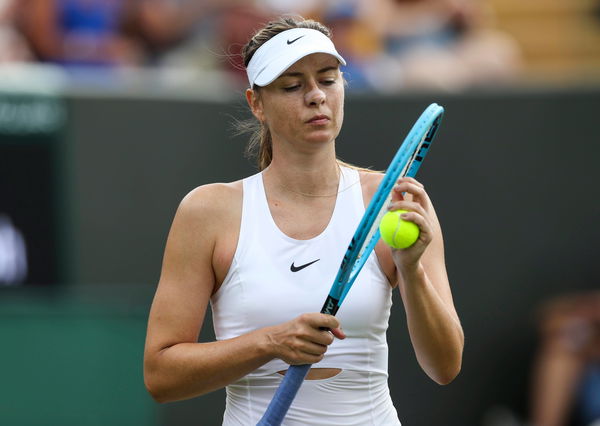
Mandatory Credit: Photo by James Marsh/BPI/Shutterstock 10326008cr Maria Sharapova during her first round match Wimbledon Tennis Championships, Day 2, The All England Lawn Tennis and Croquet Club, London, UK – 02 Jul 2019 Wimbledon Tennis Championships, Day 2, The All England Lawn Tennis and Croquet Club, London, UK – 02 Jul 2019 PUBLICATIONxINxGERxSUIxAUTXHUNxGRExMLTxCYPxROMxBULxUAExKSAxONLY Copyright: xJamesxMarsh/BPI/Shutterstockx 10326008cr
Her scream? It wasn’t about intimidation. “I started doing it young,” she admitted. “It was part of my breathing technique, and I just kept doing it throughout my career.” Around her, silence reigned. Team members were bound by confidentiality, and opponents rarely got close. “It’s difficult to maintain a friendship with someone who represents an obstacle to your greatest successes,” she said, describing her tendency to isolate herself. Before matches, she often curled up with a book, creating a bubble all her own.
But that wasn’t all she opened up about. Sharapova also spoke about her famous rival, the one whose matches with her always drew huge anticipation.
The Maria Sharapova vs Serena Williams rivalry
It’s well known that Williams had owned her rivalry with Sharapova, leading 20-2 across 22 matches from 2004 to 2019. Sharapova struck first, stunning Serena twice in 2004, at Wimbledon 6-1, 6-4 and again at the WTA Championships 4-6, 6-2, 6-4. Then the tide turned. Williams ran away with the next 19, going 8-1 in majors and 3-1 in major finals. She dominated their seven finals, capped by that ruthless 6-0, 6-1 gold medal match at the 2012 Olympics, and classic wins at the 2007 and 2015 Australian Opens.
Flushing Meadows wasn’t always kind to Sharapova. The New York noise shook her early on. “I didn’t like it; I was very intimidated by the noise. Over time, I learned to embrace this environment, to let the crowd help me get back into a match, to allow that noise to have a positive impact on the result.” That shift powered her 2006 US Open title, the second of her five majors, and the poise that took her to world number one at 18. Her Hall of Fame induction last August in Newport felt like a fitting salute.
That day, she “took a look back” for the first time, as her father teared up and Serena Williams delivered the opening speech. The American recalled “the atmosphere that suddenly changed, the real tension and fire” when they played. Sharapova laughed later. “Were you surprised she was there? It was a very powerful moment. Despite all our battles on the court, despite the things we may have said in press conferences, there has always been a lot of respect between us. This was a kind of official way of showing it.”
Sharapova thought of the fearless kid she was. “I wasn’t afraid of the stage or the lights. I always wanted to be the athlete the team chose to play the decisive tiebreak at 6-6 in the third set.” Fame came fast but never changed her. “It’s very easy to lose it, for your confidence to turn into ego, but I never allowed myself to think I was unique.” She remembered those post-match handshakes too. “You don’t want to look her in the eyes, you want to go back to the locker room, but that moment at the net is a way of saying: ‘I know what effort it took for you to get here, I respect what you do… But I still want to beat you!’”
Imagine the shock at the 2025 International Tennis Hall of Fame in Newport, Rhode Island. Serena Williams stole the show by introducing her fierce rival Maria Sharapova. The 23-time Grand Slam legend dubbed their clashes “electric.” She praised Sharapova’s grit for sharpening her edge. Williams owned 20 of their 22 showdowns. That included the brutal 2004 Wimbledon upset. “Who would have thought?” Sharapova grinned. She pulled Serena into a warm hug after the touching words.
On one hand, she got the perfect ending with her rivalry, right? But her journey in tennis wasn’t quite off to a perfect start. Maria had some trouble when it came to choosing to start her tennis career.
Why leaving home at 7 was lonely for Sharapova
On April 26, 1986, a year before Maria Sharapova came into the world, reactor number 4 at the Chernobyl nuclear power plant exploded. The disaster sent a radioactive cloud drifting across the region and forced the evacuation of 300,000 people. Among those nearby were Yuri and Elena Sharapov, living about 160 kilometers away in Gomel, Belarus. Four months later, they finally left, heading east for a fresh start and to welcome their only child. Maria was born in Nyagan, a remote corner of Siberia where her father spent two tough years working in oil refineries to save enough money for a move to Sochi on the Black Sea coast.
In Sochi’s warmer air, Maria first picked up a tennis racket. Her early talent was obvious, and by age seven, she was boarding a flight to the United States with her father. Her mother stayed behind. “She couldn’t get her visa, and we couldn’t leave because we only had one entry into the United States,” Maria later explained. The separation lasted two long years.
“Looking back, I think it would be harder to cope with today,” she said. “We have a direct connection with our phones, and seeing someone you love makes you want to be with them. Back then, we sent each other letters and maybe called each other once a month on the landline… I wouldn’t say that distance helped, but it made not being together seem more normal.” The words say everything about how difficult that time really was.
At just seven, in a new country with a father busy trying to make ends meet, Maria faced lonely, often harsh days. She didn’t speak English, and at the Bollettieri Academy in Florida, where she arrived in 1995, the dorm kids teased her. “Her English wasn’t very good,” recalled Max Eisenbud. “When she woke up, she only thought about one thing: playing tennis, while the other girls wanted to have fun.” Those rough early years shaped her. They toughened her. And they built the steely trust-in-no-one mindset that went on to define one of tennis’s greatest competitors. But it wasn’t until her body could no longer carry her on the court.
How injuries ended Maria Sharapova’s career
Sharapova called time on her sensational career in 2020, at just 32, right before the world went into lockdown. She admitted that the fire inside her had slowly dimmed. “When I woke up in the morning, what I wanted to do most in the world was go train. Towards the end of my career, I gradually felt that feeling leaving me, until I realized it wasn’t where I wanted to be anymore,” she said. The former Wimbledon champ knew it was time to let go of the life that had defined her since she was a kid.
Her career wasn’t without turbulence. In 2016, she was rocked by a two-year suspension—later cut to fifteen months—after testing positive for Meldonium. The comeback wasn’t easy. “I suffered for years,” she confessed. “I had shoulder surgery, serious injuries, forearm problems… I was stubborn, I found ways to stay in shape when I couldn’t play. But towards the end, my stubbornness became a weakness.” Sharapova’s body, once her greatest weapon, had turned against her.
On February 26, 2020, she made it official, announcing her retirement through a heartfelt essay shared in Vogue and Vanity Fair. She revealed that chronic right shoulder issues, including multiple surgeries (the latest in 2019), finally pushed her to step away. After 19 unforgettable years, she left behind five Grand Slam trophies (Wimbledon 2004, US Open 2006, Australian Open 2008, French Open 2012 and 2014), 36 WTA singles titles, and 21 weeks at No. 1. Her last match was a first-round loss to Donna Vekic at the 2020 Australian Open, 6-3, 6-4, with her ranking slipping to No. 373.
Yet Sharapova’s goodbye wasn’t bitter. She said she’d miss the sport’s little rituals but looked forward to new passions. All of which include family time, dance classes, and maybe a bit of calm after the chaos. What do you think?