
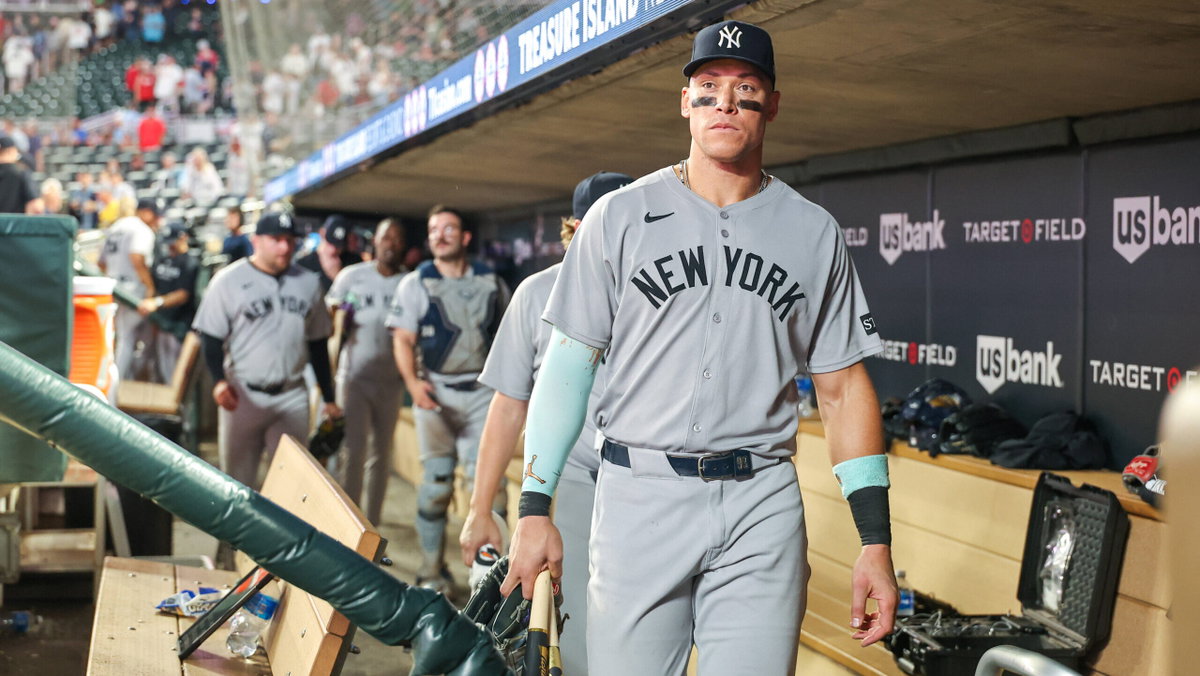
Aaron Judge confronted Jazz Chisholm Jr. over behavior that crossed clubhouse lines, raising fresh questions about leadership. Yankees reporter Randy Miller revealed that Judge had sternly addressed Chisholm multiple times during the season. Chisholm reportedly confirmed their conversations, although Miller never disclosed exactly what Judge wanted him to change. Now, the bigger question is whether Chisholm actually listened to his captain’s advice.
“It talks about how Aaron Judge was all over Jazz Chisholm this season and had to scold him sternly multiple times about the way he carried himself… Jazz just does what he wants to do,” said Pinstripes Territory host Derek Levandowski.
Chisholm repeatedly attracted attention for incidents that went beyond his performance on the field. In June, cameras caught him playing second base with a green lollipop in his mouth during a loss to Detroit. Manager Aaron Boone said the sight annoyed him and personally addressed the issue. The following night, Chisholm hit a go-ahead homer, then celebrated by showing cameras his lollipop jar. Days later, he was ejected against the Red Sox after arguing a called strike. He was upset because the umpire did not ask for help reviewing his checked swing.
The concerns continued in October, when Chisholm made a costly throwing error against the Rays. After George Lombard Jr. flipped him the ball, Chisholm attempted an off-balance throw toward first base. The ball sailed past the base and allowed Tampa Bay to score during Game 2. When asked whether he would make that throw again, Chisholm said he probably would. That response drew criticism because simply holding the ball could have prevented the run. These moments explain why questions about accountability followed him throughout the Yankees’ season.
This was not the first time Chisholm had clashed with an established veteran inside a clubhouse. Chisholm criticized the Marlins captain, Miguel Rojas, for praising him privately but raising concerns with Don Mattingly. He also described a 2022 meeting about players’ clothing and travel rules, which he resented. Rojas responded that clubhouse rules mattered and teammates had to respect one another.
Chisholm’s history of resisting authority suggests Judge’s private approach may not resolve deeper accountability issues. Derek Levandowski argues Judge does not need to confront teammates publicly to lead effectively. He points to Derek Jeter, whose quieter leadership style never stopped him from becoming a respected captain. Judge, like Jeter, can address problems privately without turning every disagreement into a public spectacle.
Miller, however, believes Judge should have been tougher because his teammates respect him. Bob Klapisch disagrees, saying discipline belongs to Boone, not the team captain.
This debate, whether Judge should lead publicly or privately, exposes a larger question about the Yankees’ clubhouse standards. The argument is that repeated issues would have brought consequences much sooner under Jeter. Under that culture, repeated issues might have brought quicker consequences from coaches and management. Now, Judge can speak privately, but Boone controls playing time, and the front office builds rosters. Chisholm finished 2026 with 19 homers, 55 RBIs, 41 steals, and a .231 average, a decline from his 2025 All-Star form. The concern is not simply Judge’s approach, but whether New York consistently enforces its standards.
Jazz Chisholm Jr. is not heading back to the Yankees
The Yankees have passed on giving Jazz Chisholm Jr. a qualifying offer, leaving his future uncertain. New York offered David Bednar $23.15 million instead, leaving Chisholm among notable unsigned free agents. The decision followed a difficult 2026 season, when Chisholm hit .231 with 19 home runs. He added 55 RBIs and 41 stolen bases, but finished with only a .711 OPS. Those numbers still show speed and power, though they fell below his 2025 All-Star standard.
His season also brought distractions, adding another layer to the Yankees’ decision this winter. Aaron Judge reportedly confronted Chisholm privately, asking him to stop behavior that crossed clubhouse lines. One widely discussed moment came in June, when Chisholm fielded an inning with a lollipop. Boone criticized that incident, while Chisholm was later ejected after arguing with an umpire. His difficult finish continued in October, as he went hitless across 8 ALDS at-bats.
Despite that difficult ending, Chisholm has made clear he wants another chance in New York.
After the Rays eliminated the Yankees, he said, “I do hope to be back.”
He explained that he grew up watching Derek Jeter and loved representing the Yankees. That attachment makes leaving harder for Chisholm, especially after his strong 2025 All-Star campaign. Still, the club’s decision not to offer $23.15 million suggests it has real reservations.
If Chisholm leaves, the Arizona Diamondbacks could offer a fresh opportunity and an opening at second base. CBS Sports analyst Matt Snyder predicted the Diamondbacks would sign Chisholm, but only if they trade Ketel Marte. That trade could create room for Chisholm, whose 41 steals would pressure opposing defenses. His 19 home runs also offer Arizona power, even after his production dipped this season. At 28, he could still rebound, particularly with a new team and a defined role.
For Arizona, his speed could turn singles into scoring chances and unsettle opposing defenses. His left-handed bat would also give Arizona another option in a lineup seeking improvement. For the Yankees, losing him means replacing 19 homers and 55 RBIs. Anthony Volpe and other infield options could help, but none guarantee Chisholm’s combination of skills. New York must weigh his upside against the concerns that shaped this offseason decision.