
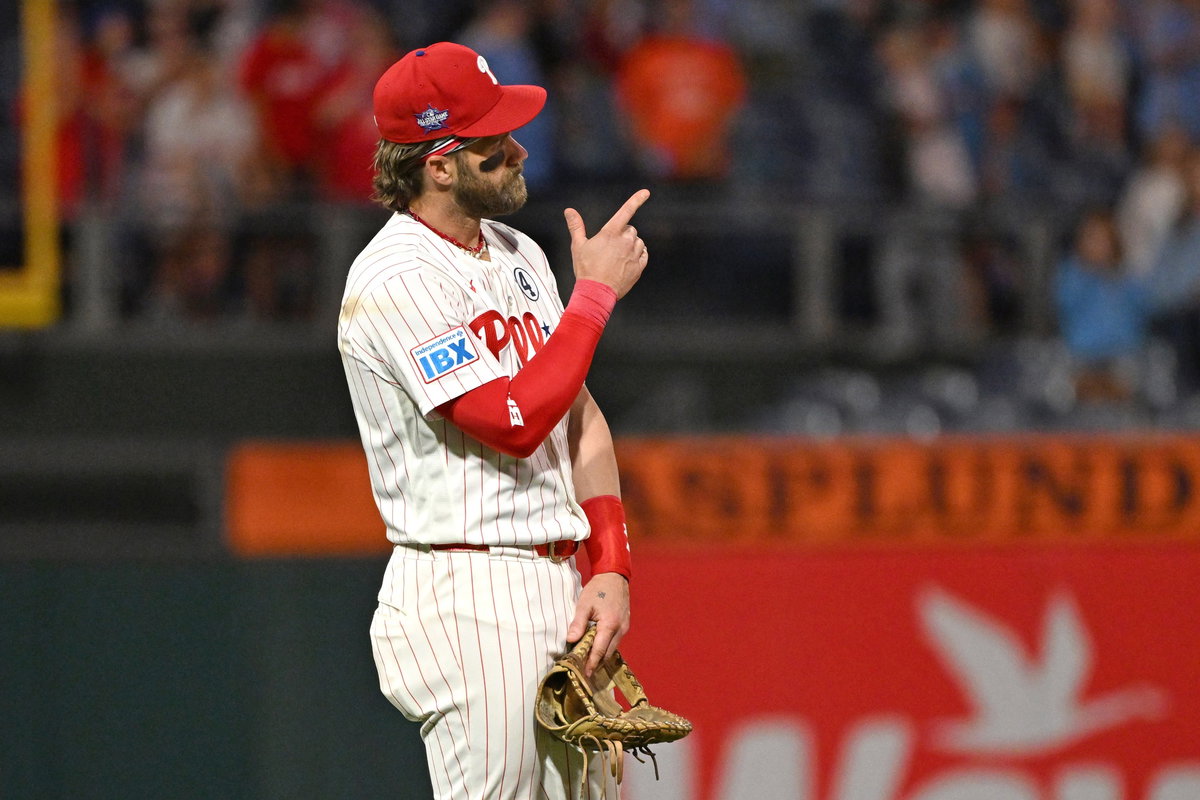
Just this past March, we saw the WNBA reach its new CBA 51 days before the league’s 30th season was scheduled to begin, and the journey was far from easy. The agreement was finalized 17 months after the players opted out of the previous deal. Now, it’s MLB’s turn to make progress in its ongoing negotiations. But if the current situation is any indication, the two sides are far from seeing eye to eye, and Bryce Harper has already made his stance clear.
Watch What’s Trending Now!
“I hope that we can come together for the sake of our game and for where our game is right now, the direction that it’s going,” Harper said recently in a conversation with The Inquirer. “I don’t think it’s ever been, in the years that I’ve played, it’s never been [as good as] this.
“We need to both come together and understand what is best for both sides to make it work and us to play baseball because the game is where it needs to be right now. And I just see it getting better and better.”
As the story unfolds on the mounds, we have something incredibly momentous unfolding in the background, and that is the collective bargaining agreement. It is basically a type of agreement between the players and the club which caters to the interests of both parties, including players’ meal allowances, travel, salary, free agency, etc., for a period of five years typically.
The first CBA for MLB in 1968 was, in fact, the first in professional sports history, and now, fast-forward to the ongoing discussions regarding the CBA, and the two sides appear to sit on two opposing ends. And at the heart of this lies the desire to implement a salary cap from the owners, as MLB is the only non-salary-capped league among the major North American sports, which they believe is against the franchise values.

Imago
MLB, Baseball Herren, USA Chicago Cubs press conference, PK, Pressekonferenz Aug 1, 2025 Chicago, IL, USA Baseball Commissioner Rob Manfred announces Major League Baseball and the Chicago Cubs will host the 2027 All Star game at Wrigley Field. Chicago Wrigley Field IL USA, EDITORIAL USE ONLY PUBLICATIONxINxGERxSUIxAUTxONLY Copyright: xDavidxBanksx 20250802_cec_bb6_001
Naturally, this is not sitting well with the union, which sees it as a non-starter. And that is what Harper is stressing, too.
“All the guys that sat out, went through strikes, went through situations that I couldn’t fathom — missed checks, missed meals, all that kind of stuff — way back when. I don’t want our decisions to be a negative for what those guys did for us. I couldn’t fathom being part of the group that took [a salary cap proposal] and was like, ‘OK, yeah, we’re good.’”
Back on May 28 this year, the MLB and its owners announced their first formal CBA proposals, which had the following proposals:
- The salary cap, including benefits expenses, of $245.3 million for 2027.
- A salary floor, also including benefits expenses, of $171.2 million for 2027.
- Equal revenue split between clubs and players.
- The centralization and equal sharing of all local revenues.
Now, if you look at the competitive balance tax (CBT), or luxury tax, payrolls as a guide, you would see that nine teams sit above the cap line while 12 are below it. And as pointed out by Craig Goldstein, the payroll threshold would need to sit around a $18.7 million loss in aggregate player salary overall if payrolls are to match the proposed cap.
Moreover, the league is also looking at an escrow system similar to that of the NBA and NHL. What essentially happens here is that a percentage of the player’s salary is withheld, and if the projections fall short of the revenue, this percentage is given to the league; but if revenue is higher than the projections, then that is shared with them. However, the MLBPA is not in favor of this, as they think that it cuts through the guaranteed player salaries.
A day before the MLB’s first proposal, the MLBPA made its demand explicit, asking:
- An increase in the minimum salary from $780,000 to $1.5 million.
- Competitive Balance Tax threshold to go from $244 million to $300 million.
- Increased sharing of local-broadcast revenues among teams.
- Draft lottery expansion.
- Elimination of the qualifying offer for outgoing free agents.
While the discussion is currently going on, U.S. President Donald J. Trump has already voiced his support for MLB’s proposal of a salary cap, citing that football follows the same model and that MLB “should have done it a long time ago.”
What happens if an agreement is not reached?
The current CBA expires at 11:59 p.m. ET on December 1, 2026, and with the way things are looking right now, history might just repeat itself. During the negotiation of the current CBA, there was a 99-day lockout forced by team owners, which delayed the start of the 2022 season.
Well, if that is the case, then MLB will most likely institute a lockout following the CBA’s expiration, and if that happens, then it would delay the start of the 2027 season. As per the U.S. Supreme Court, lockouts are permissible if down to bring “economic pressure to bear in support of” a “legitimate economic position.”
What is more, a lockout will result in a delay of Opening Day, shortened spring training, and possibly a reduction in the 162-game schedule.
With the possibility of a work stoppage looming over the league, Harper’s blunt message serves as an early reminder that neither side appears ready to back down.