
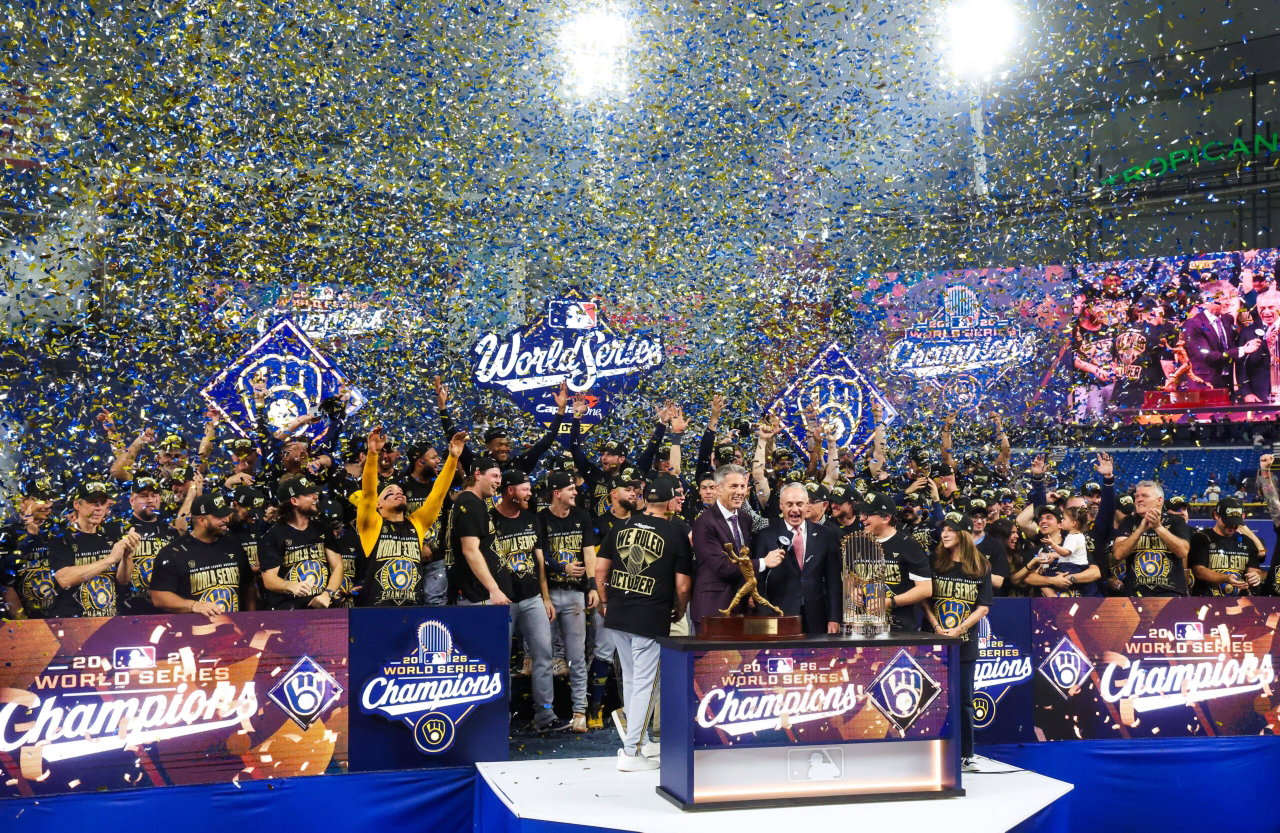
The Brewers turned relentless offense into their first World Series championship, making every at-bat count. Their lineup delivered when the pressure was highest, overwhelming opponents throughout October. But Milwaukee’s offensive success involved more than the hitters taking the field. Aaron Ashby has now pointed toward an overlooked figure who helped shape that championship identity.
Watch What’s Trending Now!
“He was one of our best friends on the team… He has the utmost confidence. And it’s like a real confidence in each individual guy that they’re the best on the field,” said Aaron Ashby in an interview with the 6ix Inning Stretch Podcast.
Aaron Ashby called Daniel Vogelbach the Brewers’ unsung hero. “He might be the unsung hero. To have a hitting coach that can walk that player-coach and player dynamic, he just brought such a different way of coaching and player relationship than I’ve seen before,” Ashby said.
His praise went beyond hitting advice. Vogelbach understood players through experience. That connection mattered inside Milwaukee’s championship clubhouse. Their bond dates back to 2021, when they shared the Brewers’ clubhouse as teammates. Ashby was beginning his major-league career that season, while Vogelbach was completing his playing stint in Milwaukee. Five years later, their relationship had evolved into a close friendship and a unique player-coach connection.
Ashby’s explanation showed why Vogelbach’s influence reached beyond the batting cage. He joked that teammates wanted to spend time with Vogelbach. Ashby compared his personality to comedian Chris Farley, recalling his humor. More importantly, he called Vogelbach “everyone’s biggest fan” and praised his belief in every hitter.
“When you have a coach that’s saying that and believes it, I think it just leads to success down that lineup,” Ashby explained.
That trust shaped Vogelbach’s first season on Milwaukee’s coaching staff. The Brewers hired him as a hitting coach in 2026. He joined Guillermo Martinez, with Eric Theisen leading their three-person hitting group. Vogelbach brought nine seasons of major-league experience, including an earlier Milwaukee stint. His pinch-hitting and platoon roles helped him understand irregular playing time. He stressed having a clear plan against each pitcher, then trusting preparation. Jake Bauers credited Vogelbach’s video work with shaping his approach.
Milwaukee’s numbers showed how productive its approach became. The Brewers hit .258, MLB’s best average, and reached base at .341. Their 668 walks ranked second, while their .744 OPS tied third. They scored 832 runs during the 162-game season. Milwaukee chased just 29.1% of pitches outside the zone, MLB’s lowest rate. Those results cannot belong to one coach alone, but support Vogelbach’s patient philosophy. His work formed part of a staff that helped turn preparation into production.
That approach appeared in key moments against the Dodgers and Rays. In NLCS Game 3, Jake Bauers battled through 11 pitches before homering. His go-ahead shot turned Milwaukee’s 2-1 deficit into a 3-2 lead. Garrett Mitchell followed with another homer, extending the advantage to 4-2. In World Series Game 3, Milwaukee scored 8 runs with 2 outs. They recorded 7 consecutive hits in that inning.
Vogelbach praised their approach: “They know that they don’t have to be the hero; they just have to give it to the guy behind them.”
Ashby was not alone in recognizing Vogelbach’s influence. Manager Pat Murphy praised his communication, care, and impact on players. “He has special talents. He has a special way of communicating,” Murphy said.
The Brewers’ manager added that Vogelbach showed “how much he cares” and had “a special way of impacting players.” President of baseball operations Matt Arnold offered an endorsement: “What you see is what you get from Vogey.” Jake Bauers also praised Vogelbach’s video work and quick advice. Their comments explain Ashby’s label: Vogelbach brought preparation, trust, and support.