
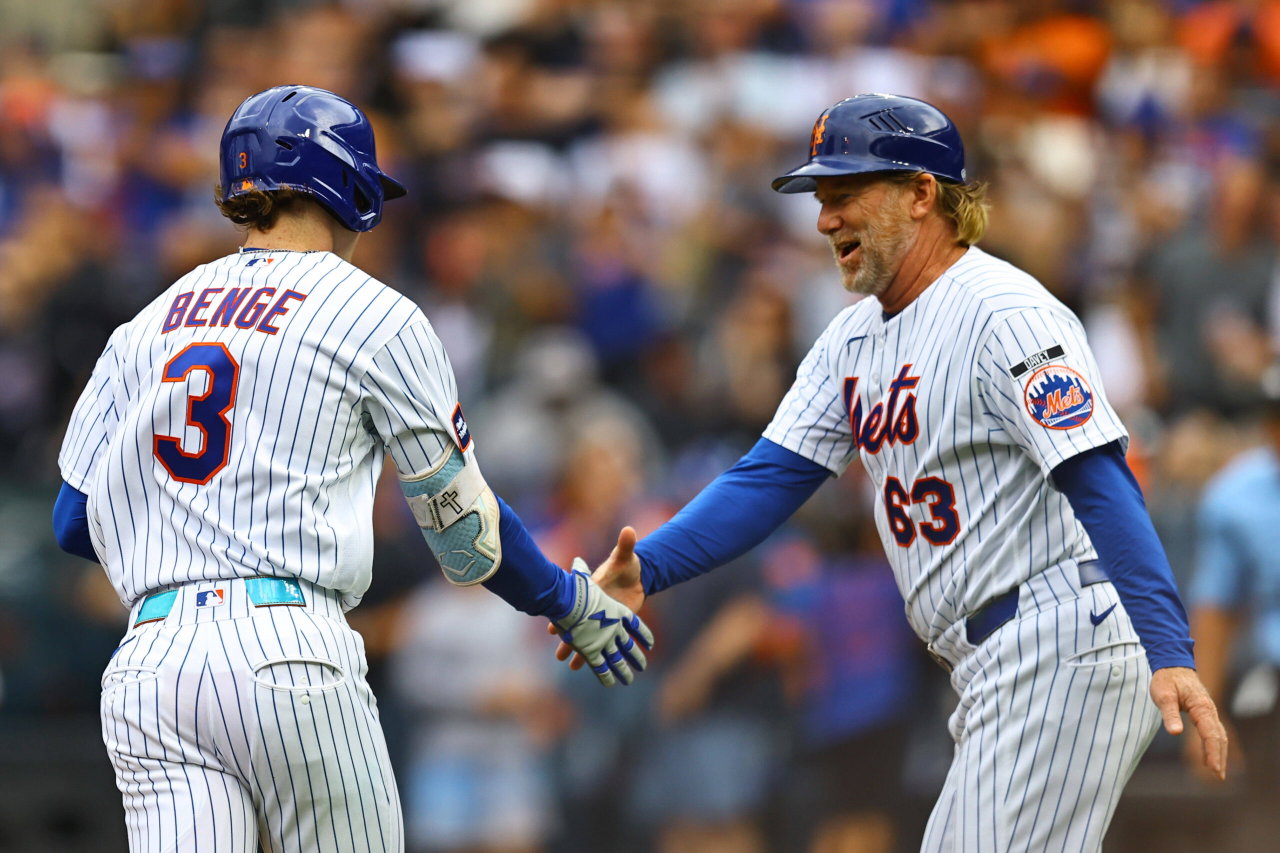
The New York Mets are on a roll, splashing millions on new additions, but their latest one is an extension that speaks a lot about their changed approach. For decades, the Mets preferred to let young players go year-to-year through pre-arbitration and arbitration, trusting they could simply outbid the market later in free agency rather than take on early injury or regression risk. This year, the Mets have shifted toward locking in cost-controlled talent early with Carson Benge. An 8-year, $130 million extension with Benge has made longtime Mets broadcaster Gary Cohen impressed by the franchise’s evolving offseason strategy.
“It’s something that the Mets haven’t done in the past in terms of signing their younger players. They felt as a larger market team they didn’t need to do so, but these are 2 special talents, 2 special people, and the Mets have gone ahead and made sure that their financial security is secure for the long term and the Mets outfield security is certainly secure as well,” Cohen said via SNY Mets.
The Mets typically avoided taking on early injury or regression risk, trusting they could simply outbid the market once a player reached free agency. By contrast, Benge’s extension covers his remaining pre-arbitration years, all three arbitration years, and his first three years of free agency (keeping him in Queens at least through 2034, with a $26 million team option for 2035).
With MLB’s collective bargaining agreement expiring on December 1 and a potential lockout and possible salary cap looming, president of baseball operations David Stearns and owner Steve Cohen locked in long-term, below-market rates on their young core before the league’s economic rules potentially change.
Last time, the Mets did the same was back in 2006 when they extended David Wright for 6 years, $55 million, during his third MLB season at age 23. The extension reflects Benge’s on-field performance, not just organizational strategy.
“The Mets have solidified their outfield for almost a decade to come, with Juan Soto, A.J. Ewing, and Carson Benge signed for the long term,” Cohen added. Paired with center fielder A.J. Ewing (signed to an 8-year, $95M extension) and left fielder Juan Soto (signed through 2039), New York’s starting outfield is guaranteed to stay together at least through 2034.
Soto split time between left field and designated hitter in 2026. Having Benge, a Gold Glove finalist who led all NL right fielders with 10 outfield assists, paired with Ewing’s speed in center gives the Mets elite range to cover Citi Field’s spacious gaps even if Soto transitions to full-time DH or first base.
Benge became the first rookie in Mets history to post a 20–20 season (20 home runs, 22 stolen bases) while hitting .282 with a 118 OPS+. Because his game relies on high contact rates, plate discipline, speed, and arm strength rather than pure power, his profile projects to age reliably throughout the life of the contract.
Hence, the Mets may just have secured a dominant outfield for the next few seasons, but a few areas are yet to be covered.
The Mets still need pitching assistance
After trading away A.J. Minter, Brooks Raley, and Luke Weaver at the 2026 deadline, New York addressed the left side of its bullpen with Alex Vesia and Darwinzon Hernández. However, closer Devin Williams was inconsistent in 2026, leaving a major void for a proven right-handed setup arm to share late-inning duties alongside Dedniel Núñez.
On the other hand, the Mets ranked 22nd in MLB in starter innings (791) and 23rd in rotation ERA (4.47) in 2026. Relying heavily on young arms like Scott, Tong, and Thornton carries workload risks, making a steady mid-rotation starter (such as Freddy Peralta or Michael King) a smart insurance policy.
With eight left-handers currently on the 40-man roster and both Sean Manaea and Kodai Senga coming off steep declines, Stearns may look to trade one of the veterans to clear roster space and payroll. Still, the Mets’ shopping spree suggests their desperation for a breakout in 2027.