
Imago
Atlanta Braves left fielder Jurickson Profar 7 celebrates during a game against the Miami Marlins at Truist Park in Marietta, Georgia on Sunday, August 10, 2025. Jen Pawol, a minor-league umpire since 2016, makes her major-league debut on Saturday, making her the first female umpire in regular-season MLB, Baseball Herren, USA history. PUBLICATIONxINxGERxSUIxAUTxHUNxONLY ATL20250810145 JulianxAlexander
Imago
Atlanta Braves left fielder Jurickson Profar 7 celebrates during a game against the Miami Marlins at Truist Park in Marietta, Georgia on Sunday, August 10, 2025. Jen Pawol, a minor-league umpire since 2016, makes her major-league debut on Saturday, making her the first female umpire in regular-season MLB, Baseball Herren, USA history. PUBLICATIONxINxGERxSUIxAUTxHUNxONLY ATL20250810145 JulianxAlexander
Jurickson Profar has been handed a full-season suspension after testing positive for a performance-enhancing drug for the second time. Under Major League Baseball rules, a second violation comes with a 162-game ban, which means Profar will forfeit his entire $15 million salary for the 2026 season. But there’s a catch.


“The penalty for second-time offenders is a full-season suspension, meaning Profar won’t get any of his $15 million salary in 2026.” Brittany Ghiroli of The Athletic said. “But Profar’s contract with the Atlanta Braves runs through 2027, meaning he will be paid $15 million in 2027, whether he’s hurt, bad, traded, or released. That’s how MLB contracts work.”
Watch What’s Trending Now!
As per Ghiroli, players who took performance-enhancing drugs weren’t always thinking before putting their careers on the line. In many cases, they were trying to boost their numbers. Then they land a big multiyear contract and secure financial stability for themselves and their families.
Sure, there’s always the chance of getting caught and losing some pay. But because MLB contracts are guaranteed, teams are still responsible for most of the money unless a player racks up multiple violations. So, for some players, that makes the gamble look like a classic high-risk, high-reward situation.
In MLB, guaranteed contracts mean a player still gets most of his money even if he’s suspended or loses playing time. For example, Jurickson Profar was suspended for 80 games. So, he’ll only lose the portion of his salary tied to those games. At his $12 million AAV, that works out to about $5.8 million in forfeitures for 2025.
But the bigger picture is what happens after that.
Getty
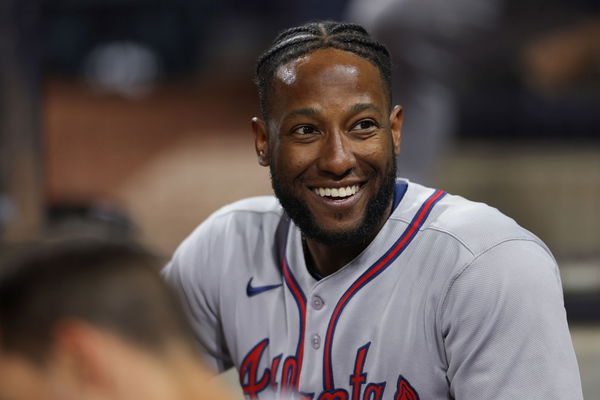
SAN DIEGO, CA – MARCH 28: Jurickson Profar #7 of the Atlanta Braves talks in the dugout during the game between the Atlanta Braves and the San Diego Padres at Petco Park on Friday, March 28, 2025 in San Diego, California. (Photo by Vincent Mizzoni/MLB Photos via Getty Images)
Profar signed a three-year, $42 million deal with the Braves. This means he’s still set to earn $15 million in 2027. And as long as he doesn’t get caught again for the same violation, the team still has to honor the contract.
That’s where the so-called loophole comes in.
That’s why cases like Profar’s have revived the debate about guaranteed contracts in MLB. As long as the potential payoff remains huge, some players may still feel the risk is worth taking for short-term gains.
Jurickson Profar’s case could force MLB to rethink PED rules and guaranteed contracts
After the PED violations involving Jurickson Profar, MLB may need to consider a couple of changes seriously.
The first option would be to toughen the punishment system. Presently, a player faces a lifetime ban only after three violations. That structure leaves a fairly large buffer for repeat offenders. So, reducing the threshold to two violations with a lifetime ban that also voids any remaining contracts could be a much stronger deterrent.
Secondly, it’s time to rethink MLB’s guaranteed contract system. Yes, that won’t be easy, especially because MLBPA would likely push back hard. Still, adding a clause that allows teams to void guaranteed money if a player is proven to have violated the league’s drug policy could be a practical middle ground.
At the moment, the narrative is that a player can still walk away with most of his contract, even after a second violation. And that doesn’t sit well with many fans. Profar’s case has already raised questions about MLB’s drug prevention program. Just a few more incidents like this could seriously damage the credibility of the system.
Hence, we wouldn’t be surprised if this issue becomes a major talking point when the next MLB CBA negotiations come around.