Imago
Source: IMAGO
Imago
Source: IMAGO
The New York Mets, until the middle of January, were not having a very good offseason. But in the span of a few days, they flipped the script. Yet, Patrick Mooney, Katie Woo, and Will Sammon listed them as this offseason’s ‘losers’ in their recent analysis on The Athletic.


They wrote, “They added Williams, Bo Bichette, Luis Robert Jr., Jorge Polanco, Luke Weaver, and [Freddy] Peralta. They ended up changing one-third of their roster. That’s a lot of newness.”
Watch What’s Trending Now!
The New York Mets’ 2025-26 offseason marks a major turning point after they missed the postseason despite holding the best record in baseball on June 12 before collapsing to finish 83-79.
Their collapse, where they went 38-55 the rest of the year, exposed weaknesses that forced a dramatic roster change.
Pete Alonso, Edwin Díaz, Brandon Nimmo, and Jeff McNeil, franchise stalwarts, all departed via trade or free agency in one of the most severe roster purges ever seen in Queens. Fans who once cheered these figures now watched their exits with heavy hearts and uncertainty.
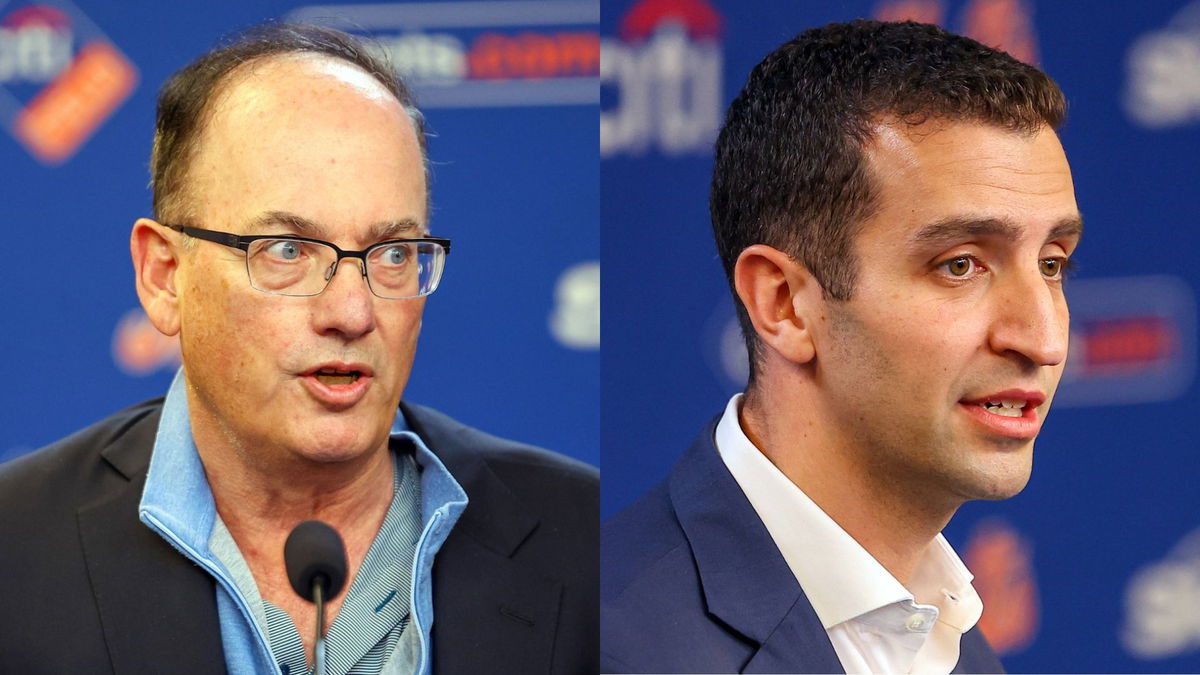
GM David Stearns clearly chose a new direction in this offseason by letting go of those core players.
His boldest splash was acquiring Freddy Peralta and Tobias Myers from the Milwaukee Brewers in exchange for prospects, aiming to fix the pitching staff that faltered badly in 2025. Peralta led the National League in wins (17) with a 2.70 ERA last season, showing he can anchor a rotation in need of stability.
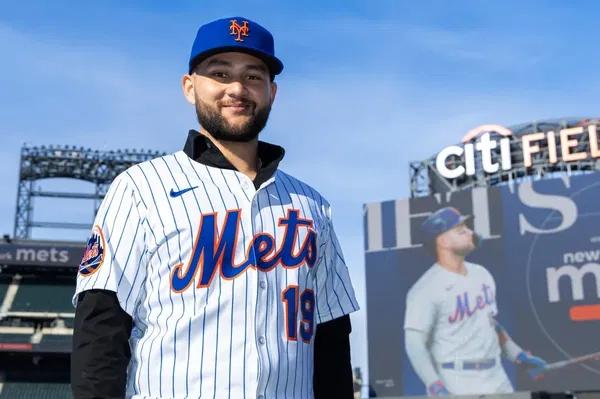
Stearns also signed Bo Bichette to a 3-year, $126 million contract after missing out on other free agents, bringing new offensive firepower. These moves were framed as both tactical and symbolic resets after the club’s horrific late-season fade.
A big part of the Mets’ decision-making this winter was tied to the club’s reported internal troubles in 2025, widely discussed in media and baseball circles.
Imago
Bichette, the Mets’ new third baseman, was officially introduced at a press conference last week. Corey Sipkin for the NY POST
Their clubhouse culture was cited as a factor influencing Alonso’s free-agency decision and the trades of Nimmo and McNeil. Reports included confidential surveys that flagged the Mets’ “team climate” lower than league average during the season.
That backdrop set the stage for a sweeping roster change to shift clubhouse dynamics.
Despite the flurry of additions, there remains a major question around whether this patchwork roster will gel on the field in 2026.
The Mets have committed substantial money to new pieces; projections show the combined 2026 contracts for key new players at roughly $145.75 million. That figure includes salary for Bichette ($42 M) and Polanco ($20 M), alongside Luis Robert Jr. ($20 M) and Devin Williams ($17 M) under contract for next season.
Compared to Juan Soto’s $61.875 M and Francisco Lindor’s $34.1 M commitments, the new core is a heavy financial bet. The entire roster, including veterans and youngsters, is being counted on to forge cohesion where there was disarray last season.
Fans remember how the bullpen and rotation simply could not hold leads during the 2025 collapse, with starters unable to go deep into games and relievers failing at critical junctures.
That collective inconsistency, widely chronicled during the slump, left supporters yearning for reliability and unity in 2026. Now, the new mix of veterans and youth carries both promise and risk for what feels like a pivotal season.
If the Mets fail again to reach October baseball in 2026, scrutiny will inevitably fall on both David Stearns and owner Steve Cohen for how this reset unfolded.
After spending lavishly, ranking near the top of MLB payrolls in recent years, the franchise still has not delivered a World Series title.
In 2025, despite a payroll near $340 million, the Mets still missed the playoffs after their steep late-season slide. That level of investment heightens expectations and fan emotions heading into 2026.
Three reasons the Mets’ season could fall apart again
The New York Mets enter the 2026 season after a major offseason overhaul focused on preventing runs, because they allowed 715 runs in 2025, the 13th-most in MLB. Their defense ranked 21st in Outs Above Average and 19th in Fielding Run Value last season, showing room for improvement. So, Stearns added players like Bo Bichette and Luis Robert Jr. in hopes of boosting defense.
Still, there remain three key areas that could make the Mets’ season collapse again, and defense is the first concern.
Bo Bichette has never played third base in the majors, and his -27 fielding run value at shortstop since 2019 shows this will test him defensively.
Juan Soto cost the Mets -13 defensive runs in 2025, tied for baseball’s weakest non-catcher. If these defensive questions do not improve, the team could give back runs it hopes to prevent.
The second major risk comes from the pitching staff, where the back half of the rotation struggled badly last season.
Pitchers such as David Peterson saw their ERAs rise from 3.06 to 6.43 in the second half, and Clay Holmes’ ERA climbed from 3.31 to 3.98. Injuries to key arms like Frankie Montas and Kodai Senga limited depth and exposed weakness in late-season innings.
If these starters do not deliver length and consistency, the Mets could repeat their late collapse.
Finally, clubhouse stability under Manager Carlos Mendoza is another variable after the 2025 issues simmered all year.
Reports noted internal conflict and frustration after the team’s second-half decline from 45-24 to 38-55. More than one error or heated exchange linked to growing unhappiness behind the scenes.
Each area involves measurable concerns from last season’s performance. Fans thus watch closely, knowing that real stats, not wishful thinking, will shape 2026.
Written by

Edited by

Ahana Chatterjee