
It is a very common trend among athletes to exaggerate their heights by an inch or two. But since the start of the 2026 regular season, baseball hitters cannot lie about their heights anymore. The strict rules have shortened hundreds of players in MLB. But one player looks a bit more dispirited than most.


“I always pressed the guys who did the measurement to leave me as 6 feet,” Miguel Rojas was quoted by Sam Blum in a New York Times article.
Watch What’s Trending Now!
Rojas said that he was so close to being 6 feet, but he was actually two inches shy. Every time there was a case of measuring his height, he would try to convince the other person to put him at 6. “What can we do to put me at 6 feet? I think it’s better optics,” he said.
We all know the temptation to appear a couple of inches taller, but the recently introduced ABS challenge system requires the accurate height for each player. It allows the system to measure the strike zone correctly and reduce the number of mistakes from the umpires.
As a result, Rojas now stands at 5 ft 10 and feels a bit dejected that he couldn’t be officially listed as 6 ft. But he is not the only one, as a total of 225 players have shrunk. That’s more than half of the 430 hitters who made the Opening Day roster. And Miguel Rojas isn’t the biggest ‘loser’ either.
There are 6 players who have lost 3 inches of their claimed heights. Gavin Lux from the Rays was previously listed at 6’2, while the Red Sox’s Connor Wong stood at 6’1. Now, they are both 3 inches shorter. Rojas is among the 48 hitters who lost 2 inches from their stature. The rest of the people who shrank lost only 1 inch.
The MLB-wide height scrutiny has impacted the most with people around 5 ft 11 and 6 ft. A total of 146 players who suffered a shrinkage belonged to this height category. And the total loss of height is almost 20 feet in MLB. That’s like three times Aaron Judge, who stands at 6’7.
Imago
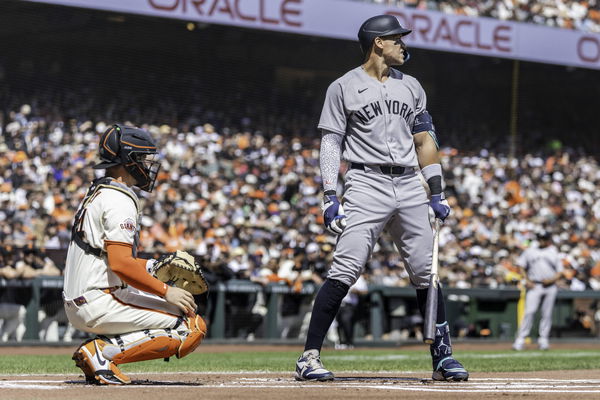
MLB, Baseball Herren, USA 2026: NY Yankees Vs SF Giants MAR 27 March 27 2026 New York right fielder Aaron Judge 99in the batters box during the MLB game between the New York Yankees and the San Francisco Giants. Thurman James / CSM Credit Image: Thurman James/Cal Media San Francisco Ca USA EDITORIAL USE ONLY Copyright: xx ZUMA-20260327_zma_c04_214.jpg ThurmanxJamesx csmphotothree483400
Anything below an even 6 is now being made fun of. The Guardians catcher Austin Hedges, who is 6 ft tall, took a dig at his teammate, saying, “Yeah, Bo is 5-foot-2, apparently.” Bo Naylor has lost 3 inches as he actually stands at 5 ft 9 now.
Padres OF Gavin Sheets has lost 2 inches from his previously recorded 6’5. But he is happy that he is still a member of the 6-footer club. But this shrinkage might not be as disappointing as it appears. Some of the players are already happy with a hidden advantage.
Miguel Rojas might gain an advantage Aaron Judge cannot
The strike zone is 17 inches wide, and that is standard for all batters. The variations take place in the height, which depends on the batter’s stature. MLB suggests that the top end of the zone starts at 53.5% of the batter’s height and the bottom of the zone ends at 27%.
In simple words, the shorter the height, the smaller the strike zone. To give you an example, we can just put Aaron Judge and Jose Altuve side-by-side. Altuve is 5 ft 6, while Judge towers at 6 ft 7. There’s approximately a 13-inch difference between the two.
Whereas people like Rojas or Lux would benefit from a smaller strike zone, Judge has to deal with a much bigger one since he hasn’t shrunk an inch. Hence, it isn’t “optics” anymore. It impacts gameplay. The shrinkage in height might actually benefit the batters.
To help you understand better, a 3-inch drop in height will lower the top of the zone by 1.6 inches. And the lower end will also come down about 0.8 inches. So, it not only reduces the dimension of the strike zone, but it also shifts position based on the batter.
This increases the challenge for the pitchers as they have to be more accurate with their throws. So the ‘short kings’ now have a real edge in the game. And Bo Naylor has perfectly reflected the current scenario for the hitters, saying, “If it gets me a smaller zone, then I’m with it.”
The loss of height of more than two hundred MLB hitters isn’t a cosmetic change. It has implemented some serious changes for both hitters and pitchers. Although it’s not the same for the two, one fact remains common to both. The game will be more honest for all of them.
Written by

Edited by

Suyashdeep Sason