
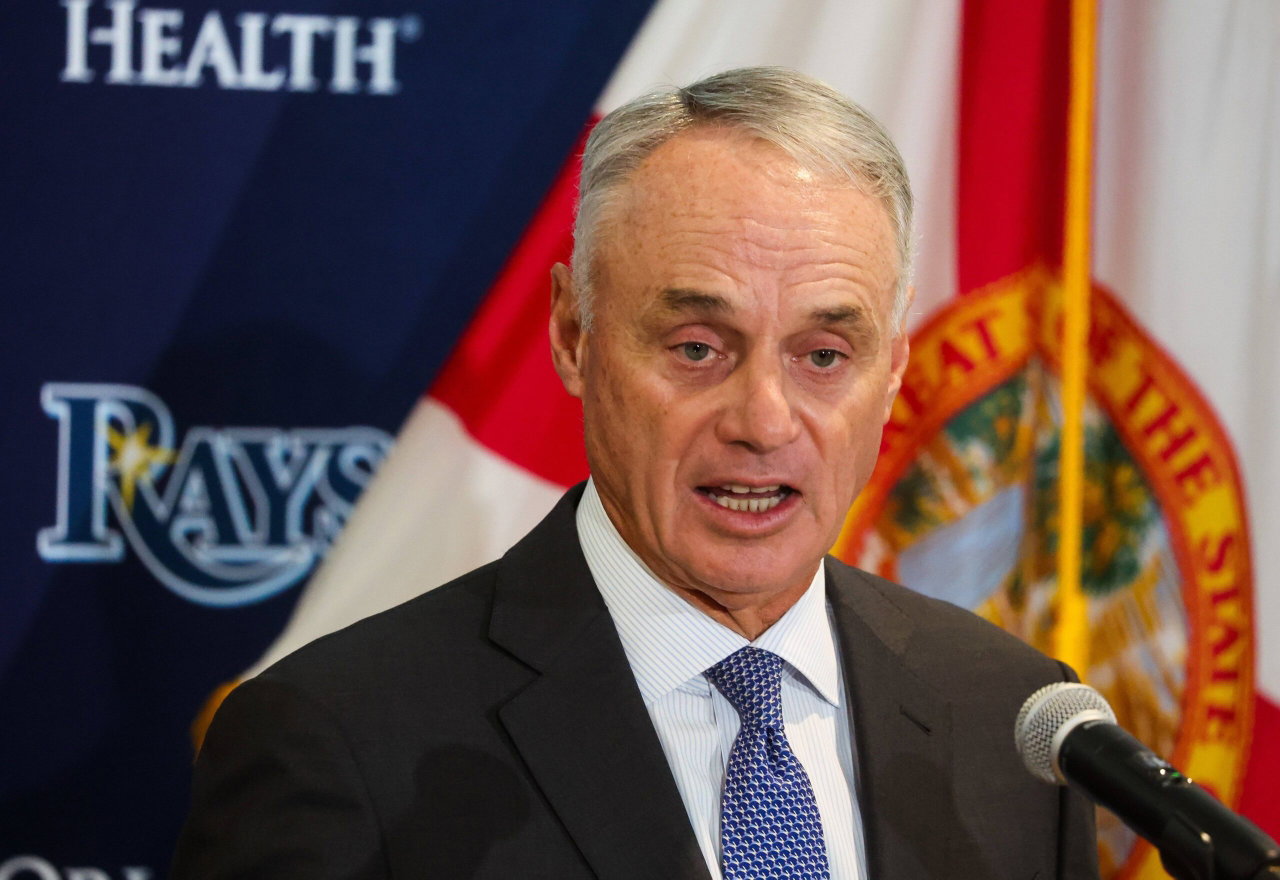
Jeff Frye wasn’t looking back at the Red Sox’s 4-2 win over the Marlins on Monday. He was looking at what baseball has become, discussing Rob Manfred’s influence on the game.
Watch What’s Trending Now!
Frye pointed to how dramatically certain aspects of baseball have changed since his playing days. He wasn’t impressed with those changes and directly criticized Rob Manfred Jr., MLB’s 10th commissioner, for what he believes has happened to the sport.
To make his point, the former Red Sox star responded to a clip on X shared by sports analyst Dan Clark.
The video that he responded to was a compilation of several MLB moments from the 2026 season.
Each frame showed the same familiar graphic: a rectangular box outlining the strike zone at different ballparks, including Rogers Centre, Dodger Stadium, and Fenway Park. It’s the graphic used during broadcasts when MLB’s automated ball-strike system, or ABS challenge system, is involved.
The numbers next to the strike-zone box showed the pitch-speed reading. In some clips, the readings were around 35-37 mph, which is obviously nowhere near the speed of a typical MLB pitch. That’s because the pitcher in the footage wasn’t a traditional pitcher at all.
One of the clips showed Miguel Rojas, a position player, tossing extremely slow pitches in what was clearly a lopsided game.
Teams typically turn to position players on the mound when a game is already out of reach, and they want to preserve their bullpen arms. And Clark couldn’t take it.
“Rob Manfred ruined baseball,” Clark captioned the clip, and Frye reposted it with his reply.
“Yes he did!”
Just two months back, during the MLB Draft, Frye had taken another dig at the commissioner, accusing him of “destroying the integrity of our National Pastime.”
Jeff Frye uploaded a 14-second video on social media, where Manfred was announcing the first pick, and ranted out his frustration in the caption:
“Rob Manfred is a failure!!! He’s too busy negotiating deals with Gambling entities to prepare for the MLB Draft. He’s destroyed the integrity of our National Pastime! Our only hope is that the MLBPA DEMANDS that he is replaced as part of the next CBA!”
He also added that the association would need to restructure the “Executive Committee in charge of Rule Changes,” as well, otherwise the “owners will continue to tinker with the game like it’s one of their toys!”
The former Red Sox outfielder never minced his words while taking jabs at the commissioner. It happened even in September 2025, when MLB’s ‘heel on the infield dirt’ rule, introduced in 2023, disrupted a game’s momentum between the Seattle Mariners and Kansas City Royals.
This time, it was more than a repost for Frye. It was another direct dig at the commissioner and the direction MLB has taken. That brings us to the larger issue:
Position players throwing slow eephus pitches and potentially taking away from the competitiveness of games. Once a rare sight, position-player pitching has become much more common since 2021.
These appearances often lead to ERAs above 6.50, while roughly two-thirds of position-player outings allow at least one run because hitters can sit back and attack the slow, predictable pitches.
One example came from Diamondbacks catcher James McCann.
He threw a series of eephus pitches ranging from 31.3 to 49.6 mph during a blowout against the Milwaukee Brewers. Only 11 of his 24 pitches were strikes.

Imago
Credit: IMAGO
But why is Manfred being blamed for this?
In 2023, MLB restricted position-player pitching to blowouts and extra-inning situations to reduce its frequency. The new guidelines replaced the old “six-run margin” baseline with asymmetrical requirements depending on whether a team is winning or losing.
For trailing teams, they can now only use a position player if they are down by 8 or more runs at any point in the game. For the leading team, they can use one only in the 9th inning or later, and only if they are up by 10 or more runs.
Teams retain complete freedom to use position players to pitch at any point during extra-inning frames.
But Frye isn’t buying these thresholds as a broader push to protect the integrity and entertainment value of the sport. And reflecting on it, the beauty of the sport might be suffering on some levels.
Allowing position players to lob 50-mph pitches during a standard 6-run deficit feels like an uncompetitive “white flag” behavior, alienating ticket-paying fans and TV broadcasters.
Before the 2023 restrictions, small-market managers used position players as a survival mechanism to protect their limited, over-taxed pitching assets. The rules intentionally stripped away this loophole, spotlighting the massive talent gap that exists between high-spending and low-spending teams.
But this whole discussion takes us beyond position players pitching and into MLB’s larger collective bargaining debate.
Rob Manfred’s role in MLB’s competitive balance debate
Rob Manfred’s role in Major League Baseball’s competitive balance debate is shaped by his position as the representative of the league’s 30 team owners. He has to balance MLB’s overall financial health with the growing gap between high- and low-spending franchises. Manfred has consistently described competitive balance as a key priority for keeping fans engaged.
However, critics argue that some of the mechanisms introduced under his leadership, such as the Competitive Balance Tax, function more as a soft financial penalty for big-market teams than as a true spending limit.
His administration has also faced scrutiny over revenue sharing, with some small-market owners accused of pocketing league payouts instead of reinvesting that money into player payroll.
As MLB heads toward its next collective bargaining negotiations, Manfred has pushed for a major structural change that would include a hard salary cap and a salary floor.
The players’ union strongly opposes that model, arguing that genuine competitive balance should come from enforcing minimum team spending rather than putting a ceiling on player salaries.
And Jeff Frye isn’t alone in criticizing Manfred’s approach.
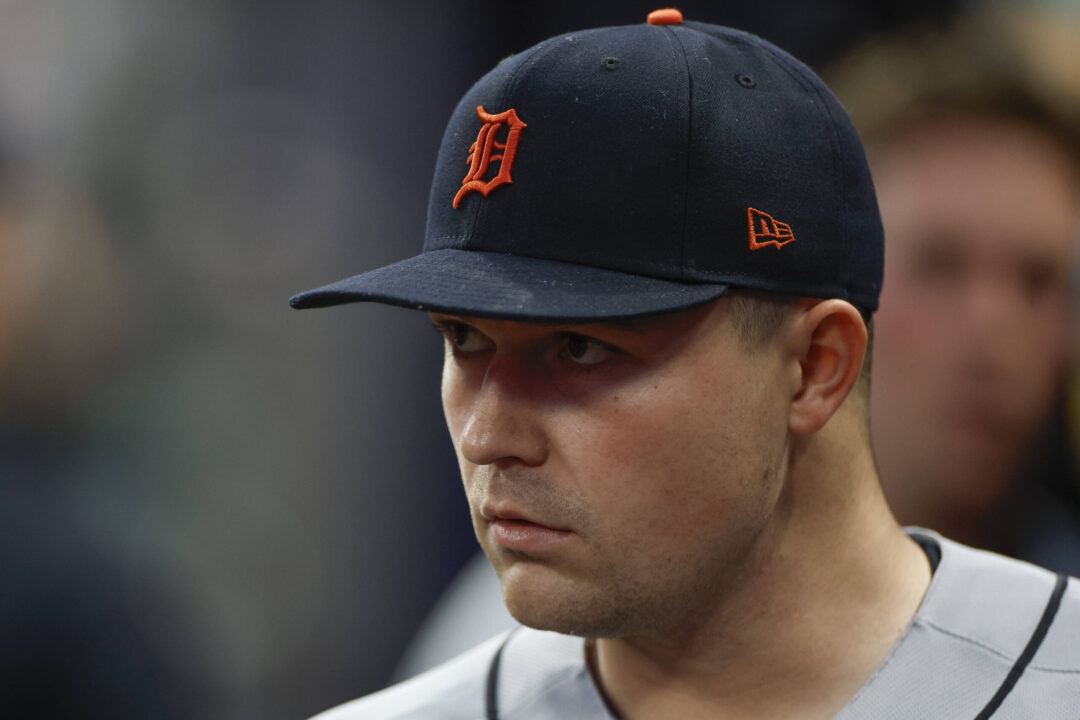
Los Angeles Dodgers pitcher Tarik Skubal has also spoken out against the commissioner’s push for a salary cap.
Imago
MLB, Baseball Herren, USA Detroit Tigers at Atlanta Braves Tarik Skubal 29 of the Detroit Tigers looks on in the dugout during a game against the Atlanta Braves at Truist Park on April 29, 2026 in Atlanta, Georgia. Photo by Brandon Sloter/Image of Atlanta Georgia United States EDITORIAL USE ONLY Copyright: x2026xImagexofxSportx x iosphotos408706
“It’s [salary cap] not good for players. If you ask any other player in any other union, in the other major sports, they would agree, and they would want our CBA structure,” Skubal told Jesse Rogers of ESPN.
With more players now speaking up, the debate is only getting louder.
The current Major League Baseball collective bargaining agreement expires at 11:59 p.m. ET on December 1, 2026. And as we all know by now, if a new deal is not reached, negotiations will stretch into spring training, threatening the start of the 2027 season.
A lockout means a halt in all free-agent signings, trades, and official contact between major league teams and players. If the dispute extends into February or early March 2027, spring training games risk cancellation or truncation, mirroring the 99-day lockout from the 2021–22 offseason.
The focus will now shift to the coming days as MLB and the players’ union work toward what could become one of the most important labor battles in recent baseball history.