
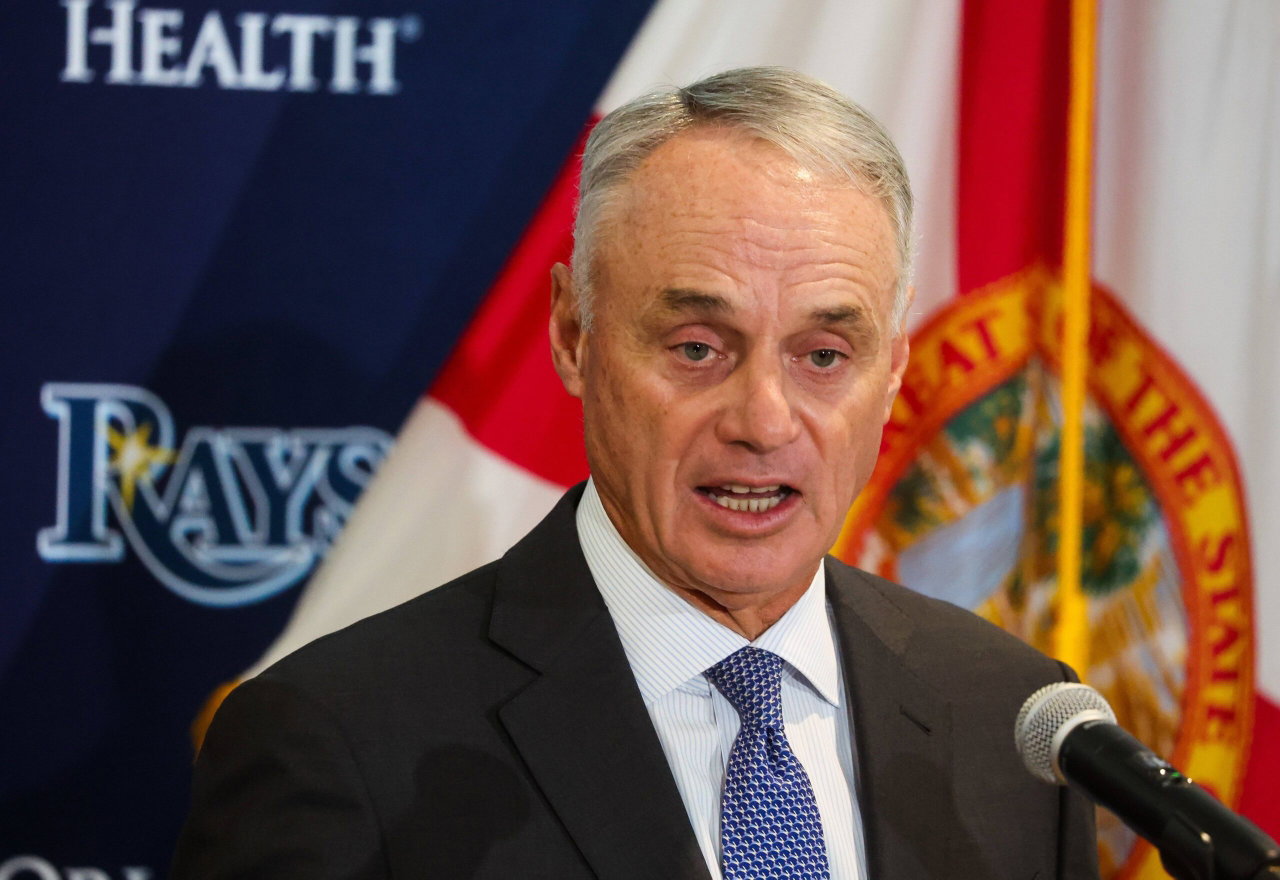
Over the past few years, CBA has become one of the biggest talking points across professional sports. NBA Commissioner Adam Silver has weighed in on the subject, while WNBA Commissioner Cathy Engelbert has also addressed the labor discussions. In fact, the WNBA finalized a new CBA in March, just 17 months after the players opted out of the previous agreement. Now, MLB finds itself at the center of a similar debate. With the MLB and the MLBPA still far apart in negotiations, Commissioner Rob Manfred has doubled down on several key issues.
Watch What’s Trending Now!
“Look, I think it would be wildly, wildly inappropriate for me to speculate what the President of the United States might do or not do in a hypothetical situation,” Manfred said when asked if he thought that Trump would intervene in negotiations, according to Bob Nightengale on X. “We know this. He’s a great sports fan, and he is really knowledgeable about the business of sports, so it doesn’t surprise me. He’s interested, but behind that, I’m going to pass.”
On the field, MLB has wrapped up its first half of the season, Home Run Derby and the All-Star Game, and soon enough, the second half will begin. While that unfolds, another equally important thing happening is the collective bargaining agreement, where the players and clubs engage in a deal spanning 5 years that caters to the interests of both parties in terms of meal allowances, travel, salary, free agency, etc.
The first CBA in MLB was introduced 58 years ago, and its provisions have evolved significantly over the years. The owners’ latest proposal, submitted on May 28, reflects a growing push to implement a salary cap. The reason is that MLB remains the only major North American sports league without a salary cap, and the owners believe the current system does not reflect the league’s franchise values.
The first formal CBA proposal also listed the following:
- The salary cap, inclusive of benefits expenses, sitting at $245.3 million for 2027.
- A salary floor of $171.2 million for 2027, including benefit expenses.
- Equal revenue split between clubs and players.
- The centralization and equal sharing of all local revenues.

Rob Manfred when asked if he thought that Trump would intervene in negotiations: "Look, I think it would be wildly, wildly inappropriate for me to speculate what the president of the United States might do or not do in a hypothetical situation. We know this. He's a great sports Show more
Beyond that, Manfred acknowledged baseball’s success but argued that a salary cap is necessary to sustain it. To support his argument, he pointed to the $441 million gap between the highest- and lowest-spending clubs in MLB.
He also maintained that every MLB owner supports the idea, saying each club would be willing to pool its local television revenue if a salary cap were adopted. Under such a system, teams like the Dodgers, who generate roughly $330 million annually from local TV deals, would share that income with smaller-market clubs such as the Brewers, whose local TV revenue is estimated at around $20 million.
The 67-year-old also addressed the chances and importance of free agency for the players.
“I think we need a system where there is a more robust free agent market,” he added. “So, if you don’t want to go to New York or Los Angeles, you have a realistic opportunity to get a viable free agent contract.”
This is not all; the league is also looking to incorporate an escrow system similar to that of the NBA and NHL, where a portion of a player’s salary is held back, and provided the revenue projections fall short, this percentage falls into the hands of the league. On the other hand, if the revenues go beyond the projections, then that is shared with the player.
Meanwhile, the MLBPA thinks that this is not something that will benefit them but will only cut into guaranteed player salaries.
Notably, the league proposed that players can only sign a contract of a maximum of 5 years. It can be extended to 6 if a player is rejoining the club. This would also bring the current long-standing agreement to an end. However, the MLBPA opposed the proposal as soon as it was presented. In fact, the two entities have been on opposite poles the entire time.
MLBPA rejects league’s public campaign
24 hours before the league put out its first proposal, MLBPA put forth its demands, asking:
- An increase in the minimum salary from $780,000 to $1.5 million.
- CBT threshold to go from $244 million to $300 million.
- Increased sharing of local-broadcast revenues among teams.
- Draft lottery expansion.
- Elimination of the qualifying offer for outgoing free agents.
Bruce Meyer, the union’s interim executive director, has remarked that the salary cap only helps the owners and does nothing to improve competitiveness among the teams. He directly opposed Manfred’s remarks about fans supporting the salary cap, saying that they are actually asking the owners to “sell the team,” but the league is ignoring those calls.
He specifically said that it allows the owners to use the cap as an excuse to not compete, and he has been saying the same from day 1.
“Salary caps are bad for fans,” he clarified. “Salary caps prevent teams from doing the things that they believe are in their interest to make the team better.”
Meyer also criticized the commissioner and the league for promoting the salary cap via MLB.TV commercials. He argued that if the fans are really on board with the proposal, as Rob Manfred claims, the league wouldn’t need to spend millions of dollars to promote it.
Manfred believes that structural reform through a salary cap is necessary for baseball’s continued growth. He also pointed out that the union initially opposed both the pitch clock and the Automated Ball-Strike (ABS) system. However, both have since become integral parts of the game and are helping it evolve.
Meyer, on the other hand, believes the real issue is the owners’ unwillingness to spend. December 1 is the deadline for the current CBA, and if the two sides cannot reach an agreement before then, the baseball community might see a delay in the start of the 2027 season.
And while the discussion continues regarding the same, U.S. President Donald J. Trump has publicly backed MLB’s push for a salary cap, arguing that football operates under a similar system and that MLB “should have done it a long time ago.”
Now, the salary cap debate intensifies as fresh comments reveal White House backing, while the players’ union renews its opposition ahead of CBA talks.