
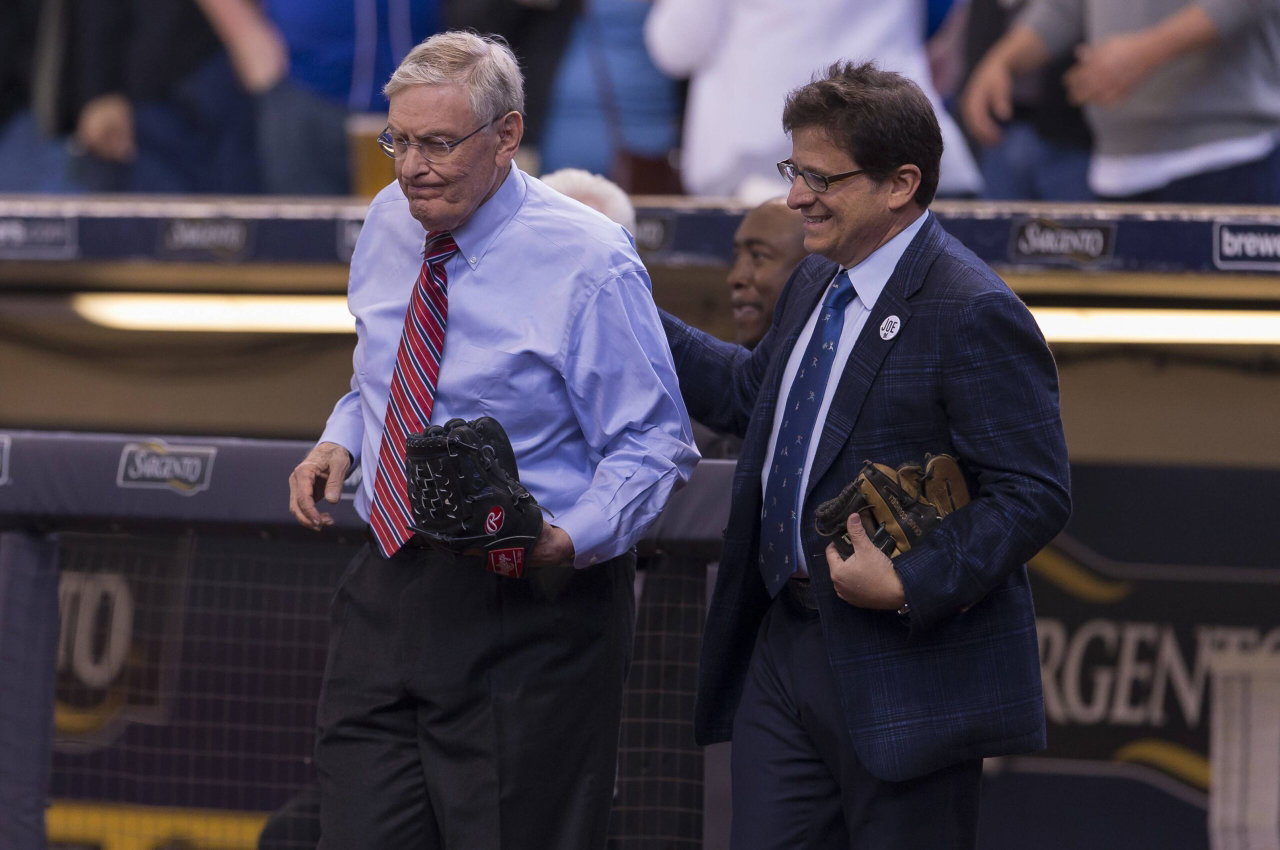
The Milwaukee Brewers swept the $340 million Los Angeles Dodgers to reach the World Series, and reignited a debate about baseball’s economic structure. Sitting 19th on MLB’s 2026 payroll chart, Milwaukee’s remarkable run has challenged the argument that baseball’s biggest spenders hold an overwhelming advantage. With the salary cap debate gaining momentum ahead of the next CBA negotiations, the Brewers’ success has given opponents of a payroll ceiling a compelling example to support their stance.
Watch What’s Trending Now!
However, despite Milwaukee’s historic run, former MLB commissioner and Brewers owner Bud Selig argues the salary cap debate is far from settled. While Milwaukee’s achievement deserves recognition, Selig maintains that the broader challenges remain deeply rooted in baseball’s economic structure. His perspective adds another layer to the growing salary cap debate, especially as MLB approaches a crucial turning point in its labor negotiations.
“This club has done just a remarkable job, from [current Brewers owner] Mark Attanasio on down,” Front Office Sports quoted Selig. “It makes me proud. It makes the people of Milwaukee proud. I’m grateful, and we’re all grateful, to be here to witness such a momentous event in baseball history.”
“The challenges of a small market don’t just disappear because of this, but what’s happening is such a powerful statement about what this team has done. You have to make adjustments. The changes that [owners] are proposing are not only rational, but they’re essential.”
Although the 2026 World Series features the Brewers and Tampa Bay Rays ($96 million), both low-payroll teams, it is not the first time small-market franchises have reached the Fall Classic. In 2023, the Arizona Diamondbacks secured a World Series berth despite a $119 million payroll. In 2020, the Rays reached the World Series with a $28 million payroll. So, despite the big spenders’ recent dominance in MLB, the small-market teams were not absolutely off track.
Still, the World Series winners list portrays a deep disparity. Kansas City Royals winning the 2015 World Series was the last example of a small-market team winning a ring.
Per Selig, the Brewers’ World Series berth does not dilute the salary cap debate; rather, it proves that payroll equality would produce more competitive baseball. Moreover, Selig is no stranger to the salary cap debate and the risk of a labor lockout.
He presided over the infamous 1994–95 MLB strike as the acting commissioner. Before the 1994 season, Selig demanded a hard salary cap to control escalating player salaries and assist low-revenue franchises. The MLBPA, led by Donald Fehr, adamantly refused to accept any cap system.
By August 1994, with collective bargaining completely stalled, the players officially went on strike. Selig officially canceled the remainder of the 1994 season and the World Series. It was the first time the Fall Classic was skipped since 1904.
Though Selig failed to secure a salary cap, the financial fallout of the strike ultimately paved the way for modern MLB economic structures. In 2002, Selig and the MLBPA finally engineered a landmark agreement that introduced the luxury tax and extensive revenue sharing.
Still, the promoter of the soft cap believes that MLB’s payroll disparity is real despite the Brewers’ dominance.
The Brewers just bypassed the payroll challenge
While it may look like the Brewers successfully fought off the payroll challenge, the reality was different. They navigated the massive spending deficit through several highly coordinated operational pillars.
The Brewers avoided the mid-tier free agent trap that standardly bloats low-to-mid revenue payrolls. They allocated the vast majority of their budget to just a few cornerstone players, filling the rest of the active roster with pre-arbitration talent earning near the league minimum.
For reference, only seven Brewers players made $5 million or more on the entire 2026 roster. Moreover, rather than buying big names on the open market, Milwaukee relied heavily on premium talent generated directly by its scouting and player development pipeline.
Homegrown stars (Jacob Misiorowski, Brice Turang, Garrett Mitchell, Jackson Chourio, and Logan Henderson) accounted for more than half of the team’s total Wins Above Replacement during their historic 103-win regular season.
The Brewers did not follow the Dodgers’ free-agent spending model. Instead, they built through the draft and development, a strategy that, per Selig, does not eliminate the need for a salary cap.