Imago
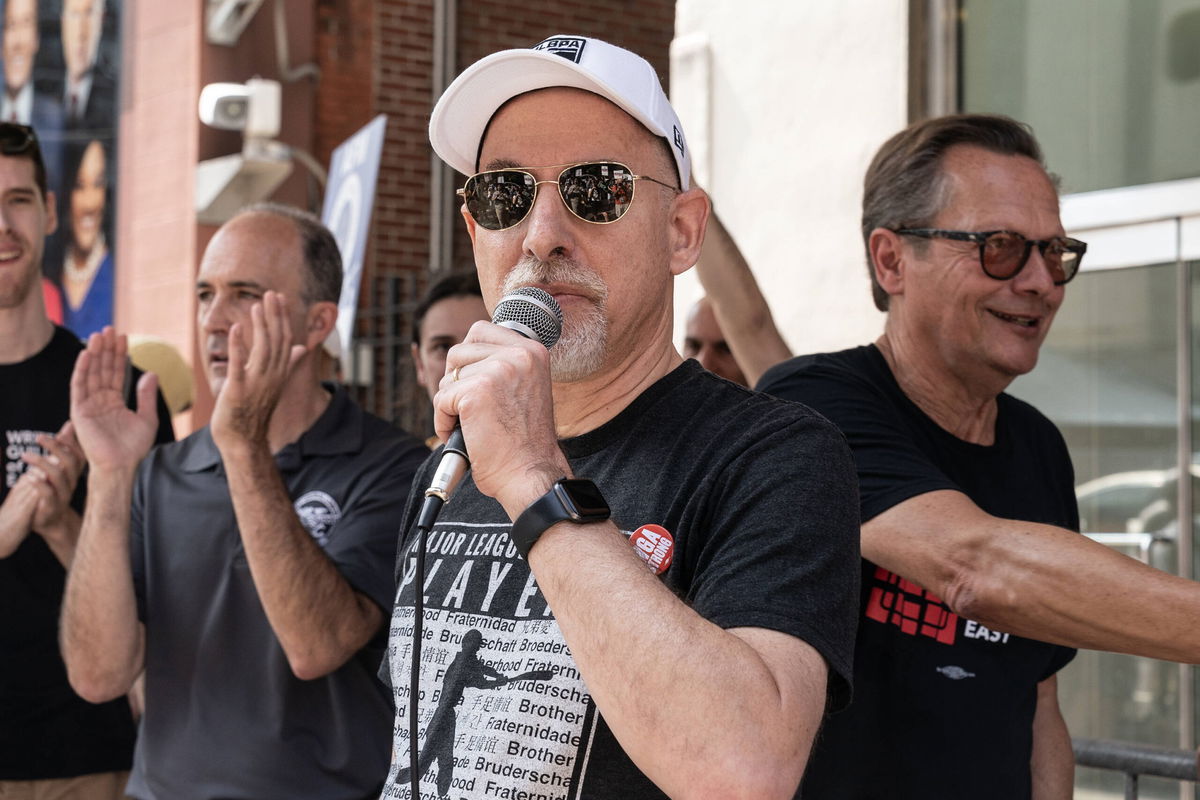
NY: WGA Sport Writers Strike Picket Deputy Executive Director at Major League Baseball Players Association Bruce Meyer speaks as striking members of Writers Guild of America picketing in front of CBS Broadcast Center on theme Sport Writers Picket in New York. Executives from NHL Players Association, NFL Players Association, MLB Players Association joined and spoke during picket. New York New York United States Copyright: LevxRadin
Imago
NY: WGA Sport Writers Strike Picket Deputy Executive Director at Major League Baseball Players Association Bruce Meyer speaks as striking members of Writers Guild of America picketing in front of CBS Broadcast Center on theme Sport Writers Picket in New York. Executives from NHL Players Association, NFL Players Association, MLB Players Association joined and spoke during picket. New York New York United States Copyright: LevxRadin
Imago
NY: WGA Sport Writers Strike Picket Deputy Executive Director at Major League Baseball Players Association Bruce Meyer speaks as striking members of Writers Guild of America picketing in front of CBS Broadcast Center on theme Sport Writers Picket in New York. Executives from NHL Players Association, NFL Players Association, MLB Players Association joined and spoke during picket. New York New York United States Copyright: LevxRadin
Imago
NY: WGA Sport Writers Strike Picket Deputy Executive Director at Major League Baseball Players Association Bruce Meyer speaks as striking members of Writers Guild of America picketing in front of CBS Broadcast Center on theme Sport Writers Picket in New York. Executives from NHL Players Association, NFL Players Association, MLB Players Association joined and spoke during picket. New York New York United States Copyright: LevxRadin
Talk of a potential salary cap is picking up steam as Major League Baseball’s current collective bargaining agreement nears its expiration. With negotiations on the horizon, team owners and the players’ union remain far apart on the issue.
Watch What’s Trending Now!
Team owners, along with MLB Commissioner Rob Manfred, are advocating for the implementation of a salary cap. However, MLBPA interim executive director Bruce Meyer has made the union’s opposition clear. In an interview with Evan Petzold of the Detroit Free Press, Meyer suggested that a lockout in 2027 is highly likely.
Following a meeting with Detroit Tigers players, Meyer said, “The league has already pretty much said there’s going to be a lockout. I think the commissioner (Rob Manfred) more or less guaranteed it. I would be shocked if they didn’t lock out when the agreement expires. Having said that, as I’ve said many times in the past, we’ll start negotiating not long after Opening Day, and we’ll be ready to meet wherever and whenever and bargain in good faith. If there’s a way to avoid it and get a fair deal for the players, we’re always looking to do that. I think the expectations of a lockout upon the expiration of this agreement are very high — almost guaranteed.”
Bruce Meyer, the interim executive director of the MLB Players Association, after meeting with #Tigers players in spring training:
– Lockout when CBA expires? “Almost guaranteed.”
– Salary cap? “It’s bad for players.” pic.twitter.com/Bj7ZWIxdx1— Evan Petzold (@EvanPetzold) March 1, 2026
According to Meyer, a lockout appears increasingly likely, much to the disappointment of MLB fans. Still, he emphasized that the MLBPA remains prepared to negotiate on behalf of its players whenever necessary.
And this standoff over a salary cap is nothing new.


In fact, MLB has been down this road before. The 1994–95 MLB strike remains one of the most significant labor stoppages in sports history. It began in August 1994 and lasted 232 days, largely fueled by owners’ efforts to implement a salary cap and expand revenue sharing, proposals the MLB Players Association strongly opposed.
The fallout was historic. The remainder of the 1994 season, including the World Series, was canceled, marking the first time since 1904 that no champion was crowned. The strike stretched into the start of the 1995 season and left lasting damage to the sport’s popularity and labor relations.
With that history in mind, the current tensions feel even more serious. Meyer reiterated that the union’s top priority is protecting players’ interests, while remaining open to finding common ground with MLB to avoid another lockout if possible.
MLBPA and Meyer are against salary cap implementation
The MLBPA and its executives have historically maintained a firm stance against a salary cap. They believe a salary cap is harmful to players and primarily benefits team owners.
“Our position, both historically and now, is pretty clear. This union, and every executive director of this union, has always been of the view that it’s bad for players, and for that reason, historically, we’ve been opposed to it. I don’t see any reason to change our view on that subject. It’s a subject I can and have gotten into at great length, but at the end of the day, the owners want it — not because it’s good for players, but because it’s good for them. The fundamental nature of a salary cap is bad for players on multiple levels, so that’s always been our view,” Meyer said.
Owners have proposed a salary cap to create parity among MLB team payrolls. The proposal also includes a salary floor. Reportedly, the cap would range from $240 million to $260 million, with a floor of $140 million to $160 million.
Such a cap would primarily impact high-spending teams like the Los Angeles Dodgers, New York Mets, New York Yankees, Philadelphia Phillies, and Toronto Blue Jays, all of whom have projected payrolls exceeding $300 million.
The Dodgers, in particular, are frequently at the center of salary cap discussions because of their aggressive spending and high-value contracts. This year, attention has turned to Kyle Tucker’s four-year, $240 million deal. If a salary cap were implemented, teams like the Dodgers would need to reduce payroll, potentially limiting future player earnings.
As the MLBPA’s executive director has emphasized, players would ultimately bear the financial consequences.
The proposed salary floor also raises questions about true parity. Even within the suggested cap and floor range, a gap of nearly $100 million would remain between the highest and lowest payrolls. In leagues like the NBA and NFL, salary caps function differently because the gap between the cap and the floor is significantly smaller. Under the proposed MLB structure, that wide margin may not deliver the competitive balance that owners claim to seek.
As Meyer has repeatedly stated, the union believes a salary cap would primarily serve owners by giving them greater financial control. The MLBPA remains firmly opposed to its implementation, continuing to describe it as “bad for the players.”
While fans hope to avoid another lockout, the outcome will ultimately depend on whether MLB and the MLBPA can reach a mutual agreement during negotiations.