
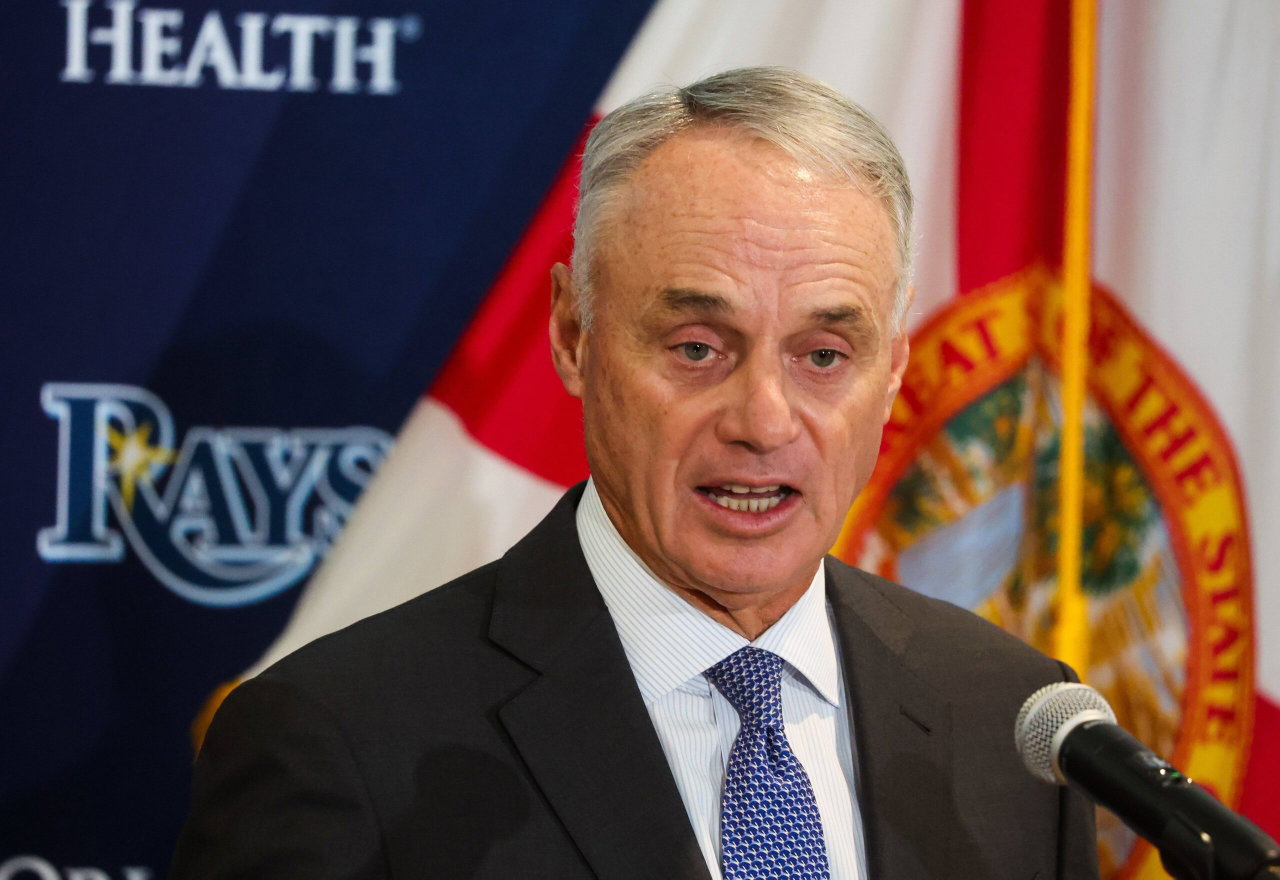
Baseball could be heading for another long work stoppage. The last lockout lasted 99 days and delayed Opening Day by a week. This one could be worse. That is quite possible after MLB commissioner Rob Manfred’s statement on the issue of a salary cap and floor. For those who don’t know, the current labor agreement expires at midnight on Dec. 1, and team owners are expected to lock out the players soon after. If that happens, teams will not be able to make trades, sign free agents, or carry out other major roster moves.
So, before the lockout begins, here are five important things baseball fans should know.
The issues with the salary cap
Major League Baseball’s collective bargaining agreement (CBA) is the deal between team owners and the players’ union. The current agreement was signed on March 10, 2022, and expires at 11:59 p.m. ET on Dec. 1.
The biggest disagreement is over a salary cap. A salary cap sets a limit on how much a team can spend on players. The NFL, NBA, and NHL all have one, but MLB does not. Instead, baseball uses a luxury tax that charges teams when their payrolls go above certain limits. The Dodgers, who won back-to-back World Series titles in 2024 and 2025, have shown how much teams can spend under this system.
Team owners believe a salary cap, along with a minimum spending limit, would help smaller-market teams compete. But the players’ union disagrees. It believes owners want a cap mainly to control how much they spend on players.
Additionally, Union chief Bruce Meyer has called the proposal a “nuclear bomb.” The union has also made it clear that it will not accept a salary cap in any form.
MLB made its latest offer on Nov. 3. It proposed delaying a hard salary cap until 2028 and setting the limit at $258.2 million. The union rejected the offer almost immediately.
Notably, commissioner Rob Manfred has said he cannot see owners approving a deal without both a salary cap and a minimum spending limit.
He has also added, “There’s plenty of room for compromise, but there’s one thing that I will not compromise, and that’s the issue that we’re hearing from the vast majority of our fans: They want a salary cap and floor, and on that we will not compromise.”
With both sides holding firm, reaching an agreement will be difficult.
A lockout is on the cards
A last-minute agreement does not look likely. Yahoo Sports has described a lockout as a “fait accompli,” while the Sporting News has also reported little reason to expect a deal before Dec. 1.
If things follow the same pattern as 2021, owners could vote to lock out the players within minutes of the current agreement expiring. That would put the start of the lockout around 12:01 a.m. ET on Dec. 2.
The salary cap is not the only issue being discussed. MLB has also proposed:
- Reducing the regular season from 162 games to 154.
- Making the Division Series best-of-seven instead of best-of-five.
- Shortening the free-agency window so the process moves faster.
- Cutting the MLB Draft from 20 rounds to 12.
The players’ union has its own list of demands. It wants higher minimum salaries, better protection against teams manipulating players’ service time, and an increase in active rosters from 26 to 28 players early in the season.
Most of these proposals are starting points for negotiations. However, many could change before the two sides reach a final agreement.
What will stop during a lockout?
For players on a 40-man roster, a lockout would bring most baseball business to a stop.
Teams would not be allowed to sign players, make trades, claim players off waivers, or release them. Moreover, players would lose access to team facilities. They also would not be able to work with team trainers on injury rehabilitation. Teams would not be allowed to contact them.
MLB reportedly told team employees not to send players holiday cards during the last lockout. However, attending a player’s wedding was still allowed.
Minor leaguers who are not on a 40-man roster would not face the same restrictions. They could continue to sign contracts, make trades and train.
There are also important deadlines before the lockout begins. The non-tender deadline is Nov. 20. By then, teams must decide whether to offer contracts to arbitration-eligible players.
Teams are expected to make several moves before the freeze. During the previous lockout, clubs agreed to more than $1.9 billion in new contracts, with over $1.4 billion committed on a single day. A similar rush of signings could happen this time.
Any free agent who remains unsigned when the lockout begins will have to wait until it ends to sign a new deal.
Players do not usually receive their salaries during the offseason, so a lockout that ends before spring training would not cost them much money. The bigger problem would come if regular-season games are canceled.
The Winter Meetings, scheduled for Dec. 7-9 in San Diego, are also unlikely to take place. They were canceled during the previous lockout.
The difference between a lockout and a strike
A lockout and a strike can both stop baseball, but they are not the same thing.
A lockout happens when team owners prevent players from working. A strike happens when players refuse to play. Both are used to put pressure on the other side during labor negotiations.
The last MLB lockout lasted 99 days, from Dec. 2, 2021, to March 10, 2022. It delayed Opening Day by a week, but the league still managed to play all 162 regular-season games.
Earlier lockouts in 1973, 1976, and 1990 were shorter and did not result in any canceled games.
The biggest warning comes from 1994. That year, the players went on strike over a proposed salary cap. The strike lasted 232 days, canceled the World Series and wiped out 938 regular-season games across two seasons.
Manfred was a junior lawyer working with the owners’ bargaining team during that dispute. When asked in June whether he was worried about a similar situation happening again, he said, “Of course I do.”
There is also another option the players’ union could consider. It could declare that it no longer represents the players. This move is also known as a “disclaimer of interest.” This could open the door for players to file antitrust lawsuits against MLB.
NBA players used this approach in 2011 and reached a tentative agreement just 12 days later. MLB’s players’ union has never taken that step. If it considers doing so, it would likely happen much later in the lockout.
Will Opening Day happen on time?
Right now, it is difficult to say whether the 2027 MLB season will begin as scheduled.
Opening Day is set for March 24, with a Wednesday night game on Netflix. A full slate of games is scheduled for the following day.
The 2021-22 lockout offers some idea of the dates fans should watch.
- Early February: Pitchers and catchers usually report to spring training around Feb. 9. Spring training games are scheduled to begin Feb. 19. If the lockout is still going, teams could have empty training facilities.
- March 1: MLB canceled the first games of the 2022 season on this date. March 1 could again become an important deadline for a deal that keeps the season on schedule.
- March 10-15: This is roughly the last window for MLB to hold a full 162-game season without major changes. Players need a few weeks to prepare for the season, and delaying the schedule too much could push the World Series into November’s colder weather.
There is no clear answer on how long this lockout could last. During the previous dispute, owners took six weeks to make their first offer, and serious negotiations did not begin until the deadline got closer.
This time, the disagreement over a salary cap could make things even more difficult.
For baseball fans, the next few weeks will be important. They will keep an eye on the Dec. 1 deadline and the dates leading up to Opening Day on March 24. If the two sides cannot reach an agreement, the start of the 2027 season could be in trouble.