
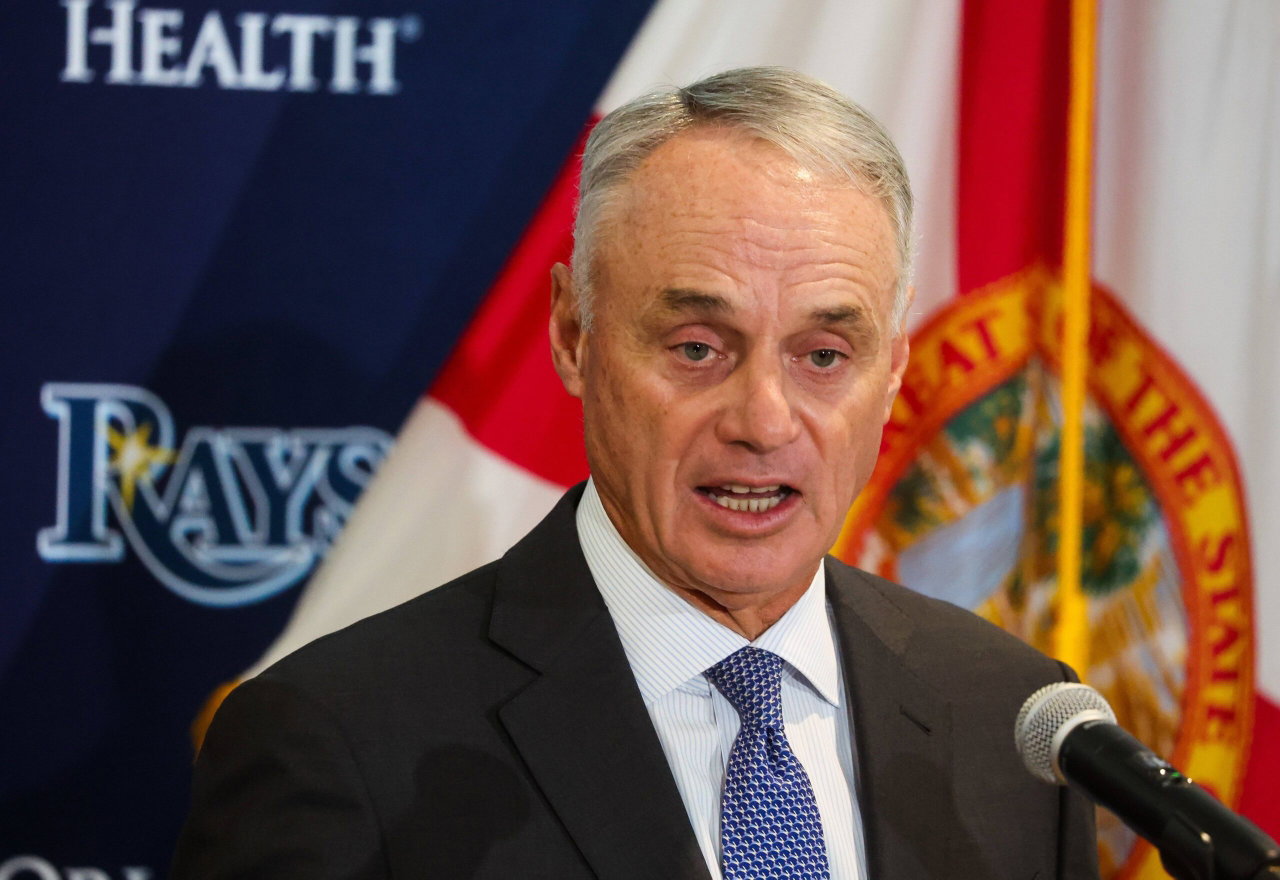
For the first time, Rob Manfred and the league want their very best big league players on Olympic duty to “market the sport” on an international level. They are ready to disrupt MLB’s regular season on the pretext of international popularity. Per reports from ESPN, the league is planning to shut down the sport for 11 days for an All-Star Game on the West Coast that would precede the six-team tournament scheduled to be played at Dodger Stadium.
Watch What’s Trending Now!
With the success of the 2026 World Baseball Classic, the USA, the Dominican Republic and champion Venezuela have already been qualified for LA28 Olympics. That has led to an increased interest to participate in the world’s biggest international event. Now, the league has proposed a mandatory participation requirement, which includes heavy consequences for players who fail to satisfy it. However, their Olympic hopes remain in jeopardy until the MLBPA approves.
“MLB proposed discipline for players who are selected to their country’s Olympic team but decline to participate without an exemption, including fines and being placed on MLB’s restricted list for as many as 2-3 weeks,” per Susan Slusser of SF Chronicle via Underdog MLB. “Proposal also stipulates that clubs, owners, agents and executives may not discourage players from participating.”
The league is in a similar conflict with the players’ association over Olympic participation as it is with the CBA negotiations. Perhaps, in this case, the strict regulations are making it more difficult for the union to agree.
The mandatory participation proposal does not allow a selected player the right to decline to represent their country in the Olympics. They also do not want players to sit out the All-Star Game.
If they refuse to participate in the Olympics, the league will automatically place the players not selected for the All-Star Game on the Restricted List on July 10, 2028. As for the players participating in the All-Star Game, they will be placed on the Restricted List on July 12, 2028. They must remain on the list without service or pay till August 3, 2028.
The only exemptions comes with injuries or family emergencies.
In case of injuries, however, the players must remain on the IL till August 3, 2028. The Commissioner’s office will also closely review IL placements to determine whether it is a ploy to avoid participation. The league has promised further disciplinary actions if clubs place a player on the IL to stop them from participating in the Summer Games.
For anything else, other than injury, Rob Manfred will oversee the matter himself to approve absence.
MLB’s message for the clubs was pretty simple: do not discourage players from participating in the LA 28 games.
However, the league’s concerns are not totally unfounded, as many players skipped the World Baseball Classic due to their clubs’ opposition. The clubs held back their players mostly to avoid injury scares early into the season.
“Big differences between the WBC and the Olympics. The WBC takes place at a point in time when players are just beginning to ramp up for the season. There’s a whole host of reasons why, at that point in the calendar, players might not be ready to play. In contrast, the schedule for the Olympics is going to cover days that players otherwise would be playing in major-league games. If they’re not on an injured list, they’d be out there playing. I think that that is a huge difference,” Manfred noted the WBC – Olympics comparison context.
With the league’s extensive list of restrictive measures, the MLBPA might become more wary as they mull over the situation. The union is already in a dilemma over tickets, accommodation, insurance, and NIL rights. They have not yet agreed to MLB’s proposal as they remain in talks with the LA 28 organizing committee, and have even reiterated that “they would not respond until they finished with LA28,” shared MLB spokesperson Glen Caplin.
Bruce Meyer reveals MLBPA’s probable next steps
The MLBPA plans to secure a deal similar to what the NHL and the NHLPA have with the International Olympic Committee for players to participate in the Winter Olympics. As the union works through these factors, MLB’s mandatory participation requirement follows everything the MLBPA is ideally against.
The players’ association has always fought for service time and the salary a player earns. Following the proposal, Bruce Meyer made it clear that the union is not in favor of it.
“They want to make it mandatory for players who are selected to appear at the All-Star Game and the Olympics,” said Meyer, per the LA Times. “The proposals that they made in terms of what the discipline would be, the ramifications if a player doesn’t want to do that, in our view, are extreme.”
Meyer also revealed the players’ association is planning to make a counterproposal to the league.
Meanwhile, the union is also figuring out a variety of issues with tickets, accommodations, and so on. According to their labor contracts, players are guaranteed first-class flights and good accommodations throughout the regular season. Though the LA 28 has offered 435 additional hotel rooms alongside the 100 reserved by the MLB, the Olympics might still not be able to deliver the level of accommodation promised to players in their labor contracts.
“In general, our players want to play in the Olympics. They’re patriotic, and for them it’s a special opportunity, and we want them to have that opportunity. Having said that, we want to make sure that they have things like travel and accommodations and things that they deserve based on who they are,” Meyer noted.
With the players’ association pushing back to protect its players, the league might have to rethink its stance in case they want to take baseball to the Olympics.