Imago
Source: IMAGO
Imago
Source: IMAGO
The one thing fans, players, and everyone don’t want is a Lockout, but it looks inevitable at this point. Because the MLBPA is not only sharpening its argument for the CBA negotiations, they are also loading its treasury in case the players need help.
Watch What’s Trending Now!
Ronald Blum wrote in his piece, saying, “Big league baseball players increased their potential war chest of cash and investments ahead of collective bargaining to $415 million heading into 2026.”
This shows that the MLB players are not going to back out of a fight when the negotiations arrive. The MLBPA has apparently built a $415M reserve and is ready for the CBA negotiations. Since 2022, this figure has been increasing exponentially. In 2022, the MLBPA had $142M, and it grew to $201M at the end of 2023. The real jump came here when it rose to $284M at the end of 2025 and is now at $415M.
This isn’t just routine growth, but an aggressive preparation for what is to come, and pointing towards a massive work stoppage.
From the $415M, the Union has held $222.1M in Treasury securities, $155.5M investments, and $37.4M cash. The cash also dropped from $144M because the money was relocated to the treasury, and the treasury saw a sharp rise from $85.3 million.
Imago
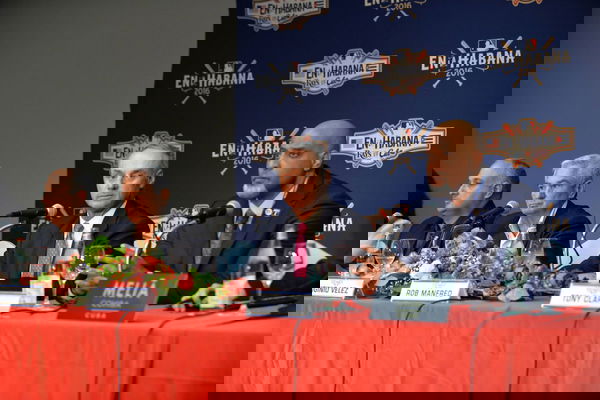
(L-R) Cuban Baseball Commissioner Heriberto Suarez, President of the Cuban Soccer Federation Higinio Velez, MLB Baseball Herren USA Commissioner Rob Manfred and Executive Director of the MLBPA Tony Clark deliver a presser on tomorrow s match before Cuba that will count with the presence of US President Barack Obama in La Habana, Cuba, 21 March 2016. TAMPA BAY RAYS PRESSER IN CUBA !ACHTUNG: NUR REDAKTIONELLE NUTZUNG! HAB004 20160321-635941869947425798
This shift keeps funds safe and liquid, helping players access money quickly during the dispute.
The MLBPA also withheld the licensing payments since 2024 to strengthen that reserve fund. This will be redistributed to the players, replacing their normal incomes. The total Union assets are said to be around $519M.
Net assets also climbed to $511.5 million, showing stronger finances before critical bargaining talks begin. At the same time, the MLB clubs are also doing their finances for the Lockout. They are reportedly withholding about $75 million per team. With 30 teams, that’s roughly $2.25B being held collectively. This takes these negotiations to another level.
The revenue inflow for the Union is mainly through Fanatics, which is paying them $106.4M, which is higher than the $94.4M in 2024. Other partners added $40.2 million and $16.7 million, keeping income steady during the buildup years.
The union is also strengthening its legal and political fronts. The union’s legal fees jumped to $4.3M from $2.8M, and the Lobbying spending rose to $788,486 from $363,034, signaling preparation for possible future government attention. But the big teams are going to play a major role in how these negotiations are going to go.
How the Dodgers are going to play a major role in the CBA negotiations
We are 8 months away from the CBA negotiations, and everything is already heating up. We all know that the same negotiations had stalled the play back in 2021-22 for 99-days. It might get even worse this time.
Commissioner Rob Manfred has clearly signaled interest in a salary cap. But the MLBPA has rejected caps before, and there are no indications that they will agree to it this time. They say that this is to protect the players and their earnings and not limit them to a certain number.
But the major problem is that the owners themselves don’t see eye-to-eye. The large market teams generate a drastically high local revenue when compared to small market teams, and that is a big problem. For example, low payroll clubs like Pittsburgh often spend under 100 million. Meanwhile, teams like the Dodgers and Yankees exceed 250 million in payroll investments regularly.
This gap creates tensions between teams as lower market teams question the larger market teams and their spending.
And that is what makes this statement by Mark Walter even more important. Walter said that money helps winning while calling for improved league parity. Yet history doesn’t agree with this, and the 2025 New York Mets are a perfect example of this. In 2025, the Mets had a payroll surpassing $340M, but they failed to even make it to the postseason.
Owners may instead expand shared media revenue, similar to NFL national deals, which distribute the income evenly. Such a shift needs approval from top earners, but Walter hinted at openness without prolonged internal disputes.
But at the end, it is about accountability and nothing else. Even with some teams earning a revenue good enough to build a decent team, they refuse to spend money, and that might be the root of all causes.
