
Imago
Credit: IMAGO
Imago
Credit: IMAGO
Tony Clark spent years projecting certainty until investigators started asking louder questions. Now, the Major League Baseball Players Association faces uncertainty while Major League Baseball braces for conflict ahead.
Watch What’s Trending Now!
Who Is Tony Clark and Why Did He Resign as MLBPA Executive Director?
Tony Clark became executive director of the Major League Baseball Players Association in 2013 after an internal leadership transition. He led negotiations in 2016 and 2022, protecting players during difficult collective bargaining talks.
His authority shaped union direction, especially as financial ventures expanded beyond traditional labor responsibilities. Clark resigned in February 2026 amid federal investigations into union business ventures. Federal investigators examined finances involving Players Way and OneTeam Partners’ licensing businesses.
Whistleblower complaints in November 2024 alleged misuse of union resources and internal favoritism. Players Way reportedly spent nearly $10 million while producing limited programs and minimal revenue.
The investigation intensified during 2025, widening scrutiny into union spending decisions and leadership conduct.
Union officials canceled spring training meetings as leadership uncertainty quickly spread across clubhouses. Clark formally resigned on Tuesday, leaving leadership vacant months before the collective bargaining expiration arrives. His resignation followed mounting pressure from investigations, whistleblower claims, and internal leadership tensions.
Imago
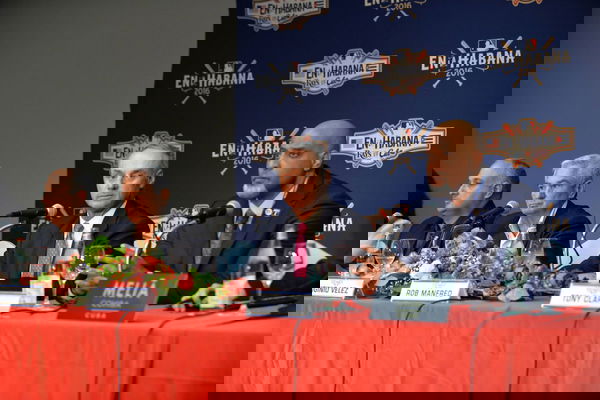
(L-R) Cuban Baseball Commissioner Heriberto Suarez, President of the Cuban Soccer Federation Higinio Velez, MLB Baseball Herren USA Commissioner Rob Manfred and Executive Director of the MLBPA Tony Clark deliver a presser on tomorrow s match before Cuba that will count with the presence of US President Barack Obama in La Habana, Cuba, 21 March 2016. TAMPA BAY RAYS PRESSER IN CUBA !ACHTUNG: NUR REDAKTIONELLE NUTZUNG! PUBLICATIONxINxGERxSUIxAUTxONLY HAB004 20160321-635941869947425798
l r Cuban Baseball Commissioner Heriberto Suarez President of The Cuban Soccer Federation Higinio Velez MLB Baseball men USA Commissioner Rob Manfred and Executive Director of The MLBPA Tony Clark deliver A presser ON Tomorrow s Match Before Cuba that will Count with The presence of U.S. President Barack Obama in La Habana Cuba 21 March 2016 Tampa Bay Rays presser in Cuba ATTENTION only editorial Use PUBLICATIONxINxGERxSUIxAUTxONLY
Clark has not been charged, and union officials denied wrongdoing publicly during investigations. His departure leaves players anxious, facing uncertain leadership before critical negotiations reshape baseball’s future.
What Is the $10 Million Scandal Probe Against Tony Clark About?
Federal investigators began examining Tony Clark and the Major League Baseball Players Association’s finances tied to the youth venture Players Way operations. Union filings reported $3.9 million spent, while sources estimated nearly $10 million total funding. Most funding reportedly came through MLB Players Inc., the union’s for-profit licensing subsidiary, structured internally.
Program activity included six clinics and several webinars between the 2019 and 2024 seasons.
The U.S. Attorney’s Office in Brooklyn opened a criminal investigation after a whistleblower complaint surfaced in November 2024.
Investigators also examined MLBPA’s relationship with OneTeam Partners, another union-linked business venture structure. Authorities requested records, questioned officials, and reviewed financial decisions tied to union spending patterns thoroughly.
Investigation followed broader scrutiny, involving licensing revenues, executive compensation, and organizational transparency concerns.
Federal criminal investigations can result in charges, settlements, or leadership changes depending on the findings.
But union leadership stated allegations remain unproven, while internal reviews continue examining the matter. Clark publicly denied wrongdoing, saying Players Way had full executive board approval, consistently documented internally.

Imago
MLB, Baseball Herren, USA cancels start of season over labor dispute A baseball fan holds a signboard reading I miss baseball in front of the venue of labor negotiations between Major League Baseball and players in Jupiter, Florida, on March 1, 2022. MLB Commissioner Rob Manfred announced the same day the will cancel the start of the 2022 regular season as the league had failed to reach a labor accord with players by the March 1 deadline. PUBLICATIONxINxGERxSUIxAUTxHUNxONLY A14AA0001261550P
Yet, the outcome could influence union stability before the December 2026 agreement expiration and negotiations begin officially.
How Could Tony Clark’s Resignation Impact MLB Labor Talks? A Look at His Role in MLB Labor Negotiations
Tony Clark became executive director in 2013, guiding players through multiple labor negotiations.
He led negotiations producing collective bargaining agreements finalized in 2016 and again during the 2022 season. He worked alongside Bruce Meyer, who served as the union’s lead negotiator during the 2022 talks officially. The 2022 negotiations followed owners locking players out on December 2, 2021, freezing transactions completely.
That lockout lasted 99 days, delaying Opening Day and canceling the first scheduled regular-season games.
Clark remained the central voice opposing salary cap proposals during tense labor discussions with owners.
Negotiations finally produced an agreement on March 10, 2022, restoring a full 162-game season schedule afterward. Players secured increased minimum salary and bonus pool changes, benefiting younger players entering the league.
Now, leadership uncertainty arrives with the current collective bargaining agreement expiring on December 1, 2026.
Owners used a lockout strategy in 2021, showing willingness to halt baseball operations completely again. That shutdown froze signings, leaving fans waiting while spring camps stood empty everywhere. Clark’s absence could shift the negotiation tone as the union prepares for another critical labor battle.
How will the Salary Cap Debate Intensify After Tony Clark’s exit and financial implications for MLB Free Agency and Player Salaries?
Tony Clark consistently opposed salary cap proposals during negotiations finalized on March 10, 2022, and agreement signing. That agreement followed a 99-day lockout beginning December 2, 2021, halting offseason signings completely.
Arbitration and salary growth became central issues during the 2022 negotiations led by union leadership.
Players secured higher minimum salaries and expanded bonus pools for younger players under the agreement. Arbitration-eligible players depend on union strength to protect earning growth during career peak seasons.
Without Clark, owners may press harder for salary controls during the upcoming 2026 negotiations cycle. Leadership changes now create uncertainty over maintaining arbitration leverage in future negotiations with owners.
Long-term salary structure depends heavily on resisting salary caps and limiting free market contracts.
Recent agreements preserved free agency timing rules, allowing players market access after six seasons. But the lockout experience showed stalled negotiations freeze contracts, delaying financial security for players across the league.
Union leadership stability influences whether future agreements protect earnings or accept structural salary limits.
The Major League Baseball Players Association must prove its strength now without Tony Clark guiding negotiations. Meanwhile, MLB owners quietly prepare to leverage, knowing that leadership transitions reshape financial power structures.
Written by

Edited by

Ahana Chatterjee