
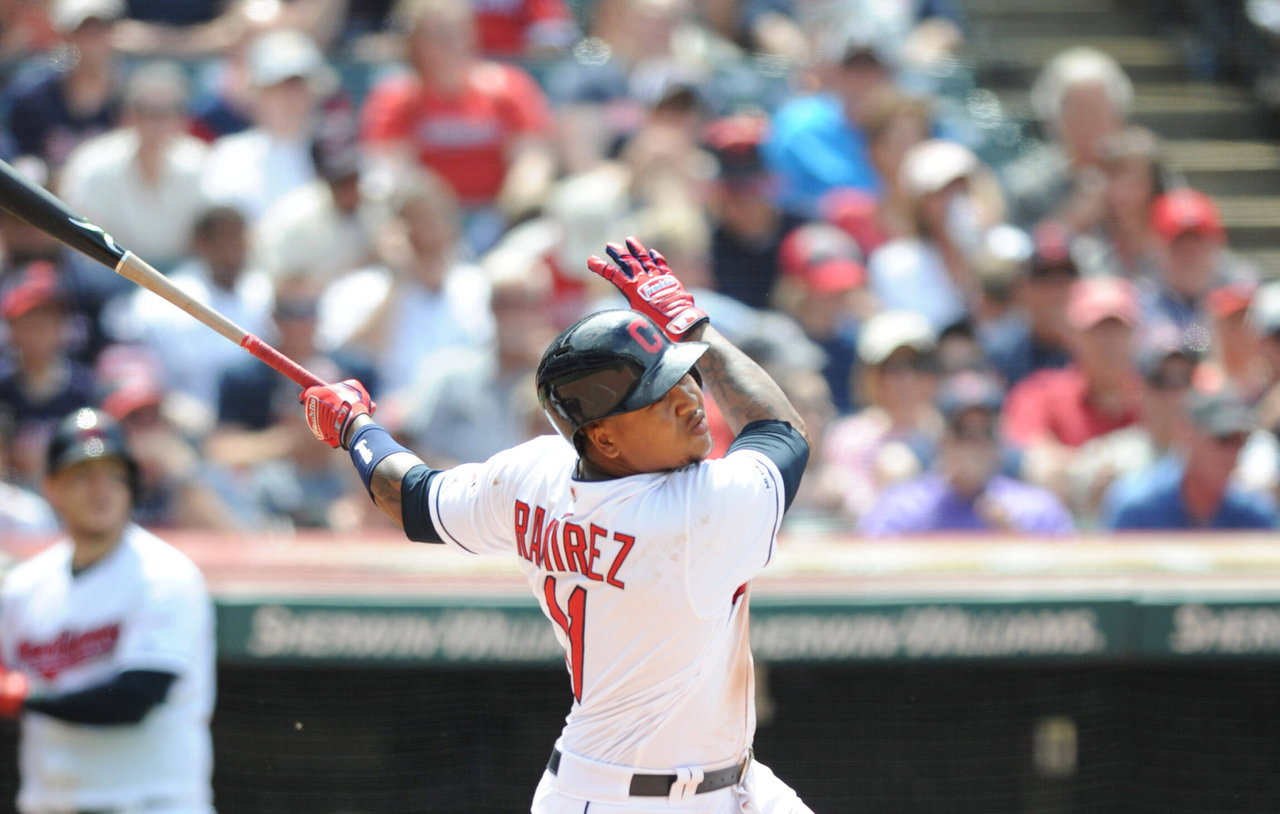
Yesterday, the Tampa Bay Rays had plenty to do to secure their first victory in the ongoing ALCS. One of their biggest challenges was keeping Cleveland Guardians third baseman José Ramírez under control.
Well, in the end, the Rays defeated the Guardians 3–1, despite Ramírez being on the field. So, what went wrong for the 34-year-old, who had a phenomenal outing in Game 1? As the headline suggests, a few mental mistakes proved costly for him and the Guardians. Let’s also break down several other moments from the game.
José Ramírez’s costly mistakes during the game
Yesterday, José Ramírez made two consecutive mistakes in the bottom of the fourth inning, helping the Rays score three unearned runs that ultimately proved decisive. The first mistake came when he left third base uncovered. Here’s how it happened.
With two outs and Victor Mesa Jr. on first base, Rays batter Chandler Simpson hit a chopper toward shortstop Brayan Rocchio.
Ramírez, who had shifted toward second base against the left-handed hitter, took a few steps toward the ball. However, instead of returning to cover third base, he watched Rocchio’s throw to first.
Seeing that third base was unattended, Mesa rounded second and sprinted toward third, reaching the bag safely as Ramírez tried in vain to get back in time. The play put runners at the corners instead of ending the inning or keeping Mesa at second.
Then came another fielding error.
Ben Williamson hit a routine ground ball down the third-base line four pitches later. Ramírez set his feet too early and waited for the ball rather than adjusting his position. The ball struck the seam between the artificial turf and the dirt cutout, took an awkward bounce, and skipped through his legs into left field.
Mesa took advantage of the error and scored from third, giving the Rays a 1–0 lead. The mistake also kept the inning alive, setting up Liam Hicks to hit a two-run single and extend Tampa Bay’s lead to 3–0.
The frustration was compounded by the fact that all three runs were unearned. Those runs ultimately proved decisive in Cleveland’s loss.
After the game, Ramírez expressed his frustration through an interpreter. “It’s frustrating. I feel bad because I wasn’t able to make that play, and after that, the runs came in. I feel bad about that.”
However, the damage had already been done. While Ramírez’s mistakes helped swing the game in Tampa Bay’s favor, there were some officiating issues.
The umpiring controversies during the game
Two key officiating moments during the fourth and fifth innings fueled discussions following Game 2.
In the fourth inning, Rays batter Victor Mesa Jr. hit an infield chopper, and the first-base umpire initially called him out.
Rays manager Kevin Cash challenged the call, and a replay review overturned the decision, ruling Mesa safe at first base.
Although the replays appeared to show Mesa beating the throw by a narrow margin, some Guardians fans on social media argued that the evidence was not clear enough to overturn the original call. The decision kept the inning alive, setting the stage for Ramírez’s fielding error and Hicks’ two-run single, which gave Tampa Bay all three of its runs.
Meanwhile, during Freddy Peralta’s six-inning outing, several pitch-tracking graphics drew attention to the strike zone, particularly on pitches breaking toward the outer edge against left-handed hitters.
The discussion extended beyond the umpiring decisions, as Junior Caminero’s on-field antics also drew criticism from Jeff Frye. The retired MLB player shared his thoughts on X.
“Junior Caminero is a damn good baseball player, and I’m a fan, but his antics are getting tired and only take away from his image. Just catch the ball and throw it around the infield like a professional. This isn’t Winter Ball in the DR or the @WBCBaseball where acting the fool is commonplace.”
Regardless, Freddy Peralta delivered a performance of his own that became one of the biggest talking points of the night.
Freddy Peralta brought the heat yesterday
One of the biggest takeaways from yesterday’s game was Freddy Peralta’s increased fastball velocity. During the regular season, his fastball averaged 94.3 mph. However, he came out firing in the first inning, with his fastballs reaching speeds of 96.9 mph, 98.0 mph, 95.5 mph, 96.6 mph, 96.0 mph, 96.3 mph, and 96.4 mph. It was an early sign that Peralta had something special working.
He carried that momentum throughout the game, throwing six scoreless innings while allowing just four singles and two walks. He kept Cleveland’s hitters quiet and reached 99.4 mph on the radar gun in the fifth inning, reportedly the fastest pitch of his MLB career.
Peralta also became only the second pitcher in Rays franchise history to record a scoreless quality start in an ALCS or World Series game, joining Scott Kazmir, who accomplished the feat in 2008.
After the game, Peralta explained his confidence in his fastball, saying, “It’s no secret that I trust in my fastball a lot and it’s my best pitch.”
Rays manager Kevin Cash also acknowledged that Peralta’s velocity stood out during the game.
That wraps up the key takeaways from Game 2. The Rays and Guardians are scheduled to meet this Thursday again, with both teams looking to make their mark in the next game.