
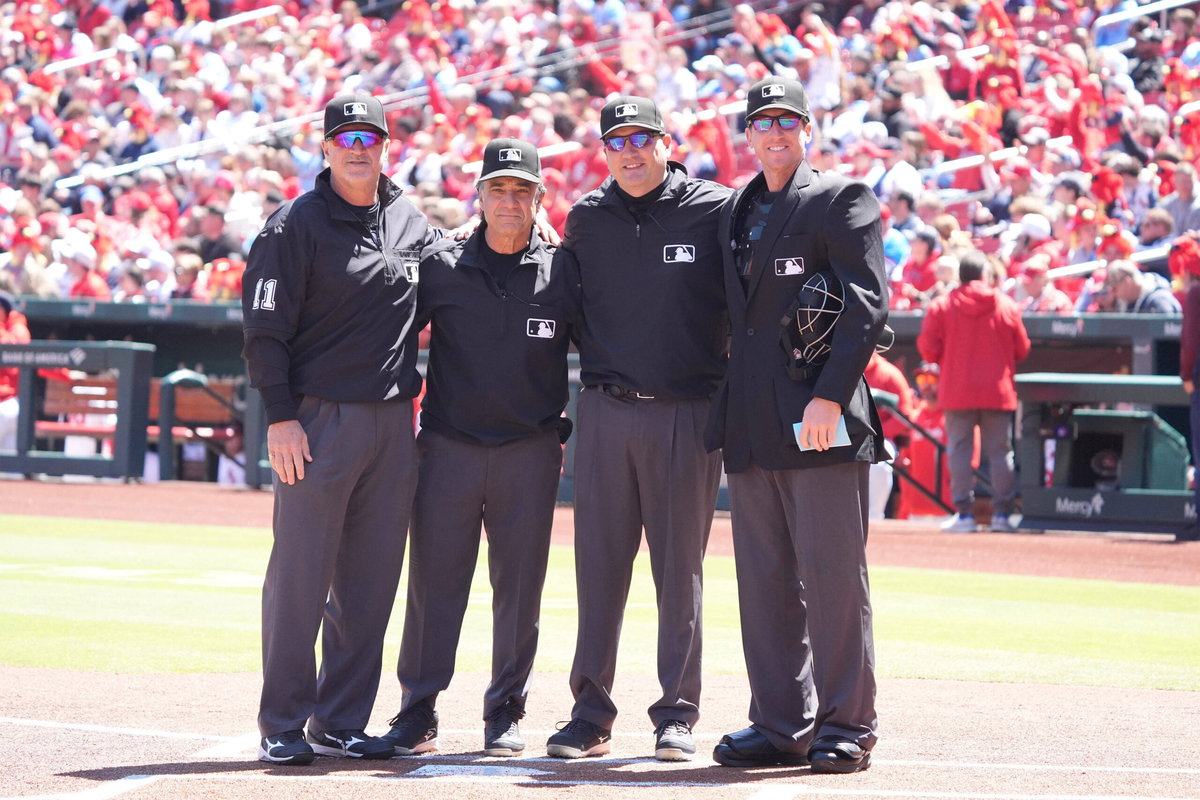
MLB is facing another legal battle, but this time, the fight comes from the men who spent decades enforcing its rules. 5 retired umpires have sued the league, claiming years of miscalculated pensions. Their lawsuit now raises questions about retirement benefits and whether other former officials were affected.
Watch What’s Trending Now!
“Five recently retired umpires, including Joe West… have filed a federal lawsuit against Major League Baseball, claiming they were wrongfully underpaid in the MLB umpires’ retirement income plan,” reported Bob Nightengale in USA Today.
The former MLB umpires have taken their fight over retirement benefits to federal court, challenging how their pensions were calculated by MLB. Joe West and 4 fellow former umpires, Gerry Davis, Tom Hallion, Larry Vanover, and Jerry Layne, took MLB to court on September 29. Their complaint accuses the retirement plan and its committee of repeatedly underpaying benefits owed to retired officials. According to Paul Holmes, this has affected more than two dozen retired umpires. Together, the plaintiffs worked 21,063 regular-season games across 179 major league seasons, giving the case considerable weight.
The central argument concerns benefits for umpires who continued working beyond the plan’s normal retirement age. Their lawyers say the retirement plan failed to apply actuarial increases when calculating benefits for umpires who delayed retirement beyond age 62. The complaint also alleges that a more generous 2005 benefit table was not properly explained to umpires.
According to the lawsuit, that table offered greater benefits after age 62, potentially discouraging umpires from working longer. The group shared at least 25 years of major-league service, with every plaintiff retiring beyond 65.
That experience makes the alleged calculation errors particularly significant, especially for officials who spent decades working behind home plate. West, for example, officiated a record 5,460 regular-season games between 1976 and 2021. Davis also retired after the 2021 season, while Hallion finished following the 2022 campaign. Vanover and Layne remained on the field through the end of 2024 before retiring. The plaintiffs say their benefits were calculated incorrectly despite the lengthy careers and years of contributions to the retirement plan.
The amount at stake remains disputed across reports, although the attorneys say the alleged shortfall runs into millions. The Associated Press and USA Today reported that the claims exceed $2 million, while Mint cited a figure above $5 million. The payment structure differs among the plaintiffs, with West and Vanover receiving lump sums and others collecting annually.
Their attorney, Paul Holmes, says MLB acknowledged its mistakes and offered reimbursement for some lost money. However, the umpires rejected those offers, arguing that the proposed payments did not adequately address what they were owed.
The dispute reportedly began in November 2021, when the umpires first raised concerns about their retirement calculations. After internal administrative appeals were denied, the group pursued settlement discussions before deciding to file the lawsuit. West says MLB executive Steven Gonzalez gave him a blunt response during those discussions.
“If you don’t like the number, sue us,” Gonzalez allegedly told him. West responded, “Does Steve Gonzalez not know my history with dealing with lawsuits?”
His history includes a 2021 defamation case against former All-Star catcher Paul LoDuca, in which West won $500,000 in damages. Holmes argues that repeated errors cannot simply be dismissed as mistakes, particularly when several retired umpires have faced similar issues.
MLB faced another legal battle involving its umpires in 2006, following a mass-resignation dispute in 1999. Fifty-seven of 68 umpires submitted resignation letters, leaving 22 without jobs and triggering years of legal proceedings. In August 2006, federal judge Petrese B. Tucker ordered MLB to pay five umpires $3,106,368 in back pay, interest, and medical costs.
The group included Joe West and Larry Vanover, who are also plaintiffs in the current lawsuit, while MLB was separately ordered to make pension contributions of $47,422 for Larry Poncino and $42,356 for Vanover.
“Once is a mistake, ten to 12 times is a pattern,” he said. He also believes at least two dozen retired umpires could have been affected by the same calculations. MLB declined to comment on the allegations because the lawsuit remains active. Judge Ronnie Abrams has scheduled a pretrial conference for December 11, leaving the retirement plan’s calculations at the center of the dispute.
MLB and the umpires have never looked eye-to-eye
MLB’s relationship with its umpires has not always been smooth, with legal disputes stretching back decades. One of the biggest clashes erupted in 1999, when 57 of 68 major-league umpires submitted resignation letters. The disagreement began over MLB’s proposed changes to umpire supervision, authority, and working conditions. Union leader Richie Phillips organized the move, hoping MLB would negotiate rather than replace experienced officials.
However, Commissioner Bud Selig and the league’s presidents responded by hiring replacements. By July 27, the AL had filled its vacancies, while NL positions were open. Of the 32 National League umpires seeking withdrawal, Coleman accepted 19 requests. Budig rejected 6 American League withdrawals, leaving several officials without a job. Eventually, 22 umpires found themselves out of work, turning the disagreement into a major legal battle.
The umpires’ union challenged MLB’s decisions, arguing that the league had violated their employment agreement. Instead of settling everything, both sides eventually agreed to send the dispute into arbitration. In May 2001, an arbitrator ordered MLB to reinstate 9 umpires with back pay and benefits. Joe West and Larry Vanover were among those reinstated, while Tom Hallion was denied reinstatement.
The ruling did not end the disagreement. The legal fight continued when the union and MLB pursued separate lawsuits over the arbitration decisions. The union challenged unfavorable parts of the ruling, while MLB contested the arbitrator’s authority and decisions. The district court largely upheld the arbitration outcome, prompting both sides to take their cases further.
On February 17, 2004, the Third Circuit Court of Appeals issued its decision. The court upheld key parts of the earlier ruling, including reinstatement decisions involving 7 National League umpires. These disputes show that disagreements between MLB and its umpires are hardly unusual.
The 1999 conflict involved 57 resignations, replacement officials, lost jobs, and years of court proceedings. The 2001–2004 battle also showed both sides willing to challenge decisions through federal courts. Now, Joe West and 4 other former umpires are fighting MLB over retirement benefit calculations. Although the current case involves pensions rather than employment, baseball’s history shows these clashes can become lengthy legal battles.