Imago
Image: MLB.com
Imago
Image: MLB.com
It seems MLB is starting to follow a path similar to the NBA and NFL, at least in broadcasting.
Watch What’s Trending Now!
If you remember, there’s been talk about how the regional sports network model is falling apart as fans move away from big cable bundles. Cord-cutting and a more pick-and-choose approach to viewing have been looming problems for MLB. Especially since teams thrived under the old system. And when you pair that reality with what Rob Manfred has been pushing for a more centralized, national broadcasting setup, it’s clear where things might be headed.
Manfred’s vision took a meaningful step forward with the Nationals becoming the latest team to move away from the traditional RSN model and adopt the national broadcasting model!
“The Nationals announced Wednesday that they’re stepping away from their local broadcasting deal with the Mid-Atlantic Sports Network. Major League Baseball will handle in-market distribution via streaming on the league’s MLB.tv platform and through yet to be announced cable/satellite partnerships,” MLB Trade Rumors reports.
Imago
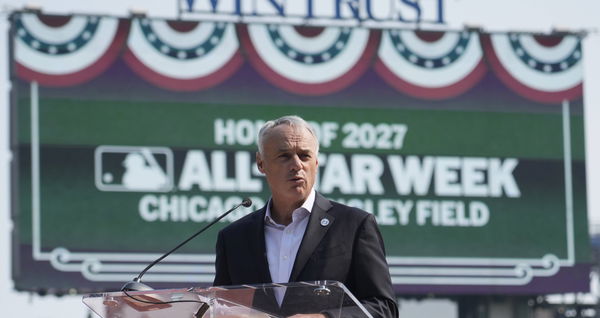
MLB, Baseball Herren, USA Chicago Cubs press conference, PK, Pressekonferenz Aug 1, 2025 Chicago, IL, USA Baseball commissioner Rob Manfred announces Major League Baseball and the Chicago Cubs will host the 2027 All Star game at Wrigley Field. Chicago Wrigley Field IL USA, EDITORIAL USE ONLY PUBLICATIONxINxGERxSUIxAUTxONLY Copyright: xDavidxBanksx 20250801_jla_bb6_168
To date, the Diamondbacks, Padres, Twins, Guardians, Rockies, and Mariners were the teams operating under MLB’s in-house broadcasting umbrella. The rest of the league stuck with their own regional sports networks. Now, with the Nationals joining that group, they become the seventh team to move in this direction.


But why such a move?
It mostly comes down to the Nationals’ rocky stint with MASN, the network jointly owned by the Nationals and Orioles. Disputes over rights fees dragged both sides into arbitration. And that lingering uncertainty reportedly complicated the Lerner family’s attempt to sell the team in 2022. The bad blood even spilled onto the baseball side, with the two clubs avoiding trades altogether.
Things finally shifted when David Rubenstein bought the Orioles from the Angelos family two years later. That opened the door for a reset. That led to a deal last March that settled all past disputes and locked in fees for the 2025 season. This also gave the Nationals the freedom to explore other options starting in 2026.
Now, with Nationals.TV: The team’s games will be available locally via cable and satellite, as well as on MLB’s streaming platform.
However, it’s not just a change for the Nationals, either! It’s another clear sign that MLB’s broadcast landscape is evolving. And more teams could be headed down this same path sooner rather than later.
MLB is up for a radical change owing to its broadcasting
The biggest difference between MLB’s and the NBA’s national TV models comes down to how centralized they are, how often national games take priority over local broadcasts, and how the money is shared. And Manfred manifests the same here in MLB!
According to Manfred, MLB wants to reach a point where each team’s games air on fewer platforms. More clubs are recognizing that maximizing revenue requires a more national approach.
And honestly, MLB seems to be moving full speed in that direction. The league is clearly positioning itself for a single, more unified national broadcasting setup. Manfred recently pulled back the curtain on MLB’s new deals with ESPN and Netflix, both of which run through 2028. That positions the league to renegotiate its media rights starting in 2029.
Before MLB can fully get there, though, the biggest hurdle is convincing big-market teams to walk away from their still-lucrative RSN deals. But with MLB now directly controlling the broadcasts for seven teams, Manfred’s job is getting easier.
Given how things are unfolding, MLB could be entering a highly interesting and potentially transformative era.