Imago
Image: MLB.com
Imago
Image: MLB.com
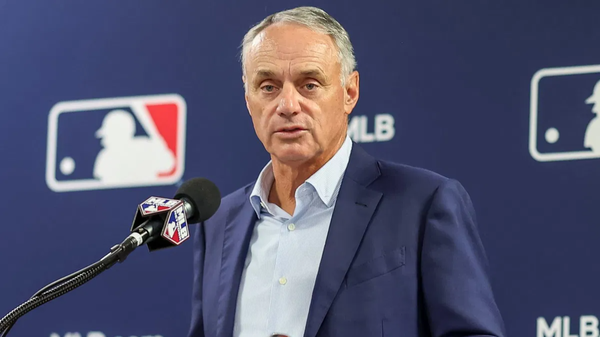
This fight between the Players’ Union and the League has been going on for such a long time. But it should end before the 2026 season, or things are going to get very, very difficult. And by the looks of what Rob Manfred and MLB are doing, there are no signs that this fight is going to end.
Watch What’s Trending Now!
Recent reports reveal that Rob Manfred is trying to do everything to pressure players into a salary cap.
“Players and fans want a full season of competitive baseball,” said the MLBPA after Manfred’s comments about the negotiations. They also continued saying, “The league and owners say they want to avoid missing games… they appear to be dead-set on trying to force players into a system that, the last time they proposed it, led to the most missed games ever and a cancelled World Series.”
MLB and the MLBPA are tense as the current collective bargaining agreement expires Dec. 1, 2026. Owners continue discussing a salary cap internally, while players view those talks as a direct threat. According to Jeff Passan, players see any cap proposal as a declaration of labor war. That framing has sharpened early negotiations more than a year before formal CBA talks begin.
Players believe a salary cap is being forced despite owners saying competitive balance requires limits. Philadelphia Phillies star Bryce Harper publicly confronted commissioner Rob Manfred during a July clubhouse exchange. Harper, signed to a 13 year $330 million contract, owns a career .911 OPS mark.


That production strengthens player arguments that market-driven salaries reflect performance rather than imbalance claims alone.
Imago
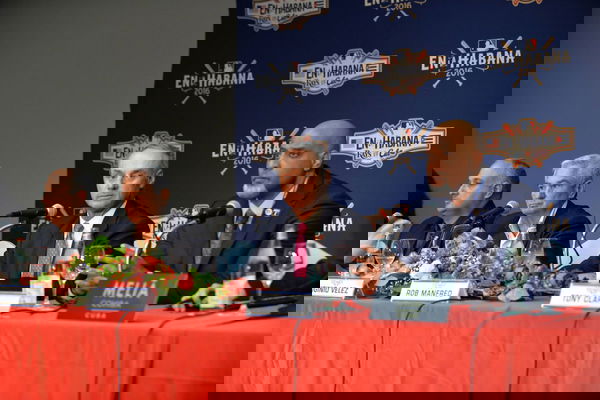
(L-R) Cuban Baseball Commissioner Heriberto Suarez, President of the Cuban Soccer Federation Higinio Velez, MLB Baseball Herren USA Commissioner Rob Manfred and Executive Director of the MLBPA Tony Clark deliver a presser on tomorrow s match before Cuba that will count with the presence of US President Barack Obama in La Habana, Cuba, 21 March 2016. TAMPA BAY RAYS PRESSER IN CUBA !ACHTUNG: NUR REDAKTIONELLE NUTZUNG! PUBLICATIONxINxGERxSUIxAUTxONLY HAB004 20160321-635941869947425798
l r Cuban Baseball Commissioner Heriberto Suarez President of The Cuban Soccer Federation Higinio Velez MLB Baseball men USA Commissioner Rob Manfred and Executive Director of The MLBPA Tony Clark deliver A presser ON Tomorrow s Match Before Cuba that will Count with The presence of U.S. President Barack Obama in La Habana Cuba 21 March 2016 Tampa Bay Rays presser in Cuba ATTENTION only editorial Use PUBLICATIONxINxGERxSUIxAUTxONLY
Tensions continue rising as players warn a lockout could follow failed negotiations over cap language. MLBPA officials privately reference 1994, when a similar dispute erased the postseason entirely from baseball. That strike lasted 232 days, canceled 948 games, and cost owners about $580 million in revenue.
Players lost roughly $230 million in salaries as fans watched the World Series disappear that year.
The league also suffered long-term damage, including attendance drops and the eventual loss of Montreal. That franchise later relocated after payroll cuts followed the strike, and fan trust never recovered. With revenues, media deals, and fan patience thinner today, another shutdown could hurt deeper leaguewide finances.
Both sides now negotiate knowing the next decision could shape baseball for decades to come.
Rob Manfred and the owners are testing patience, while players prepare for a full-scale battle. Bryce Harper’s confrontation shows the union won’t quietly accept a cap imposed without discussion. If negotiations fail, baseball risks repeating 1994’s disaster, proving history enjoys humiliating those who forget it.
How Tarik Skubal’s arbitration could set the stage for the battle between Rob Manfred and MLBPA
If you thought MLB’s labor drama was only about Bryce Harper and the Phillies, think again. Tarik Skubal of the Tigers just threw a curveball into the mix, challenging the league’s arbitration norms. Rob Manfred now faces a situation where one player’s contract could ripple through the entire MLBPA fight. How the Tigers and MLB handle Skubal might preview the next CBA clash.
Tarik Skubal’s arbitration with the Detroit Tigers has drawn national attention as the largest salary gap in history. He filed for 32 million dollars while Detroit offered 19 million dollars, creating a 13 million dollar difference. Skubal’s back-to-back AL Cy Young seasons produced a 2.21 ERA, 0.89 WHIP, and 241 strikeouts in 195.1 innings.
Fans are watching closely as his elite performance challenges traditional arbitration norms for pitchers.
This arbitration is more than a player versus team dispute, involving MLB and the MLBPA in strategy. Commissioner Rob Manfred’s Labor Relations Department influences team filings, while the Players Association guides agents like Scott Boras. Skubal’s camp is citing special accomplishments and five-plus service time rules to compare salaries across free agents.
The case highlights broader disagreements over player compensation as the current CBA approaches expiration.
The outcome of this hearing could reshape future negotiations and set the tone for a potential lockout. If Skubal wins, he becomes the highest-paid arbitration pitcher, surpassing the projected 17.8 million dollars. Detroit’s willingness to go to a hearing mirrors its history of limiting early settlements in disputes. Fans and league officials are seeing this fight as a preview of the next collective bargaining battle.
Rob Manfred and the MLBPA now watch Skubal’s case with more anxiety than a September playoff. Detroit’s handling of Skubal might teach every team how not to negotiate elite pitching talent. If Skubal wins, the arbitration system could suddenly feel more like free agency on steroids.