
Disclaimer: This article discusses alcohol addiction; if you or someone you know is struggling with alcohol use, help is available. Contact the SAMHSA National Helpline at 1-800-662-4357.
Watch What’s Trending Now!
Playing baseball has been Scott Spiezio’s one true purpose in life. As the son of former baseball player and two-time World Series champion Ed Spiezio, he was switch-hitting by age 3. Every training session at the gym or in their basement ultimately led to the pinnacle of Scott’s career — Game 6 of the 2002 World Series. But as impressive as Spiezio’s rise to success was, his fall from grace was equally dark.
After Spiezio’s career came to a halt because of a serious back injury, the former first baseman spiraled into addiction. In a recent interview on Cardinals Territory, he opened up about the dark side of dealing with a career-threatening injury.
“When I drank, I became a totally different person, and I quickly, unknowingly, started becoming an alcoholic,” Spiezio said on Cardinal Territory. “I was using that as my counselor instead of going and seeing somebody.”
Spiezio debuted with the Oakland Athletics in 1996. He spent his first four seasons playing for the A’s before moving to the Anaheim Angels (now the Los Angeles Angels) in 2000. In 2002, Spiezio reached the moment he and his family had been dreaming about:
The World Series. He stepped up gloriously in the clutch moment.
The Angels entered Game 6, trailing 3-2 against the San Francisco Giants. With the Angels down 5-0 in the seventh, Spiezio sparked their comeback.
He hit a three-run home run off Felix Rodriguez, hearing the loudest noise in his life, and the Angels rallied for a 6-5 win. The Angels went on to win the championship, and Spiezio got his first World Series ring.
The 53-year-old became a hero overnight. His popularity increased rapidly, only to take a turn for the worse. “Ego,” or as he put it, “edging God out,” started to creep in. He started believing in the hype, as people told him how great he was. In his hometown, Morris, Illinois, there were billboards calling him a hometown hero.
The mayor gave him a key to the city. He was honored at his high school. The town named a street after him: Scott Spiezio Drive. To be honest, this entire situation reminded us of one character from The Mentalist.
Trevor “Doc” Dugan, who played a QB in Season 4, Episode 9 (The Redshirt) of the series. Of course, not the entire storyline, but just the character, how he used to think he was the greatest of all. But then, one conspiracy against him, and things changed for the better.
Coming back to our real-life MLB hitter, after the 2003 season, he left the Angels, signing a three-year, $9 million deal with the Seattle Mariners.
In Spring Training, Spiezio was at third base when he tried to catch a pop-up over the pitcher’s mound. He tripped and blew his T6 and T7 thoracic discs. The diagnosis was brutal:
Another collision could paralyze him.
He went to different doctors, but none cleared him to play. Depression hit Spiezio as he navigated the uncertainty in a new city without his close friends. He went from drinking rarely to being unable to survive without alcohol.
There was a time in his life when Spiezio was even hesitant to take Advil or Tylenol. But then, he was spending $2,000 to $3,000 a night on bottle service.
“Put, like, a Jack and Coke in front of me, and before I could even finish that one, there was a second one in front of me. It started helping me deal with that depression and anxiety. That first night, I might have had four drinks; the next night I had eight; the next night I had 16. Before you know it, I’m creating a habit here,” Spiezio added during the interview.
From winning the A’s Dave Stewart Community Award in 1997, to being the Angels’ Roberto Clemente nominee in 2003, to someone who worked with DARE, to becoming an alcoholic without realizing it. Eventually, his relationship with his father started to fray. The same man who has been a two-time WS champion.
It was because of Ed Spiezio that Scott made it to the big leagues. Their basement was set up for Scott to do drills. Throughout his youth, every practice ended with the same situation:
A 3-2 count, two outs, bases loaded, down one run, bottom of the ninth inning, Game 7 of the World Series. That drill sure did help him gain the edge for the Angels. The training followed even in high school.
The two used to arrive at the gym at 6 a.m. to practice in the batting cage, work out, and then the kid would go to school. That relationship started getting tainted. Then got even worse.
Going through some marital issues, he began using cocaine recreationally. During this phase, he had a fallout with his father, and they stopped talking.
In his second season with the Mariners, he was released, and the following offseason, he got married again. None of his friends showed up. At that point, he was drinking nearly a bottle of vodka every day.
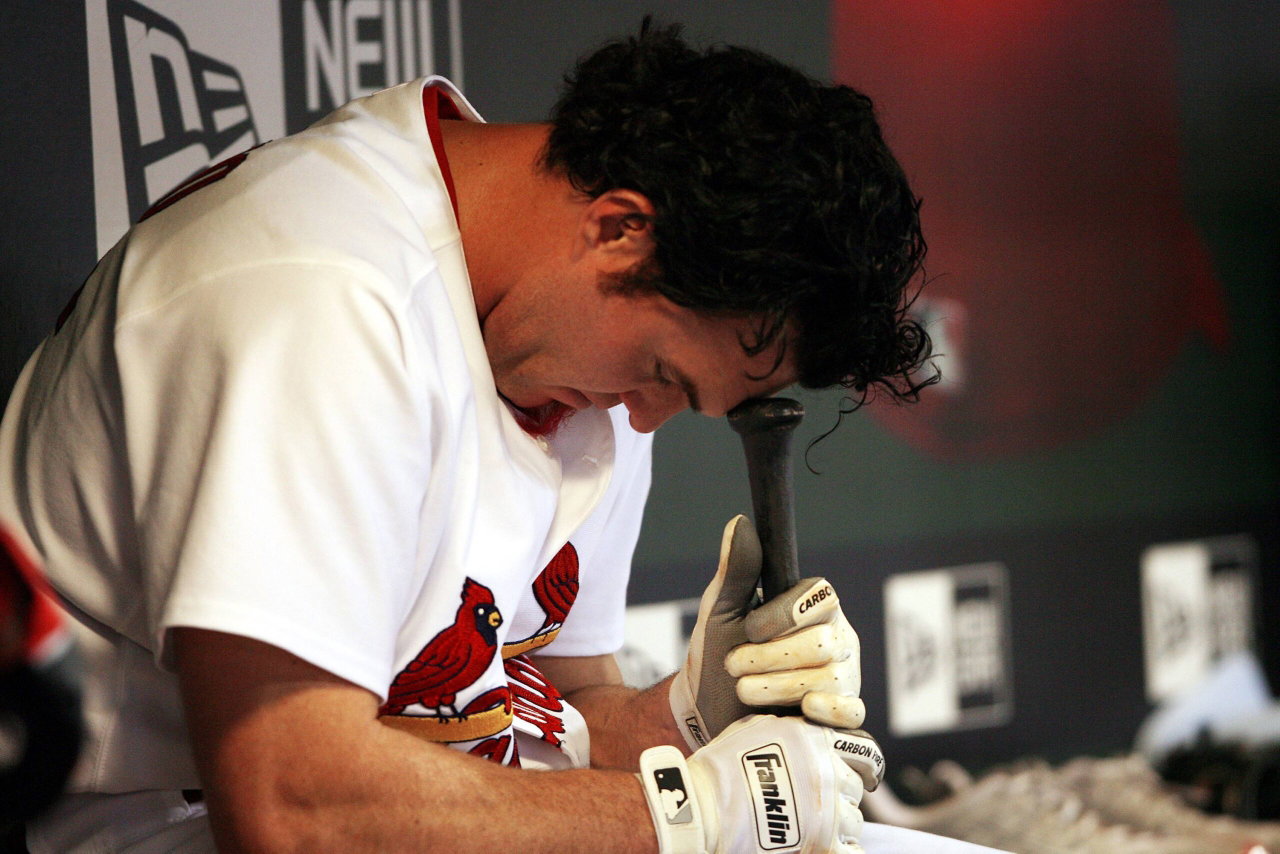
Spiezio also revealed that he felt he could not open up to anyone. But then, things started changing a bit from 2006, when the St. Louis Cardinals invited him to spring training as a minor leaguer, the same team where his dad played. Despite not talking with Ed, Scott donned his father’s jersey no. 26. That season felt like a reincarnation.
He was hitting .272 with 13 home runs and 52 RBI while playing all over the field. Spiezio even played a massive role in their World Series-winning team. But this victory hit the pro differently, as he couldn’t celebrate it with his father, who was also a champion of the same team. Neither was the fanfare the same as in 2002. Yet, not everything remains dark for life.
On Opening Day 2007, when the Cards were awarding their players with the rings, they had a special surprise for Scott.
His dad presented him with the ring, who was initially unsure about meeting his son. Scott burst into tears.
“The Cardinals brought my dad back without me knowing to give me my ring in 2007. The first time in history, and only time in history, that a father and son have won with the same organization. They called him up and presented my ring to him and then called me up, and he presented my ring to me, and we hugged, and that was the prodigal son moment that turned everything around,” Scott said.
That meeting was at least the starting point of a bigger change.
“It was the start of the change in my life,” Spiezio observed. “It still took another 10 years for me to get totally sober, but there were many times during that time that I had periods of sobriety. But I couldn’t kick it for good until April 2018.”
In between, he even drank alcohol out of water bottles in the dugout, and even played at a theoretical limit of .20, per Scott, even though the legal limit is .08. One day, he even collapsed in front of the trainers.
He was sent to an outpatient rehab facility in St. Charles, Missouri, near St. Louis. He was back in the lineup after 28 days, but the addiction didn’t go away. In 2008, the Atlanta Braves signed him to a minor league contract, but the same year, he retired. The addiction persisted even after retirement.
From 2007 to 2016, Spiezio was in 11 different rehabs. He spent hundreds of hours in AA meetings and with counselors. At that point, Spiezio ceded control of his property and the money he had left to his parents.
“(My parents) strung me along to bring me food and would help me. They saved my property so I had somewhere to live. Otherwise, I would have spent everything and thrown everything away. And yet I was smart enough to give – I trusted them so much that I gave them power of attorney and I got rid of all my cars, got rid of all my credit cards, got rid of my checks, and let them do everything, so I wouldn’t have access to money,” Spiezio said.
In 2018, an MRI of his back changed Spiezio’s life in the right direction.
He had ended up with jaundice, and his failing liver was the wake-up call Spiezio needed. The then-47-year-old reportedly had a 20% chance of surviving, and to have any chance of making it, he needed to go six months without alcohol. Only then would he be eligible for a liver transplant.
“I went from a guy that never drank alcohol to thinking I don’t know if I can go six months without drinking to save my own life. I just cried out to God. I said, ‘God, take away my cravings.’ And that was April 6, 2018,” Spiezio said, per FOX News.
“From that day on, I’ve had zero cravings. When I see alcohol, I get physically ill when I see it. I feel like I’m going to throw up.”
Every couple of weeks, he went back to the hospital to have two liters of fluid drained from his abdomen. Slowly but surely, Spiezio felt better.
Upon his return to Northwestern Hospital for the fourth time, the doctors were awestruck with the reports.
“By the fourth time I went in, they read my scans, they looked at my blood work, and said, ‘We don’t know how to explain it, but your liver is normal, and your blood work is great. We’ve never seen anything like this before. All we can say is somebody upstairs is looking out for you,'” Spiezio shared.
It was a journey, and the road was definitely tough, but Spiezio emerged as the winner, as he reminded:
“It’s never too late. I always say as long as you got a breath, you got a pen to write a great ending. As long as you got a pulse, you got a purpose. It’s never too late to get sober. It’s never too late to mend broken relationships.”