
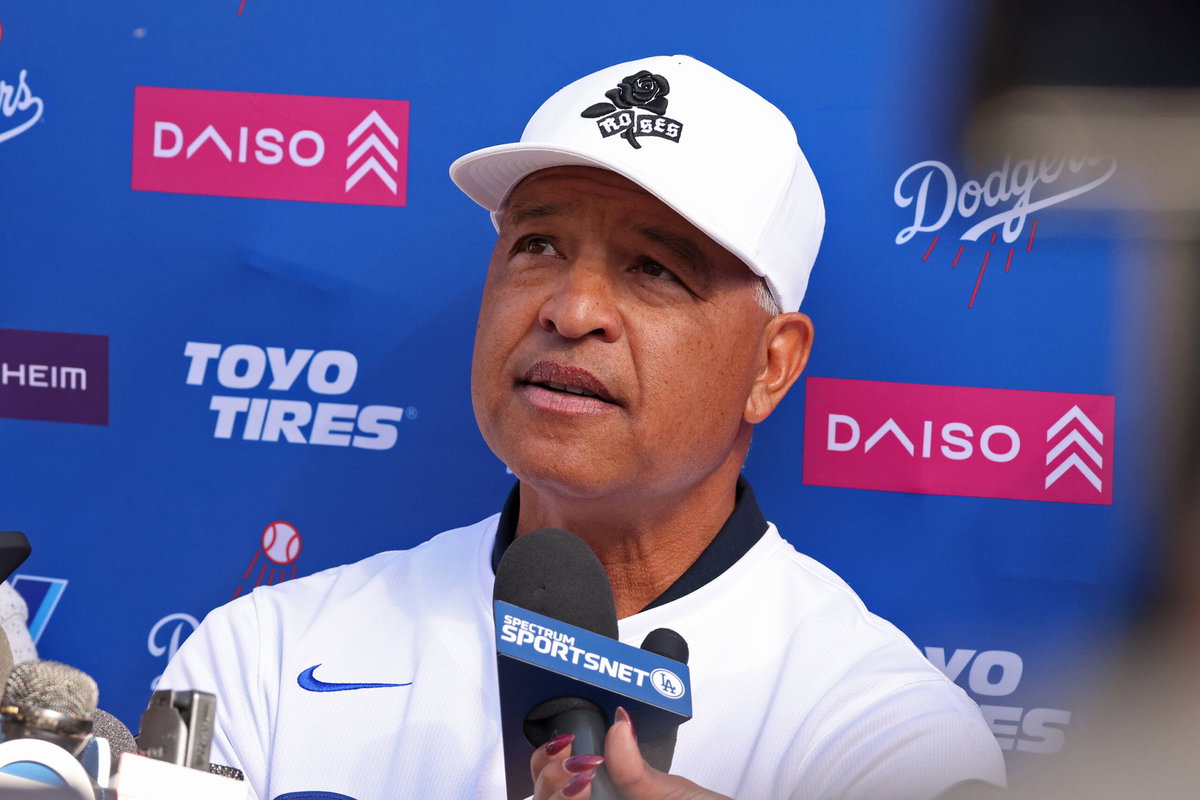
Dave Roberts manages one of the most star-studded rosters in the league, and the Los Angeles Dodgers play like one. But according to Roberts, their impressive championship success is not shaped by something we can see on a box score.
Watch What’s Trending Now!
It runs deeper than the analytics and has everything to do with their MVP Shohei Ohtani and ace Yoshinobu Yamamoto.
According to the Dodgers manager, Ohtani and Yamamoto brought a level of discipline and intentionality inside the clubhouse that set a benchmark for the entire team. It did not go unnoticed by the players.
Roberts recalled on the611podcast that Dodgers veteran Mookie Betts also felt the same.
“Mookie told me a couple of years ago, ‘Doc, we wouldn’t have won the World Series if it wasn’t for Shohei and Yamamoto’. And his point was the discipline that they had every single day,” said Roberts on the podcast.
“How they work with intention every single day, because what that made, it raised the level even higher for our guys. Yamamoto’s day-to-day is three to four hours of intentionality to prepare to throw a bullpen. Shohei is the same way. Roki is getting there, but his culture- that’s what they do.”
The Dodgers signed Ohtani and Yamamoto ahead of the 2024 season.
Ohtani signed the historic 10-year, $700 million contract, while Yamamoto agreed to a massive 12-year, $325 million deal. They proved that every million spent was worth it, as the Dodgers became the World Series champion in 2024 and again in 2025.
Ohtani’s three-homer, 10-strikeout performance in Game 4 of the NLCS, leading to the World Series, is one for the history books. In Game 2 of the 2024 World Series, Ohtani suffered a partial dislocation in his left shoulder while trying to steal a base. But showing incredible toughness, he returned in Game 3 to play against the New York Yankees.
It does not happen without intentionality, and Ohtani’s whole regimen is driven by it. Shotime runs by the clock; from sleeping to bullpen sessions, everything has a fixed schedule. He is Roberts’ “easiest player to manage.”
Last season, Ohtani finished Game 3 of the World Series by reaching base a record-setting 9 times, hitting 2 doubles and 2 homers. The two-way phenom ended the championship batting .333, with 3 homers and 5 RBIs.
Yamamoto was equally impressive.
During the 2024 Fall Classic, Yamamoto threw a one-hit, one-run game, pitching for six innings. In the following edition, he threw in three games and gave up 2 runs to the Toronto Blue Jays, logging a 1.02 ERA.
“When you’re talking about winning 11 games in October, I couldn’t believe more [that] it’s about people, and players you can bet on,” Roberts said on the podcast.
Ohtani and Yamamoto are the players Roberts bet on. Their success is defined by the discipline they rigorously maintain.
When Yamamoto arrived at the Dodgers clubhouse, he brought his own regimen that influenced others.
He relies on flexibility to generate momentum rather than brute strength. Apart from taking bullpen sessions like clockwork, Yamamoto also practices javelin throwing.
He follows a routine designed by his personal trainer and guru, Osamu Yada. Yamamoto also famously keeps a notebook in the dugout to jot down observations from the game. All these habits work together to make him successful.
Roberts also revealed how the presence of these Japanese players influenced the Americans.
“So now, when you get younger players that we have, or even American players that are veterans, they’re like, they’re doing it this intentional, this precise, and that’s the thing that, as a manager, I love,” noted Roberts.
“Because you don’t know where games are gonna go. Games are gonna get hot, and the pressure’s gonna get there. But you have to be able to default to kind of what you know. And that’s what, again, in baseball, can kind of default to doing things the right way.”
And to the Dodgers’ credit, they did not try to ignore the vastly unfamiliar culture. Rather, they chose to learn from it. Perhaps that mentality is what makes them champions.